
Downtown – Asheville, North Carolina
Asheville was named for Samuel Ashe (1725-1813), the first speaker of the North Carolina SEnate and governor from 1795 to 1798. The village was incorporated by the General Assembly in 1797, and included part of a 200-acre land grant the state awarded to a prominent settler named John Burton in 1794. He laid out half-acre lots along an old trail near the current location of Biltmore Avenue and Broadway. Less than 100 years later, The General Assembly declared Asheville a city on March 8, 1883.


The first city hall was designed by Wills Brothers and completed in 1892. The two-story Victorian Romanesque structure was located east of the square on what is now Market Street. In the early 1900s, the square west of City Hall was redesigned and named Pack Square. The site included a large circular fountain, trees and benches. The greatest periods of growth were from the onset of railroad travel in 1880, and particularly the period from 1910 until 1930, “which witnessed an evolution from horse-based transportation to automobiles and a real estate boom.” This city reached a population of 50,000 people by 1930 and the onset of the Great Depression.
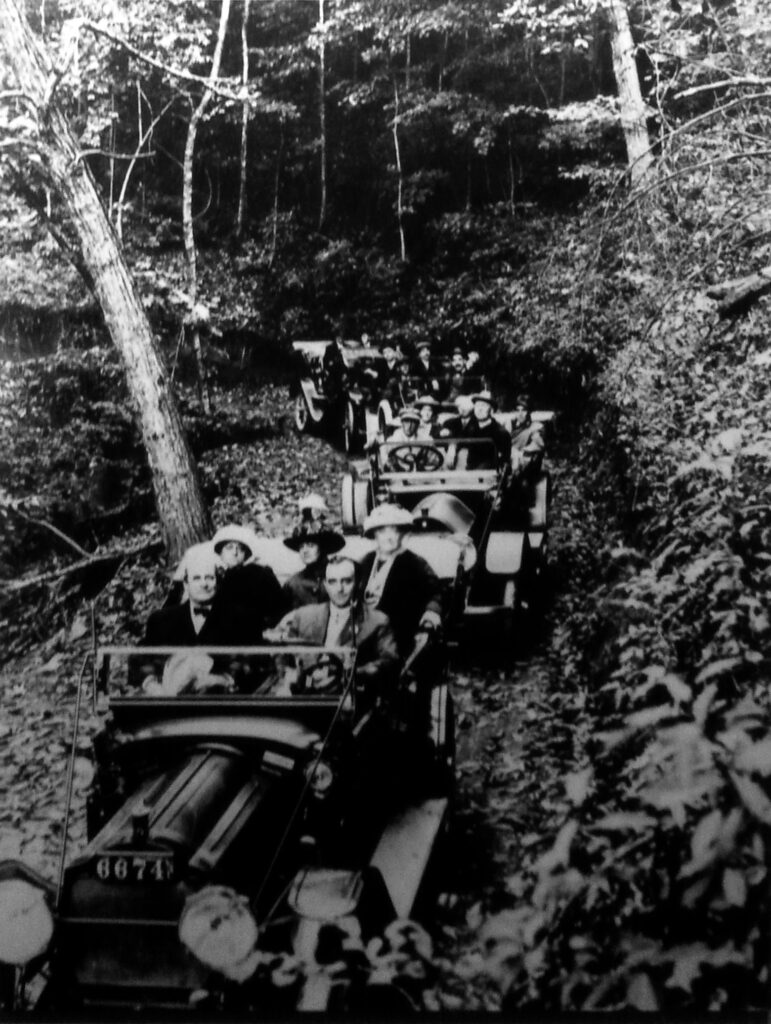
The real estate market began to decline in 1926 and local banks failed in November 1930. The city spent “the next 40 years paying off its debts.” There was a silver lining for preservation. “The city kept many of its wonderful old buildings because no one could afford to replace them. These structures (today) are among Asheville’s most celebrated features.”
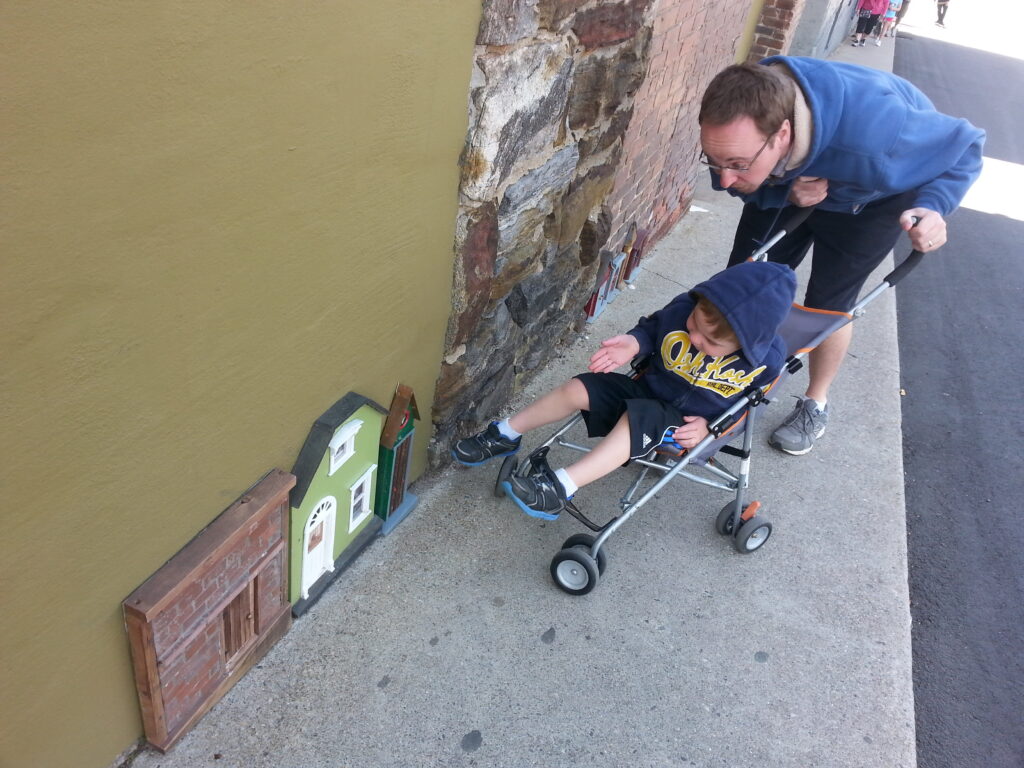

Part of the fun of Asheville was seeing all of the little features. Here a fairy house gives people the ability to open doors and see inside.

The Vance Monument is a late 19th-cetnruy granite obelisk that memorialized Zebulon Vance, former North Carolina governor. Richard Sharp Smith, supervising architect for Biltmore Estate, designed the monument. George Willis Pack, a New Yorker who had recently moved to Asheville, mostly funded the monument.
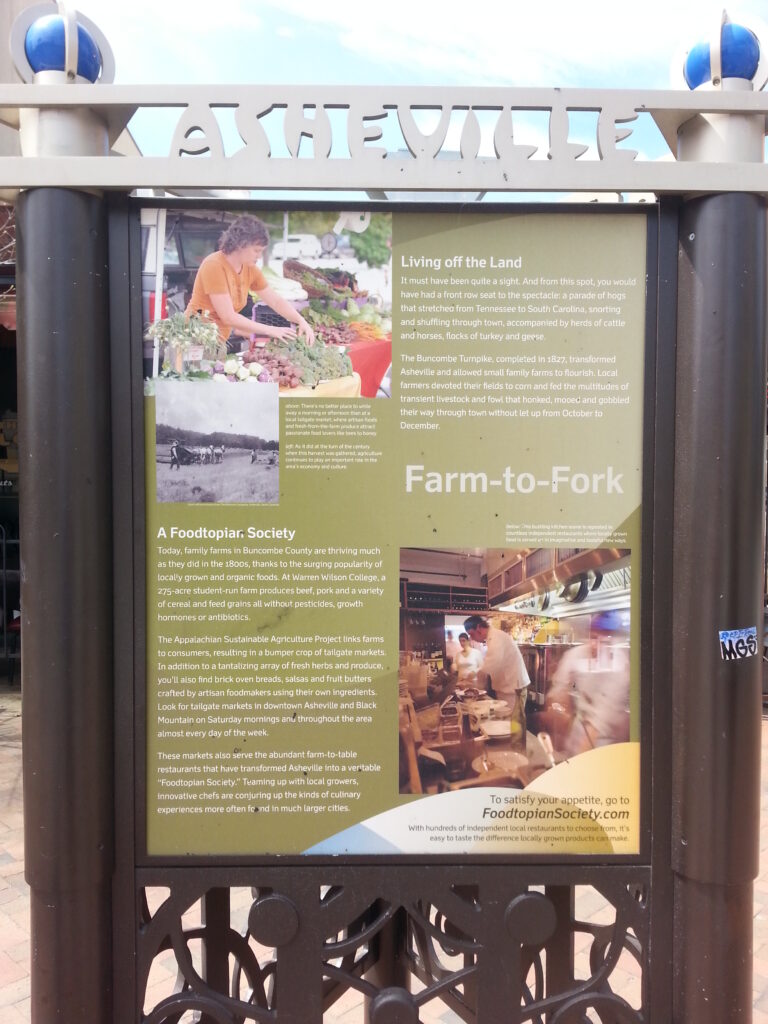


A very unique marker celebrating local foods, recounts on “a parade of hogs that stretched from Tennessee to South Carolina, snorting and shuffling through the town, accompanied by herds of cattle, and horses, flocks of turkey and geese.” The Buncombe Turnpike, completed in 1827, helped small family farms to flourish. Local farms produced corn for the livestock that passed through town from October to December. The marker then goes on the state how: “Today, family farms in Buncombe County are thriving much as they did in the 1800s, thanks to the surging popularity of locally grown and organic foods. Work at Warren Wilson College and the Appalachian Sustainable Agriculture are mentioned. Tailgate markets provide an array of fresh herbs and produce, brick oven breads, salsas and fruit butters.
These farm-to-table restaurants featuring farm-to-fork dining “have transformed Asheville into a veritable ‘Foodtopian Society’ with hundreds of independent local restaurants to choose from.
Asheville Urban Trail

The Asheville Urban Trail recounts how automobiles propelled Asheville’s growth. On one block it was documented how between 1912-1913 bricks were laid “for a new kind of wagon.” The process of “filling stations and car dealerships replaced livery stables.” The Western Carolina Auto Hotel was the city’s first parking garage, built in 1926 at 11 North Market.

Another plaque on “Civic Pride” recounts how “Asheville’s central square has long served the needs of government and commerce.” The city hall with bell tower had police and fire departments, along with municipal offices. Stalls downstairs are where “African American and white merchants operated a public market.” They sold fish, game, meat, and produce to city residents, hotels, and tourists.

The “Hotel District” remembers some of the many hotels that operated in Asheville. One of these, the Eagle Hotel, opened in 1814 by Irish immigrant James Patoon. It had an ornamental eagle perched high in front. Almost opposite the Eagle was the Swannanon Hotel that began operations in 1878, making South Main Street (now Biltmore Avenue) a 19th century social center.
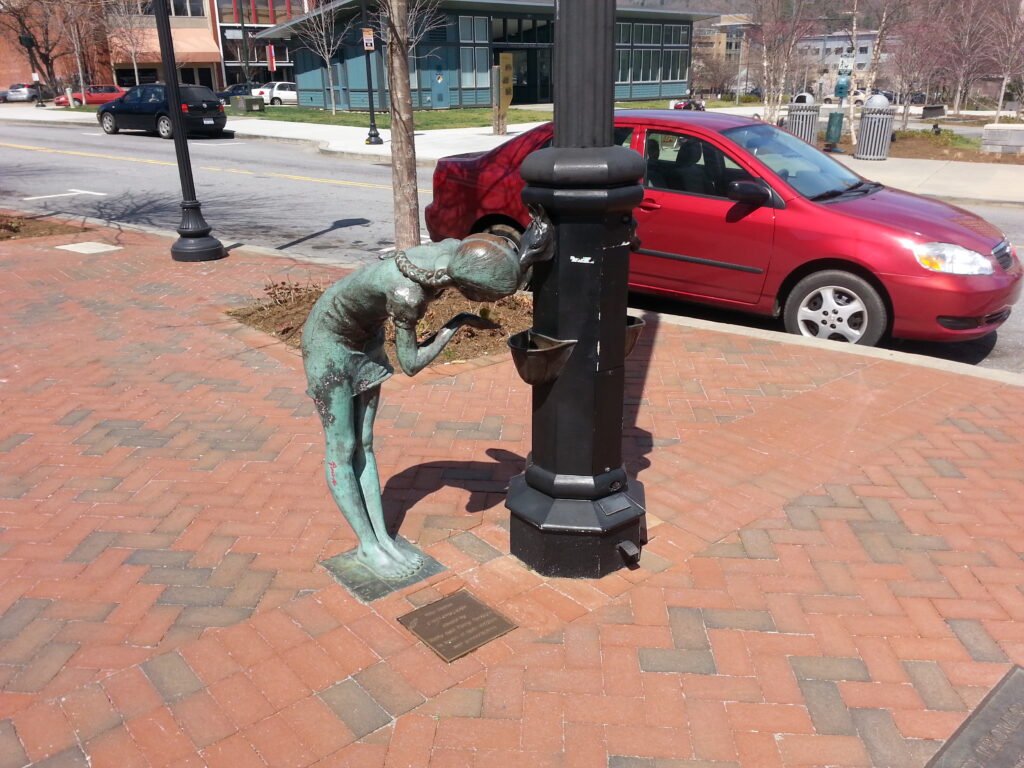
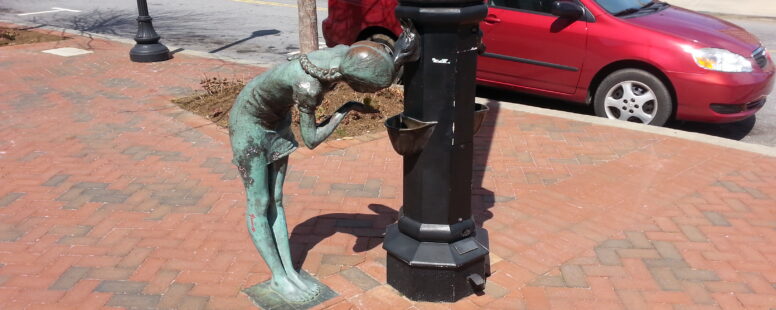
Prior to introduction of electricity in the 1880s, gas and kerosene lamps let Public Square, no known as Pack Square. Horse-head fountains affixed to lammpposts at the east and west end of the square were fed from a reservoir on Beaucatcher Mountain. A sculpture Childhood, “represents the promise of the future.”

W.O. Wolfe’s tombstone shop once stood on this corner. He made tombstones and other monuments. In the summer of 1917, ill health forced Wolfe to retire and move into the Old Kentucky Home, where he lived until his death in 1922. During the real estate development boom, “L.B. Jackson purchased this property from Julia Westall Wolfe and built Asheville’s first skyscraper.” Designed by architect Donald Greene, the Jackson Building opened in 1924.
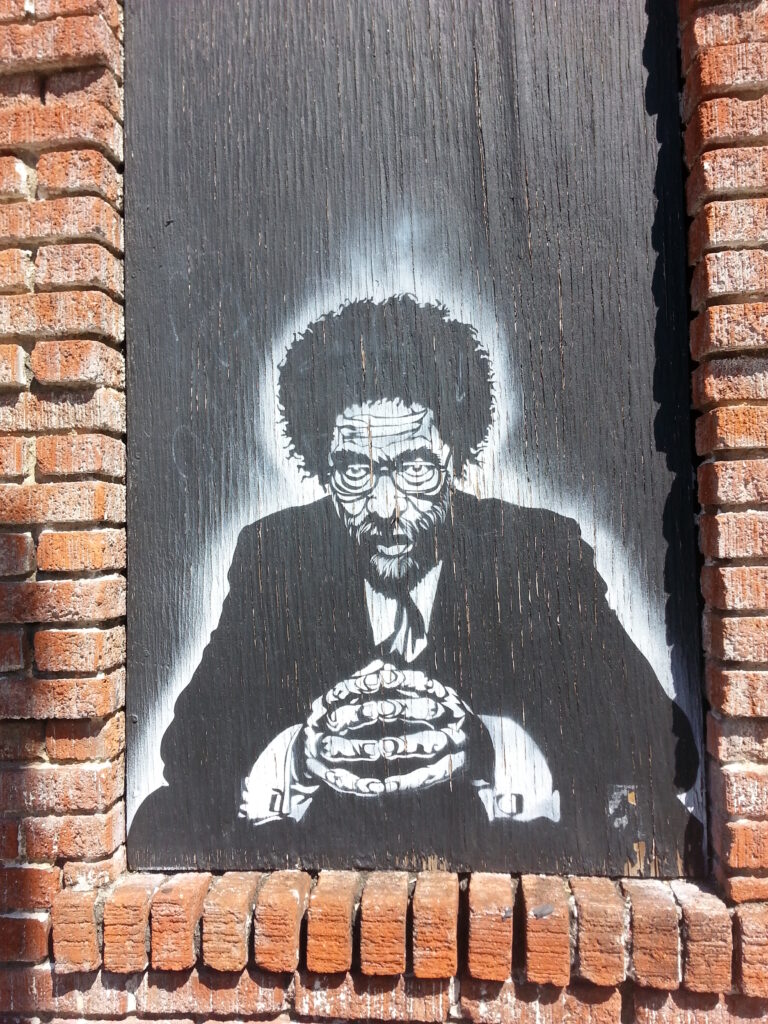
Cornell West street art. The only flaw is it almost too perfectly fills this space, meaning it is a one off, rather than a pattern used repeatedly elsewhere.
A curious interpretive sign for The Main Store that opened and operated for more than 40 years at 22 Patton Avenue. The owner, Coleman Zageir (1894-1975) opened the store in 1922. Zagier was community minded, once saying “If you are a member of the community, that’s a responsibility you should recognize and assume.” After selling the business, it was later renamed, moved to the Asheville Mall, and ultimately closed.
Thomas Wolfe Memorial
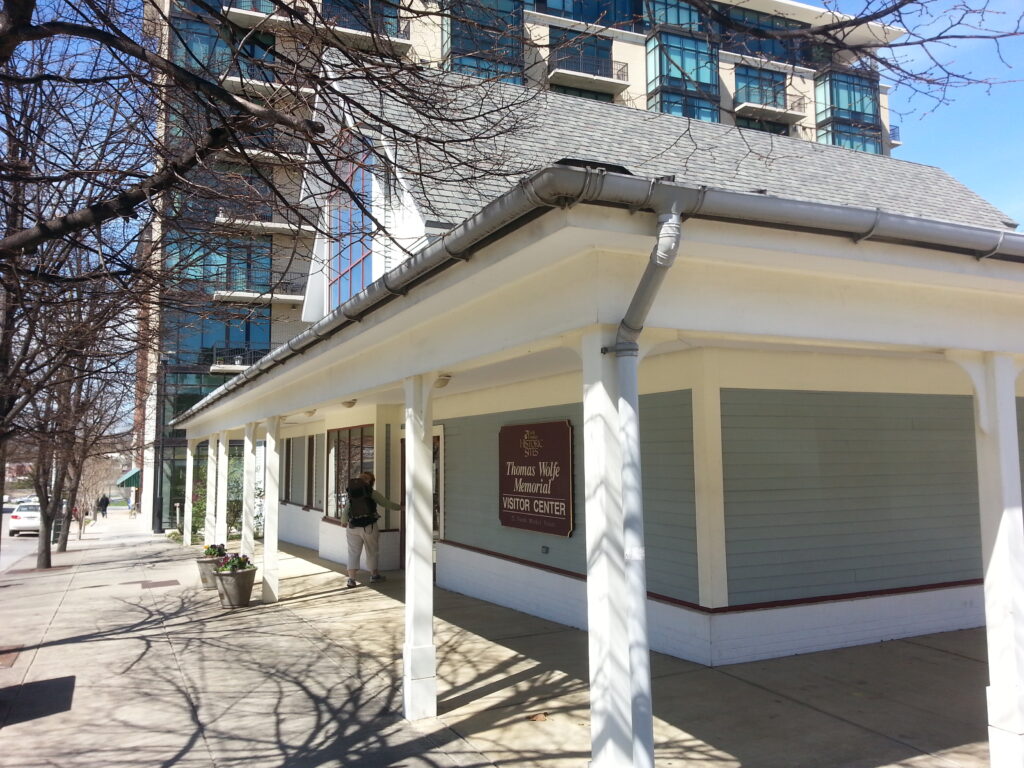
The Thomas Wolfe Memorial Visitor Center is where tickets are sold to tour the house. Exhibits inside tell the story of author Thomas Wolfe. The building makes a nod to the house and its materials, while clearly having modern features as well including the light filled atrium with a glass curtain wall.
Exhibits describe construction of the railroad and how the first train traversed the Black Mountains to reach Asheville in October 1880. Biltmore was built a few years later around 1889. “When Thomas Wolfe was born in 1900, Asheville was a bustling resort town with a population of 14,964. George Vanderbilt’s Biltmore estate was thriving. The city had already earned its reputation as a health resort, especially for those with tuberculosis and other lung ailments, for it was thought that the mountain air provided beneficial treatment. At the turn of the century there were twenty-five health resorts in the area. Although the number of such resorts declined over the next few years, there were still sixteen sanitariums and hospitals in business in 1916.” By 1915 there were also twenty hotels and more than 100 boarding houses. Visitors could attend the theater, visit the opera house on the third floor of the courthouse, take sight-seeing tours by carriage or motorcar, or enjoy one of Asheville’s 13 city parks.
The Wolfe family came to Asheville because of its reputation as a health resort. William Oliver Wolfe operated a stonecutting business. After a bitter divorce from his first wife, he and his second wife, Cynthia Hill, settled in Asheville in 1879. They hoped the mountain air would be good for her health. Cynthia died of tuberculosis five years later.

The original family home at 92 Woodfin was built by W.O. in 1881. The house had three bedrooms, was entirely heated by fireplace, and lacked plumbing. The deep backyard had a swing and playhouse, fruit trees, and a vegetable garden. W.O. married his third wife, Julia, on January 14, 1885. The house was crowded, with two of its three bedrooms used by his parents. “W.O. suffered from inflammatory rheumatism and had a difficult time controlling his love of alcohol, which caused continuing strive with Julia. She eventually found a way to escape the unstable situation.”
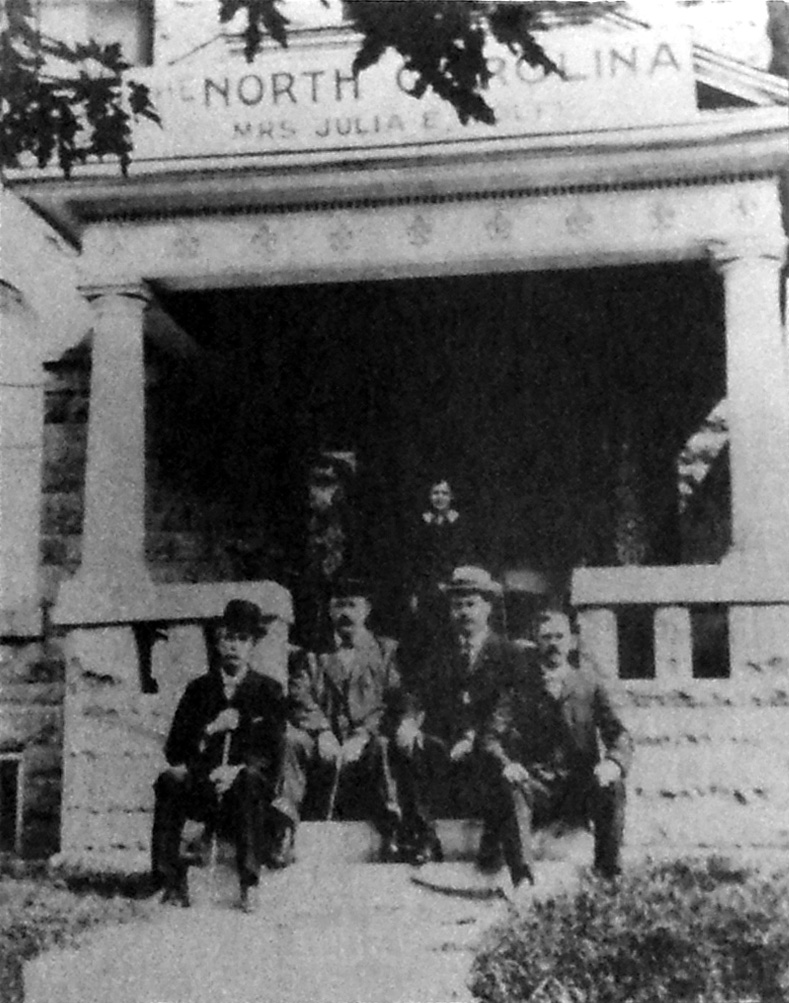
In 1904 she opened a boardinghouse in St. Louis to serve North Carolinians visiting the World’s Fair. Tom and his four siblings accompanied her. “She abandoned that venture when her twelve-year-old son Grover died of typhoid fever contracted at the fair.” Soon after returning to Ashville, she looked for another boarding house venture. Thomas Wolfe, writing about his mother years later wrote:
The town seemed to be an enormous blueprint to her: her head was stuffed uncannily with figures and estimates – who owned a lot, who sold it, the sale-price, the real value, the future value, first and second mortgages, and so on.
The Old Kentucky Home boardinghouse is where Tom and his mother Julia lived after 1906. Built as a private home by Erin Sluder in 1883, it became a boardinghouse in 1889. Rev. T.M. Myers from Louisville, bought the house in 1900 and named it for his home state. Julia kept that name. Thomas Wolfe in Look Homeward Angel wrote of the house:
Dixieland was a big cheaply constructed frame house of eighteen or twenty drafty high-ceilinged rooms: it had a rambling, unplanned, gabular appearance, and was painted a dirty yellow. It had a pleasant green front yard, not deep but wide, bordered by a row of young deep-bodied maples… And Eliza, looking toward the town, said: “They’ll put a street behind there some day.”


The Thomas Wolfe House was designated a National Historic Landmark in 1972.


This playhouse was built by W.O. Wolfe, father of Thomas Wolfe, in 1900 for his children. A plank walkway led from the front of the house to the doorway of the pine playhouse. The younger children spent many hours there, especially during bad weather or on Sunday afternoons. This is partly because W.O. “demanded quietness in his house.” Tom especially enjoyed the playhouse “seeking there the solitude denied him elsewhere.” It was moved from the family homesite at 92 Woodfin Street for preservation in 1955.
Following an extensive education, Thomas Wolfe wrote several plays that received a “disappointing public reaction.” Wolfe turned to teaching at New York University’s Washington Square College. He taught freshman composition “at which he worked hard but for which he had little patience.” Wolfe made seven international trips, traveling extensively in Britain, France, and Germany. He was particularly fascinated with Germany, home of his father’s ancestors, and made many trips there after his father’s death.
While returning from one of these trips he met Aline Bernstein. An accomplished stage and costume designer, she had been trying to get Wolfe’s play Welcome To Our City published before she met him. She subsequently supported Wolfe both emotionally and financially as he worked on his first novel Look Homeward, Angel, which he dedicated to her. Following that book he ended his love affair with Mrs. Bernstein and resigned his positioned at New York University. His posthumous novels, The Web and the Rock and You Can’t Go Home Again, chronicle their love story.
While public and critical reaction of Wolfe’s novels were positive, at home they struck a never. That is because local figures he used as models for his characters were “so thinly disguised that they were easily identified. Asheville appreciated neither the recognition nor Wolfe’s candor.” Wolfe stayed away from Asheville for seven years “after receiving cards and letters containing threats from some citizens.”
Wolfe lived in many apartments in New York in Greenwich Village, Brooklyn, and various hotels. After returning to New York from Asheville in October 1937, he lived at the Chelsea Hotel on West 23rd Street in room 829. After he died in 1938, his brother Fred went to New York to close out his affairs and pack his personal effects for shipment to Asheville.

Plaque for Thomas Clayton Wolfe, “A Great American Writer, Born on This Site, 92 Woodfin Street,” on October 3, 1900. You can, indeed, never go home again. Fitting that all that remains is a monument surrounded by chipped stone, for a house built by a monument maker.