

Visit to Winnipeg, Canada
Broadway Food Trucks
Immediately we were struck by the concentration of food trucks along Broadway. While formal sit down restaurants were fairly sparse, the food trucks were plentiful. This was a creative adaptation to serve the many people utilizing the surrounding office buildings.


As we observed these food trucks, we also took significant interest in where people walked and sat. The improvised seating beneath canopies of trees were very popular.


Less popular were the more formal tables in the direct sun without shade.


This simple table set in the corner of a yard in front of a fairly simple two-story hipped roof house, commands the space around it. This is due to placement in a corner, as well as due to the connection with the main walk and staircase immediately behind it. The use of a finely crushed stone as a paving material gives the space the table sets on a more architectural feel.

This three-dimensional bulletin board incorporates district branding information, while providing a convenient public location to post fliers. The absence of a covering probably causes the posters to deteriorate quickly. This is a unique if not somewhat idiosyncratic manner to promote social participation and civic engagement.
Bulletin Boards
Bulletin Boards were a recurring feature throughout Winnipeg. There was even some mild competition between different neighborhoods to have the best appearing boards.


This bulletin board for the Exchange District was created by artist Michael Carol in 2009. The Winnipeg Arts Council commissioned this work as part of their public art program.

Public Art
Public art is plentiful throughout Winnipeg. We found something around nearly every corner.

Nook Diner has a large mural along one of the primary walls. It evokes a nostalgic street scene, of a similarly sized and scale building to the one that it is on.


Public art is so popular, in fact, that a whole festival was being planned. The “Wall-to-Wall Mural + Culture Festival” was held September 1-30, 2017. Numerous partners from the public and private sector combined to make the festival possible.


We were pleased to see examples where art was incorporated into the signage and wall surfaces of businesses, enhancing them in ways that traditional signs do not, while also enhancing the place identity.
Brown’s Creek
Brown’s Creek was once a significant component of Winnipeg’s river system, draining a vast area of land west of the Red River, an area now known as the Historic Exchange District. Brown’s Creek ran easy along present-day William Avenue, to the foot of Bannatyne Avenue and Waterfront Drive, draining into the Red River. By the 1880’s the pace of expansion of Winnipeg’s downtown quickened, placing a high demand on land for new roads and buildings. The creek was slowly filled in and its bridge across Main Street removed. By 1890 it had all but vanished. Today John Hirsch Place commemorates the former creek bed through its meandering paving pattern and water conservation features.


This innovative street furniture transitions into a slatted wall to screen a private dining area from the public sidewalk. A base of flat slats rests on a rectangular steel frame. The uprights run between these varying the depth of the bench at the base.

The Forks
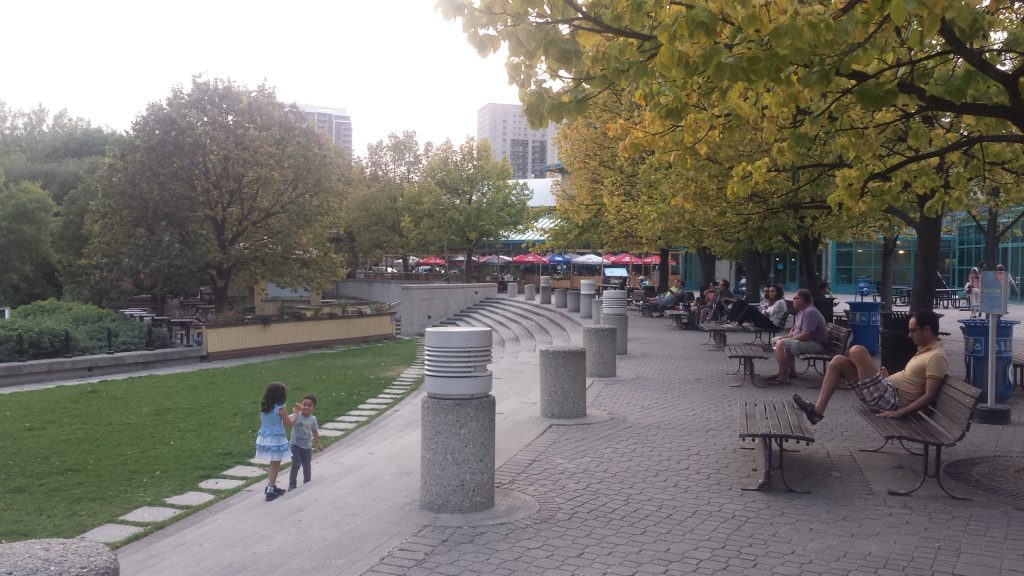
The Forks is a vibrant indoor market with dining and entertainment. Outdoors there are outdoor gathering places and a sizable amphitheater. All together they make a destination for Winnipeg and the region.


These decorative metal screens give a sense of enclosure for the people sitting down, while also visual interest for those passing by.

Custom furniture allows several people to sit at the same table, each with a designated seat attached to the metal frame of the table itself.

Outdoors there is a covered space for performances and a wide staircase, amphitheater like, that allows groups of people to assemble.


Marketlands
This 2.4 acre site in the Exchange District was undergoing the early stages of previtalization before we arrived. People were welcome to walk through the area and contemplate what might be possible for this area.

A shipping container was placed near the center of the site with vibrant pastel colors. Pavement painting corresponded with the colors on the container. Together they were utilized as place activation elements and to allow people to meet at the site.


Manitoba Centennial Center Concert Hall

The formidable Concert Hall has a modern facade that is reminiscent of a cheese grater. Large concrete canopies provide some cover for cars as they approach. A huge digital billboard gives the opportunity to promote activities happening inside the hall.
Keyhole Viewer

This keyhole viewer recreated the silhouette of a building that once stood here, but has since been demolished. Standing at the right angle it is possible to see where the building stood in the urban environment.


Manitoba Theatre Centre

The Manitoba Theatre Centre has the stature of a major performing arts location. Adding to the whimsy of the space is a quirky sculpture showing two people associated with the theater taking it all in. For the adventurous guest there is an empty seat in the reclined position, just asking passersby to join in the scene.


Upper Fort Garry Provincial Park

The landscaping at Upper Fort Garry Provincial Park is very attractive. Rows of trees are offset by brick pavers. Lighting of a pedestrian scale draws people through the space. And historic buildings present a handsome stage scenery to the space.
Osborne Village
The Canadian Institute of Planners recognized Osborne Village, Winnipeg as a Great Neighborhood in 2012.

The Gas Station Theater caught our attention right away. The theater itself was vibrant and colorful thanks to a full way mural of various performances, and a very well lit internal lobby with color and visual interest of its own. The whole area screams art. An outdoor plaza is less cared for with what appears to have been a fountain, now covered over, and a slightly too high to sit on landscape wall.


Project Bookmark Canada provided an opportunity for Canadian authors to have visibility and a physical presence.

One final detail that caught our eye were these oversized luminaries elevated above the ground. They have LED lights inside that are programmed to change colors. As a place activation element this was highly effective, giving instant character and some additional safety to this spot, especially at night.
