The Woodrow Wilson Presidential Library & Museum – Staunton, Virginia


The Woodrow Wilson Museum in Staunton, Virginia features the house where Wilson was born, a World War I trench warfare exhibit, and a Pierce-Arrow limousine. There are also surrounding gardens to explore.
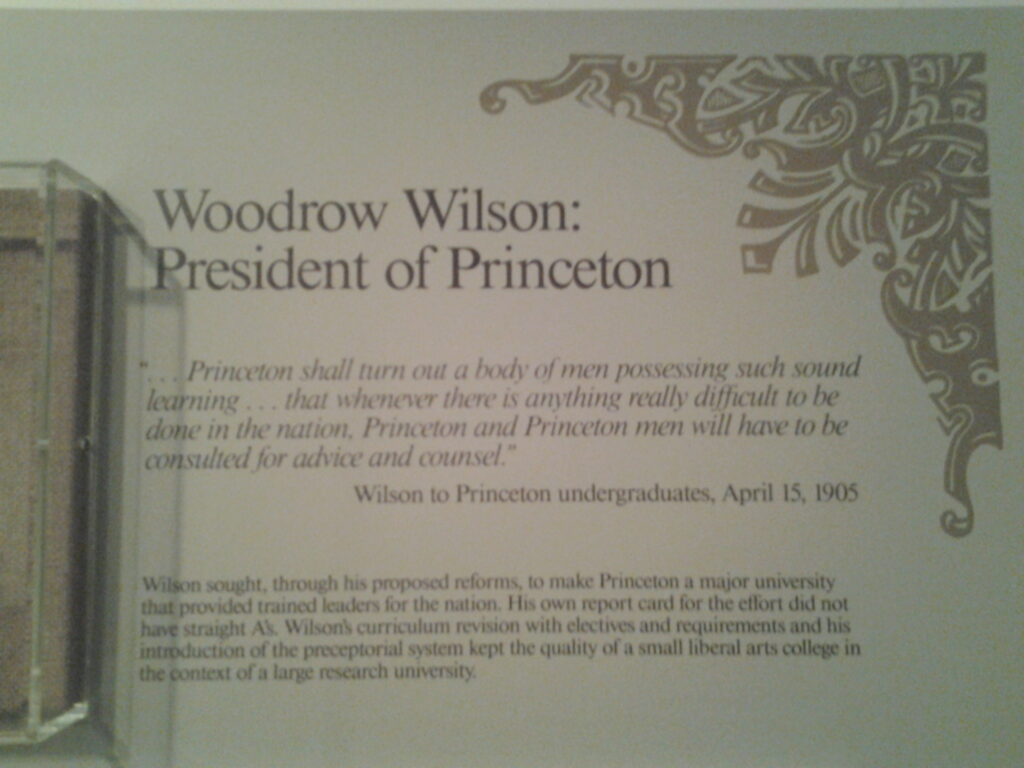
As President of Princeton University, Wilson undertook reforms to make Princeton a major university that trained leaders for the nation. He sought to keep the quality of a small liberal arts college in the context of a large research university.


Wilson went from College President to New Jersey Governor in 1910. He did this through alinging with the Progressive Movement to counter the excesses of laissex-fair individual and its products: political corruption and control of government and the economy by a wealthy minority. {Progressives looked to government to use collective action and regulation to remedy abuses and serve the public interest. Politicians persuaded Wilson to run for governor in 1910, believing they oculd control him. Progressives doubted that he was one of them and opposed his nomination. Wilson following his election surprised both groups by his performance and track record. He opposed the “boss” system in politics and came out in favor of popular election of U.S. Senators, election reform, workers’ compensation, and regulation of public utilities.
As President of the United States, Wilson undertook economic reform through legislative and party leadership. Monetary policy ensured a money supply that expanded and contracted with the economic cycle. Banking and monetary systems were put together in the new Federal Reserve, a chief goal of Wilson’s New Freedom program.
Wilson opposed restrictions on immigration. Between 1900 and 1920 the population of the United States increased from 76 million to 106 million.


He moved to the left on many social issues. Among the points he advocated for were an 8 hour day for railway workers, workmen’s compensation for federal employees, assistance for merchant seamen, and creating an extension service for farmers. By 1916, the radical left backed him in the election. During the coal strike at Ludlow, Colorado in 1914, Woodrow Wilson sent troops for the first time to intervene on behalf of striking workers. Prior presidents only sent troops to uphold management and to break strikes.
Racial justice is one area where the Wilson administration did not usher in reform. Following the Supreme Court’s Plessy v. Ferguson case in 1894, there was a sharp increase in racial segregation. Black Americans responded by forming organizations to combat injustice, by creating self-help mechanisms within the black community, and by trying to work with the small minority of white Americans actively concerned with racial justice. Leadership from the Wilson administration was largely absent. Five of Wilson’s ten cabinet members with southerners, two of whom had strong anti-black prejudices. Wilson favored segregation believing that it would help black Americans to develop their opportunities free from white competition.
Women’s activism during the Progressive era led to greater equality of eocnomic, political, and social status. The International Ladies Garment Workers Union advocated for higher wages and improved work conditions. Organizations of middle-class women such as the General Federation of Women’s Clubs and the National American Women’s Suffrage Association worked to gain the right to vote. The powerful and primarily rural Women’s Christian Temperance Union fought for the prohibition of alcoholic beverages. Wilson, with traditional southern views on women, was unsympathetic on the movement for women to vote, claiming in 1913 and 1914 that suffrage was a local and state matter. By 1916, however, Wilson addressed the 4,000 delegates to the National American Woman Suffrage Association in Atlantic City, saying he was fighting for their cause.
World War I: The “Doughboy” War
As a young boy, Woodrow Wilson witnessed the destruction caused by the Civil War. He grew up to hate war, and opposed American involvement in the European conflict of 1914. After German belligerence cost many American lives, Wilson entered the war in 1917. The war thrust the U.S. into the international arena, established the nation as the world’s leading industrial power, and accelerated the movement of the U.S. population from farms to cities.
This small but powerful exhibition took people literally into the trenches to experience World War I firsthand.


After a brief period of sweeping troop movements, World War I settled into static combat frozen in twin systems of trenches stretching across the Eastern Front and the Western Front. Machine guns, long-range artillery, and flamethrowers gave defenders in trenches a decisive advantage against attacking troops. During one British assault on German trenches at the Somme River, 57,000 attackers were killed or wounded during the first morning of the offensive.
The trenches themselves were exposed to the natural elements of rain, heat, snow, and coal. Artillery and poison-gas attacks were daily occurrences. Hoards of rats and millions of lice made the trenches that much more inhospitable and deadly. Unsanitary conditions led to spread of dysentery and influenza, while water covering the trench bottoms caused a serious fungal infection called trench foot.
Wilson maintained a steady policy of neutrality. In the 1916 he campaigned with the popular slogan, “He kept us out of war.” When Americans were killed by German submarine attacks, the President realized that he might not be able to avoid war. Wilson undertook a deliberate program of strengthening the nation’s military preparedness. The U.S. Navy began to build six new battleships while the Army expanded its forces by one-third. Americans were encouraged to buy war bonds to fund these defense programs. Wilson toured major cities and launched a public information campaign with buttons and posters to encourage public enthusiasm for the effort.
President Wilson led Congress to declare war on April 6, 1917. The U.S. expanded its army from only 130,000 troops to two million by 1918. General John Pershing commanded the American Expeditionary Force in France, where the new troops slowly shifted the balance. After defeating the last-gasp German offensives in the spring, Pershing launched a final offensive to capture railway facilities that supplied German troops. The Meuse-Argonne Offensive was the largest battle in U.S. history with more than 1.2 million Americans, of whom 126,000 were killed or wounded.
Allied offenses on the Western Front increased pressure on Germany and Austria-Hungary in fall 1918. In October of that year the Germans began exploring a ceasefire with the Allies. The Armistice began on the eleventh hour of the eleventh day of the eleventh month – 11:00 a.m. on November 11, 1918. The financial cost of the war for all nations was $186 billion while the human cost was incalculable. Allied causalities were 22.4 million, while the Central Powers had 16.4 million causalities.
The Limousine


The Pierce-Arrow limousine is the vehicle that greeted Wilson outside of Washington, DC, when he returned from the Paris Peace Conference in 1919. From that time through March 4, 1921, President Wilson rode frequently in the limousine. In 1924, after Woodrow Wilson’s death, his wife Edith gave the limousine to a group of citizens in Staunton. It remained in a garage for over ten years while Mrs. Wilson worked to make the Wilson Memorial a reality. The Woodrow Wilson Birthplace Foundation was formed in 1938 to restore the Manse in which Wilson had been born. This work was completed in 1940 and the Manse opened to the public in 1941. The limousine remained unrestored and moved from a coliseum at the city’s fairgrounds where it was parked on a dirt floor, to a nearby field where it was vulnerable to vandalism. This neglect continued until 1972 when restoration was undertaken by Charles Goodrich Thompson of South Tamworth, New Hampshire. The limousine made two ceremonial stops before returning to Staunton in March 1973. The first was in Princeton, New Jersey, and the second was Washington, D.C. Once returning to Staunton in 1973 it was put on display in 1973. Occasionally it was driven out as an ambassador for the Birthplace and Staunton. Mechanical trouble led to the engine giving out in 1989.
The Gardens
The garden tour goes along meandering paths with pergola interspersed throughout.


At one point the straight lines gave way to curved topiaries forming a sort of maze.


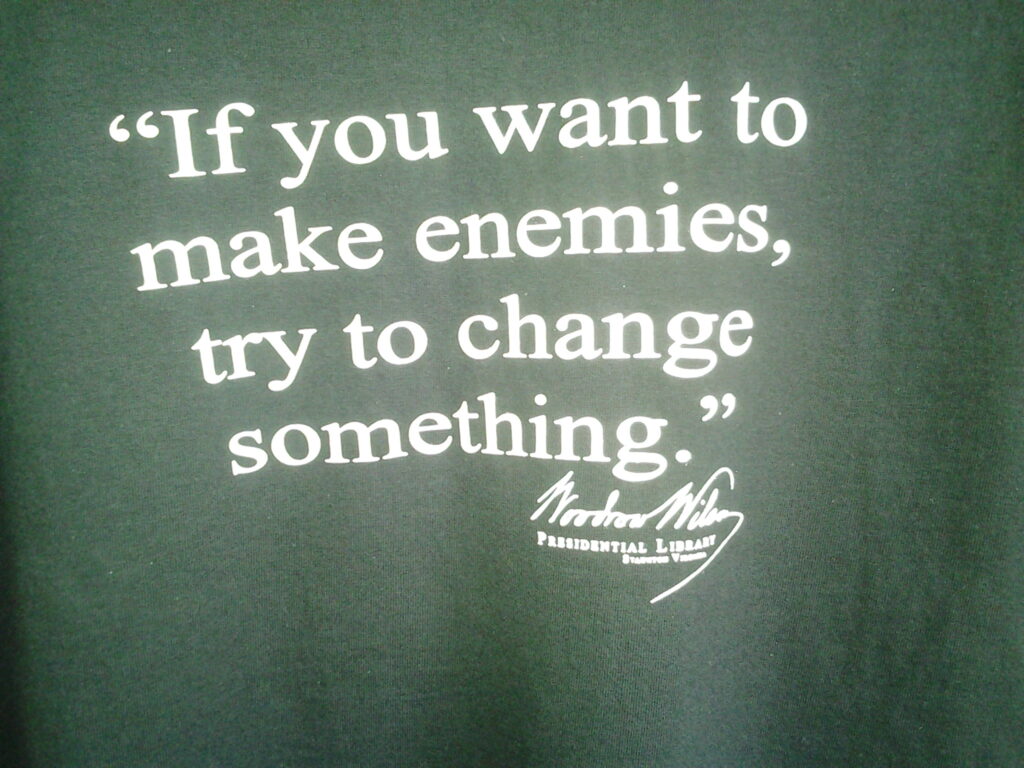
As we left, one quote jumped out at me that I’ve carried and repeated often: “If you want to make enemies, try to change something.” – Woodrow Wilson