
Visit to Pigeon Forge and the Great Smoky Mountains – Gatlinburg, Tennessee
The Southern Appalachian National Park Association was formed in Asheville to explore the goal of creating a 12,000-square mile park whose boundaries spanned parts of North and South Carolina, Georgia, Virginia, and Tennessee.
By the 1920s the 814-square-mile area that would become Great Smoky Mountain National Park had lost two-thirds of its forest cover to logging operations. Only a few pockets of old-growth timber were left intact, mainly in the eastern half of the park. This left the landscape unrecognizable by inhabitants of only a generation earlier.

Anne M. Davis worked tirelessly with her husband Willis to establish a national park in the Smokies. Inspired by a trip to Yellowstone, in 1923 she resolved that the mountains of East Tennessee and Western North Carolina should be preserved as a national park. The following year she ran for the Tennessee General Assembly and became one of the first women elected to the Tennessee House. She sponsored legislation to provide state money to buy land for a national park. Eventually she was successful in getting a bill passed allowing purchase of the land.
Park proponents in North Carolina and Tennessee joined forces to create the Appalachian National Park Association in 1925. Their purpose was to raise money to acquire park lands. Combined, the two states raised less then half of the necessary funds.
In 1927, John D. Rockefeller, Jr., pledged $5 million from the Laura Spelman Rockefeller Morial, named for his mother. Rockefeller designated the gift as “match” requiring the two bordering states to raise an equal amount before they could access the funds.

Great Smoky Mountains National Park was established in 1934. President Franklin Delano Roosevelt was on hand for the dedication event. In 2013 it was estimated that Pigeon Forge and the Great Smoky Mountains attracted 11 million visitors annually with $837 million economic impact from travel. Theaters in the region supported 20 shows in 12 theaters with 14,054 seats. The Great Smoky Mountains are the most visited U.S. National Park.
Dixie Stampede

Our first night we made an obligatory visit to the Dixie Stampede. This was not my first time, but for Chrissy and the boys it was. Overall it made for some good entertainment. The unforgettable influence on Dolly Parton on Dixie Stampede and also the larger Smoky Mountain region was inescapable as patrons headed for the exits after the show.
Gatlinburg Welcome Center

Our visit began at the Gatlinburg Welcome Center. It was movingly dedicated to Zeno Wall, Jr. by the Gatlinburg City Commission in February 1993. Inside we found exhibits and guidance to help prepare us for our trip.


The topographical table was quite helpful to orient ourselves with the landscape. Unlike more contemporary tables, this one was not to touch.
From the welcome center we embarked on a hike along the Fighting Creek Natural Trail. Once the location of a thriving community with a school, store, church and post office. Cornfields and farmsteads defined the landscape in 1925. All that is left today are piles of stones and plants that tell the story of the past. Walnut trees, boxwood, and yucca are just a few examples. The Ownby’s preserved cabin is open to visitors.


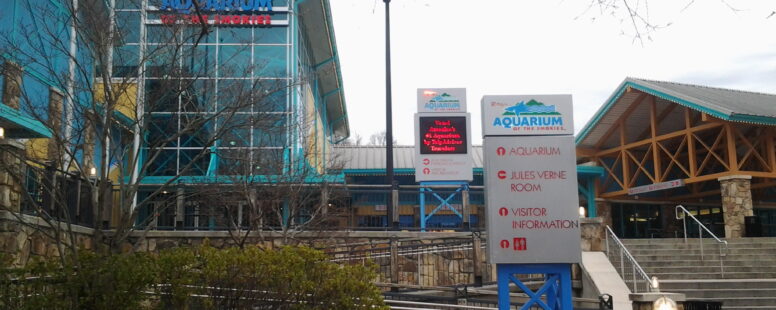
While being in nature was fun, the lure of the attractions in Gatlinburg was strong. While we didn’t go in, Ripley’s Believe it Or Not had a prime location. A companion attraction, Ripley’s Aquarium of the Smokies was a somewhat greater draw.

From the entrance the Aquarium is impressive with a mixture of rustic and modern elements. Stone and timber is incorporated throughout, giving a nod to the rustic look of the Smokies.


Viewing of the tanks gave some opportunities to feel immersed with aquatic life.

An underwater tunnel allowed for some very close encounters with the fish and even a few sharks.

The penguin exhibit also allowed us to get up close and personal.


The commercial district of Gatlinburg presented an eclectic mix of longtime businesses and hotels. More contemporary buildings were incorporated with very well designed public spaces to encourage circulation throughout. National franchises had a very visible presence as well, trading on the millions of visitors a year.
Pigeon Forge
On the edge of the park a far more extensive and sprawling entertainment complex developed in Pigeon Forge. This area is defined more by freestanding and detached buildings only accessible by automobiles. Holdovers from earlier eras were present, showing how some adapted well with time while others were period pieces with less connection to the present than the time they were built. There is a difference between being a genuine attraction and aspiring to be one.


