

America’s Historic Triangle – Williamsburg, Jamestown, and Yorktown, Virginia
College of William and Mary


The Wren Building at the College of William & Mary is the oldest building at the nation’s second oldest institution of higher learning. Inside and outside there is a palpable sense of history.
Merchants Square
Inspired by the rich architectural heritage of the 18th century, Merchants Square blends the atmosphere found in the nearby Historic Area of Colonial Williamsburg with modern-day shopping and dining. Marketing materials tout how “We offer the best in personal service, high-quality merchandise, world-class food and shop owners who really care.”
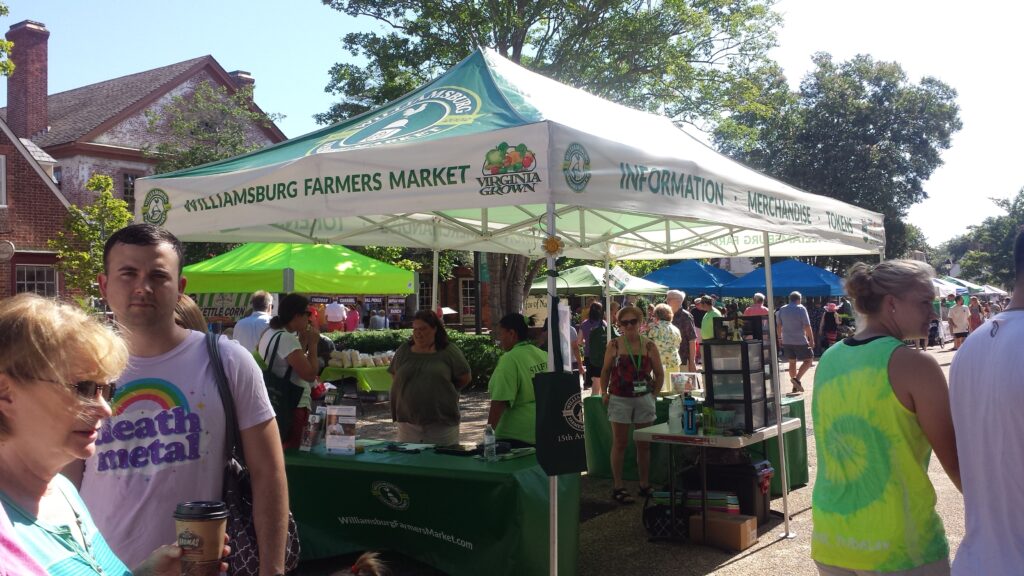
We had the good fortune to visit on a market day. Vendors lined the main street in town. We were particularly struck with how well organized the market was, and how the tent clearly highlighted the official market tent stood out.


The wayfinding was particularly effective, highlighting the more than 40 shops and restaurants.

Additional wayfinding highlights upcoming events like the “Summer Breeze Concert Series.”
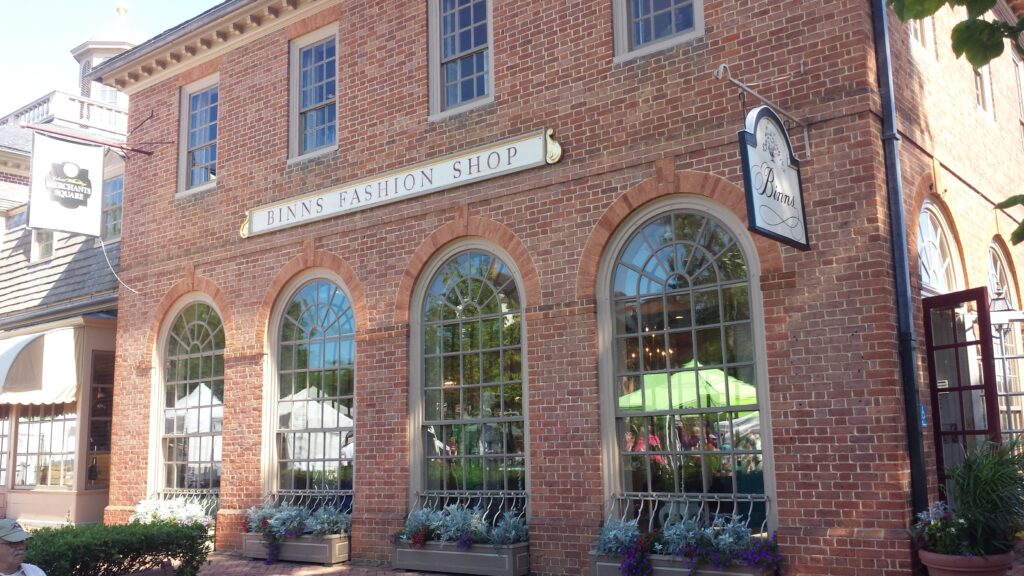
Binns Fashion Shop is in a handsome arcaded block. The blade sign and fascia sign reinforce one another while also being visually distinct.

Everything Williamsburg and Danforth handcrafted fine pewter are very visible, thanks to their signs. The Danforth sign is mounted to a heavy wood post, as was common in the 18th century.


In our family a visit to Williamsburg is not complete without a visit to The Cheese Shop. The grilled cheese here is among the best that we have had. They have a wonderful selection of wines in the basement too. Their extensive outdoor dining setup shows what a popular destination that they are for visitors to Merchants Square.

The Whythe Candy Shop is next door to The Cheese Shop. On face this is a good example of clustering complementary uses. The candy shop does not sell cheese, and the cheese shop does not sell candy, but both sell a similar product that customers may want to shop for both.
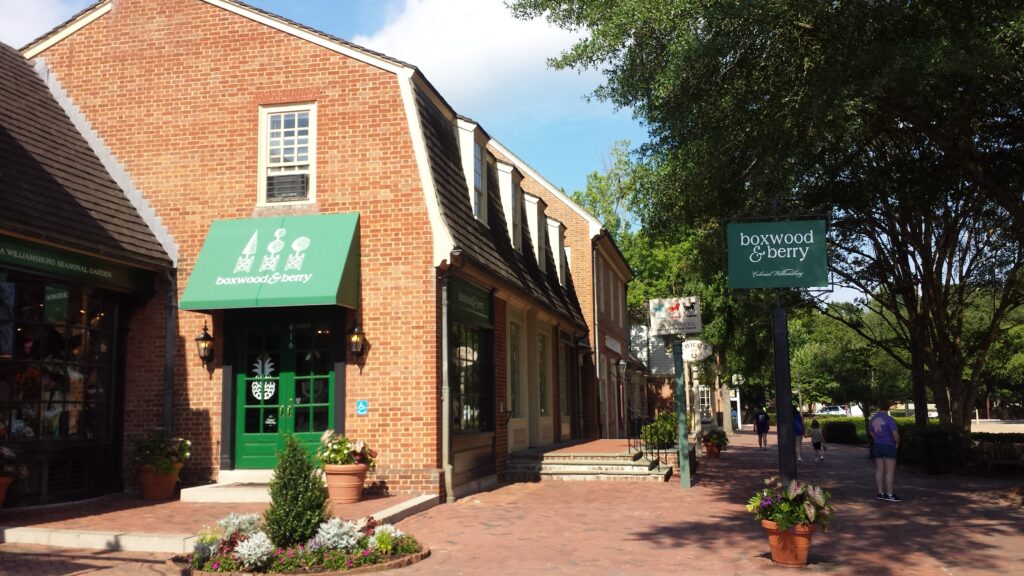
Boxwood and Berry is a seasonal garden shop. Given their product lines they might have more of a street presence without outdoor retail. This could tell a story and draw people into the store. The few planters and landscaped beds do not really give justice to this store or what it sells.

Fat Canary was once a wine and liquor store, but at the time of our visit was vacant. The undulating bay windows are architecturally distinct. They also might have made it difficult to highlight the products inside.

Scotland House has imported gifts. The signage at street level is distinct with a scaffold that has the sign suspended from it.

Blue Talon Bistro may be a great, but its waterfall awning is not. It looks dated, worn, and out of keeping with the historic character of the surrounding area. A retractable awning with text only on the valance would be a better choice.


Additional views of the streetscape show how paving, wayfinding, an established tree canopy, and well maintained plantings all add to the pedestrian environment.


Additional buildings borrow from historical precedents, particularly Federal style with its five bay division. The variety of textures and colors creates visual interest, while repeating similar form.

Dedicated cleaning and maintenance staff help to ensure that Merchants Square is always in its best physical condition.
Historic Area of Colonial Williamsburg

At the time of our visit the interpreters were out in full force. Our kids were particularly drawn to them. The back and forth and asking questions created a very dynamic learning experience. Here in the garden we enjoyed viewing the broad variety of plants, all being grown using traditional techniques.

There are many photogenic moments, including when the horse drawn carriage rides by driven by another interpreter.


Family photos in the stocks are a proud tradition.

This jerkinhead roof cottage has a one story addition with flush board.

The Brush-Everard House, also known as the Everard House and Thomas Everard House, was built by John Bush ca. 1718. It is one of the oldest houses in Virginia.
William Levingston, merchant of New Kent Coutny, built the first theater in English America on this cite in 1716. For three decades companies entertained audiences at the “Play House” with latest successes from the London stage. In 1745 the City of Williamsburg converted the frame structure into a municipal hall. The building was demolished ca. 1770 after construction of the Courthouse on Market Square.

The George Wythe House was built in the 1750s, it was the home of George Wythe, signer of the Declaration of Independence and father of American jurisprudence.

Peyton Randolph, Speaker of the House of Burgesses for nine years, lived in this Williamsburg house from 1745 until his death in 1775.


The Tayloe House is an 18th-century house built from 1752 to 1759 and was restored in 1950–1951 by Colonial Williamsburg.


The Raleigh Tavern was undergoing a porch reconstruction at the time of our visit. This was the culmination of many of years of research into one of Williamsburg’s most important historic sites. Archaeologists, historians, and architectural historians studied this building carefully since 1929. Thomas Waterman designed the original reconstruction. Since the 2000s a re-examination of early records and re-excavation of the area in front of the tavern led scholars to conclude that the Raleigh was fitted with a long open porch before 1773, when it was first mentioned in the Virginia Gazette. Porches of this kind were common on taverns in eastern Virginia in the third quarter of the 18th century. The porch reconstruction was supported by Robert and Cynthia Milligan.


Previously we wrote about the Richard Charlton Coffeehouse Reconstruction as it was underway. On this visit we were pleased to see it fully completed and in operation.


The Nelson-Galt House is one of the private homes not available for tours in the Historic Area.

The Prentis Store is the oldest surviving commercial structure in Williamsburg. William Prentis constructed the brick building at Duke of Gloucester and Colonial Streets since 1739. The building housed a variety of businesses. Now part of Colonial Williamsburg, a restoration in 1972 returned the building entrance to the original above grade height.

Outside of Archibald Blair’s storehouse, kids were given an opportunity to participate in an archaeological dig. Reservations are required for digs scheduled six days a week at four different times earch day. Then in the afternoon a rotating schedule of hands-on activities and guest speakers explores what happens to artifacts once they are taken out of the ground.


The Ludwell–Paradise House was built in 1752–1753 for Philip Ludwell III. In December 1926, it became the first property John D. Rockefeller Jr. authorized W. A. R. Goodwin to purchase as part of the Colonial Williamsburg restoration campaign. After being restored, the Ludwell–Paradise House held the Abby Aldrich Rockefeller Folk Art Collection from 1935 to 1956. The building now serves as a rented private residence in the Williamsburg historic area. Philip Ludwell II purchased the lot where the Ludwell–Paradise House was constructed in September 1700. Timbers in the structure were dated as being felled in 1752 and brickwork indicates the entire building was completed simultaneously. The house was used as a rental property, a tavern that once hosted George Washington, and a host for The Virginia Gazette newspaper.

As we prepared to leave Colonial Williamsburg, we were reminded how the tradition of preservation, rehabilitation, and reconstruction is carried on by the many craftsmen at the site. Here two of them are fitting a new stair stringer.

Fittingly we finished our visit at Old Bruton Parish Church. Here is a plaque remembering the role of William Archer Rutherfoord Goodwin as a “minister, teacher, and man of vision.” The plaque goes on that he “in whose Heart and Mind was conceived the Thought of restoring the Beauty of this ANCIENT CITY and who was himself the inspiration of is fulfillment.” These were the words placed on a plaque by his “friend and fellow workers” John Davison Rockefeller, Jr. in 1941.
Historic Jamestown


Jamestown has undertaken an archaeological investigation into one of the earliest permanent settlements. The ongoing excavation and the impressive museum create a link to the past.
Jamestown Settlement

The Jamestown Glasshouse is on the site of the first manufacture of glass in Colonial America. Here they are actively demonstrating the techniques utilized. At the gift store it is possible to purchase glass manufactured on site.


Jamestown Settlement is a recreation of the early village at a site far from the original settlement. This preserves the archaeological record at Jamestown, while giving flexibility to build and disturb a site without such deep historic associations.
Yorktown
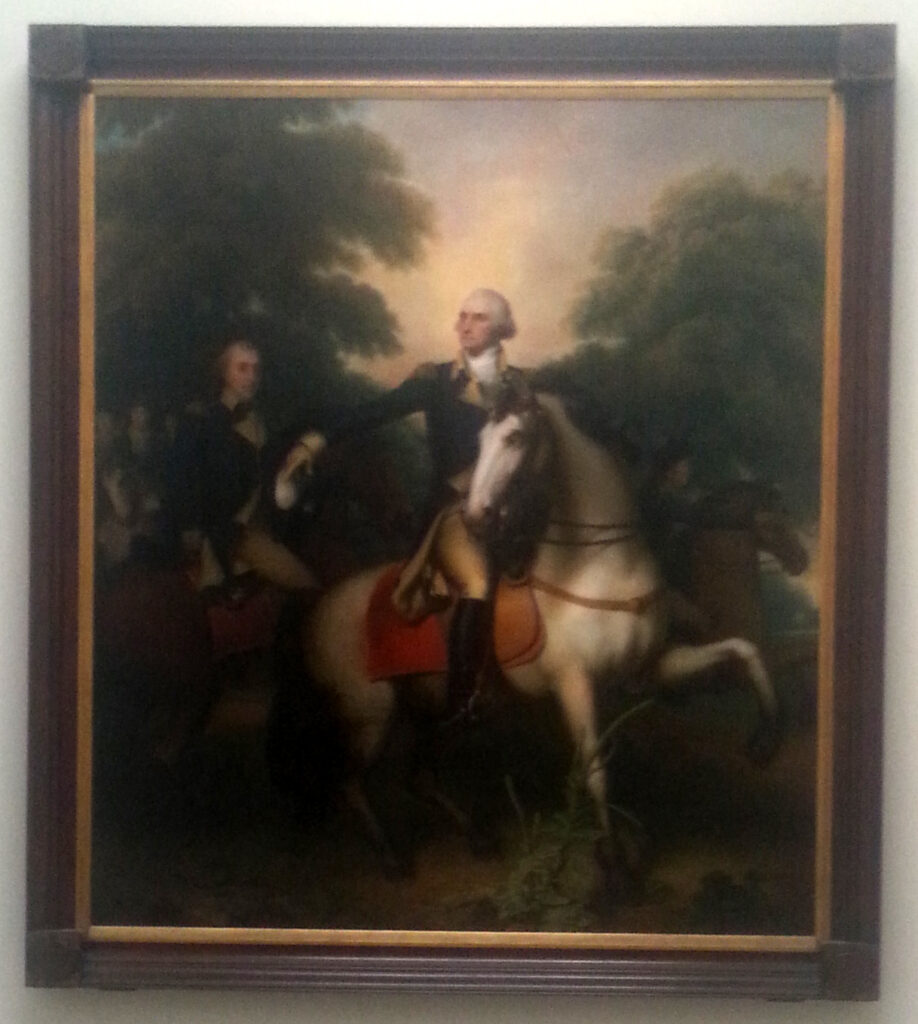
The National Gallery of Art has an equestrian portrait of Washington before Yorktown by Rembrandt Peale.