
Making Better Public Spaces in Downtown Wyandotte
Over the past several decades Wyandotte has transformed from an industrial economy dominated by large factories lining the river, to a more exclusively residential one with many of these factories being replaced by houses and parks.
The entire east side of Biddle Ave. between Elm and Eureka was occupied by the Eureka Iron Works from 1854 through the early 1900’s, before being converted for commercial and residential uses that are there today. Other factories lining the river to the north and the south were removed as well, with the Bishop Fur Factory demolished to make way for Bishop Park – a popular city park; and the handsome BASF Park on the site of the former ship building yards in the area south of the popular Portofino Restaurant (3455 Biddle) today.
The story of Wyandotte is not one about what it does not have, but of making what is has work better together. For instance, how might BASF Park and Bishop Park be connected, perhaps by a biking and running trail that expands from the north to the south border of Wyandotte? And what might we do to assure that the river frontage now available to the public between Oak and Elm remains available to the public, instead of being blocked off by private developments like other areas along the river have already been? These are some of the most important questions that local leaders and policy makers must decide in the months and years ahead. Will we celebrate our riverfront as a public amenity, or reserve the riverfront for the enjoyment of the select few?
One cannot look at the waterfront alone, without considering the streets, the business areas downtown, and the residential areas adjacent to these. Improvement of public spaces has been an important theme in recent years – especially following successful completion of the streetscape project. We have seen the emergence of the “Fountain Park” at the intersection of Eureka and Biddle, the Millennium Clock Tower and pergola south of Owl’s Korner Gift Shop (3050 Biddle), and numerous other outdoor seating areas and public places.
The “Flower Park” at the north-east corner of Biddle and Oak has an elliptically shaped flower bed that is raised above the ground, with an arched sidewalk and several benches behind it and a sliver of grass tapering northward toward a point, like an ice cream cone or birthday hat.
From the perspective of 50 feet above the ground, this park space appears attractive, well proportioned and logical. This is the perspective that designers and those involved with planning and approval of the park no doubt utilized. This, of course, bears little relation to the experience of residents and visitors to our downtown on the ground, who rarely view or use the park from a perspective 50 feet in the air.
Specifically – 1) the flower bed blocks the benches that are located behind it from easy access via the sidewalk, 2) there is no shade provided over the benches (nor with the current crab apple trees will there likely ever be) making this area less attractive to sit in, and 3) when sitting in these benches there is not a well framed view to look at.
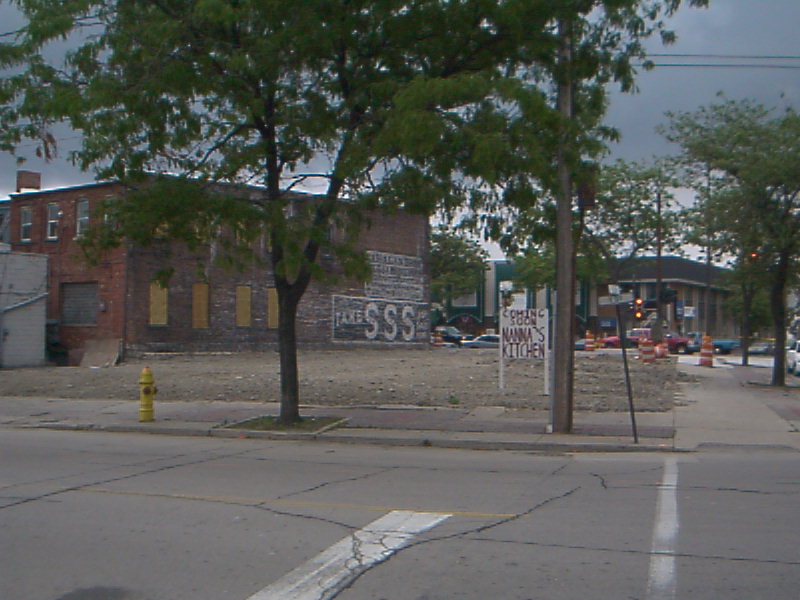
Location before Flower Park construction, Photo by Isaac Kremer, June 15, 2001.
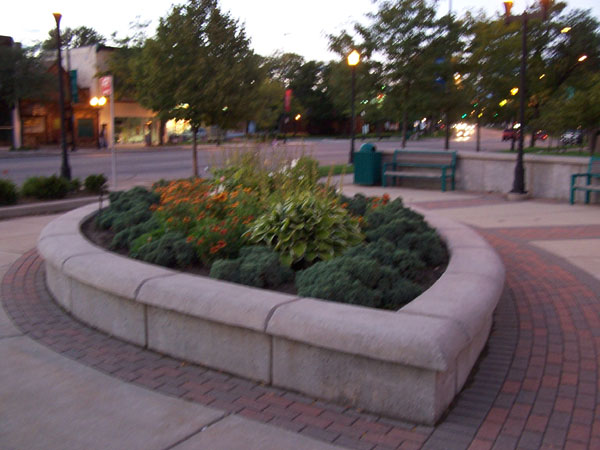
It is natural to ask then how we might make the “Flower Park” a better place. For starters, 1) move or remove the flower bed and incorporate flowers into the sliver of land ranging to the north, 2) move the underused benches to higher intensity areas where they are more needed downtown, 3) install interesting public art or street furniture such as a table with a checkerboard pattern inscribed in it, where people can bring checker or chess pieces and play their sport in public, and 4) provide shade in this area. This is a rare case also where benches lining the sidewalk and facing across the street may be appropriate, pointing towards the handsome spire of the Methodist Church and the award-winning Biddle Gallery (2840 Biddle) on the other side of the street.
It is a natural transition to focus attention on the emerging café scene in Wyandotte, because this too comprises a portion of the public space, and small changes here might make downtown Wyandotte a more attractive place to visit. The Grind (3037 Biddle) has been a mainstay downtown for the past decade, with motorcycles frequently lined up along the street, and perhaps creating the most active and interesting block in Wyandotte. For those who complain about the motorcycles and their riders, they are missing out on the value they add to the character of downtown: 1) they provide activity, 2) bikes and their riders are interesting to view, 3) motorcycles take less space to park than automobiles bringing more people into our center, and 4) the patrons of The Grind are mature, responsible, and help to keep the peace by providing valuable eyes and ears on the street.
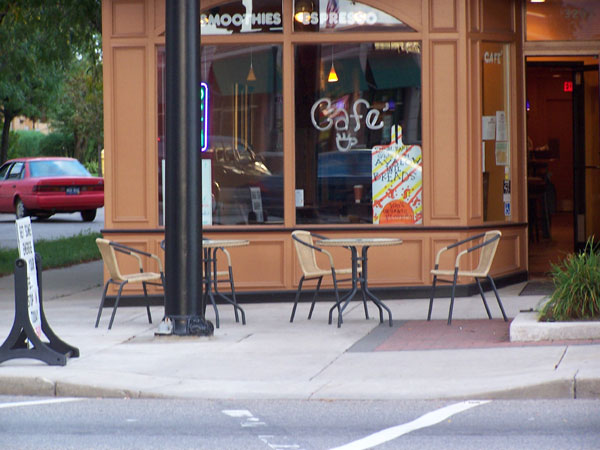
In more recent years other public seating in the café and restaurant format has emerged. There is the seating west of the Sports Brew Pub (166 Maple), south of Nanna’s Kitchen (2962 Biddle), along Sycamore Street near the new Stroh’s Ice Cream (3042 Biddle), and two shaded tables outside of Jimmy John’s Gourmet Sandwich (3169 Biddle) and two un-shaded tables outside of Energie Coffee & Smoothie Bar (3203 Biddle).
The city’s support for this emerging café scene has been mixed. Business and building owners have been required to sign hold harmless agreements and to assume liability for any incidents that occur on the public space of the sidewalk fronting their businesses. Limitations have also been placed on the number of tables that may appear in front of buildings. And in places such as Energie, streetscape elements (the planting boxes and tree surrounds) further limit the amount of tables that may be placed on the sidewalk.
Railings are another shortcoming of the café spaces as well. Some areas have heavy “defensive” features such as spiked fences, large brick piers, and fences that rise above eye level when people are sitting down. These features combine to transform what might be an attractive outdoor seating area – into one that is uncomfortable, and as a consequence – often empty. What have other cities done? Shorter railings have proven to be sufficient, rising no higher than knee or waist level and with horizontal bars rather than spiky black vertical posts. To secure furniture it is possible to stack chairs and lock them together when not being used, and to attach or lock tables to the ground. As most business owners downtown will attest – there simply is no interest for someone to steal the furniture because a) it is cheap, b) the market for cheap fenced (pardon the pun) furniture is limited, and c) it is not worth the risk of being caught to steal something that can be purchased for a couple of bucks at K-mart, and that almost everyone who wants some already has.
The message here is pretty simple – if you want people to visit your town, to stay there, and to spend their money, create places that are edgy, interesting, provide choice, are well shaded, and that provide a smooth transition between the outside and inside. Places that are scary, ugly, and “defensive” just don’t cut it.
There is currently discussion by the Mayor and other officials to create a Public Art Commission. One hopes that a broad view is taken of the public space in Wyandotte, and that the configuration and refinement of the public spaces is considered hand-in-hand with the expansion of efforts to include attractive and interesting public art downtown – because both efforts have the same outcome or goal – to attract people downtown.
Creating better places downtown is an issue that diverse people and organization can and need to come together on. The WBA, DDA, Planning Commission, City Council, business owners, residents, and visitors to Wyandotte all have a contribution to make. One caveat to remember is that it is not always the multi-million dollar plans and high-price consultants that create places that are attractive, hip, and cool. Rather, it requires people who care, who are willing to work together, and who through a series of small changes – that once being implemented and tested are determined successful and retained, or if unsuccessful thrown out and thought through again – that ultimately creates places that are worth visiting, shopping, and living in.
We all have a stake in making Wyandotte a better place. Wyandotte – if you indeed are the “Jewel of Downriver” one hopes in the months and years ahead, we will all work together to provide the Polish that is needed to make this place shine!