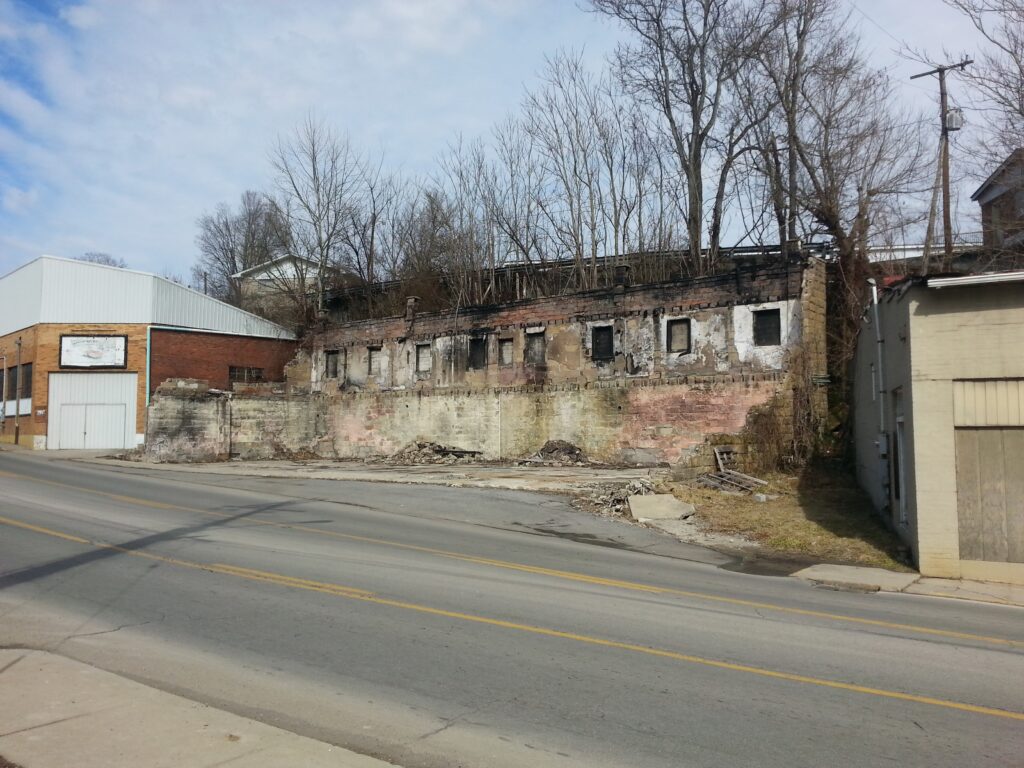
Downtown – Clay County, Kentucky
Clay County was named for General Green Clay (1757-1826). Born in Virginia, he came to Kentucky in 1777. He served in the Virginia Legislature from 1788-89 and the Virginia Convention that ratified the Federal Constitution. From 1793 to 1808 in Kentucky House, Senate, and Constitutional Convention. General Clay with 3000 Kentuckians held back British and Indians at Fort Meigs in May 1813. A cousin of Henry Clay, the county was formed from parts of Madison, Floyd, and Knox.


Recent efforts have sought to position Clay County as the “Gateway to Kentucky’s Elk Country.” As part of the Elk Restoration Area being administered by the Kentucky Department of Fish and Wildlife Resources and the Rocky Mountain Elk Foundation. Clay County has mountain terrain, rolling fields, streams and rivers that comprise 26,000 acres of wildlife management areas.
An interpretive panel on Historic Trails and Places linked together the Warrior’s Path, Dr. Thomas Walker, and Daniel Boone.
Dr. Thomas Walker entered present day Clay County at Collins Fork of Goose Creek. They left the cabin they constructed on the Cumberland River as a means of establishing their claim as the first explorers of Kentucky. They traversed to the forks of Goose Creek to present day Garrard where they joined the Wariror’s Path and travelled it northward to the mouth of Laurel Creek. From there they went across the ridge to Sextons Creek and northward from there to the Kentucky River. He built the first house in Kentucky on his return voyage to Virginia at a spot south of the Cumberland River south of present day Barbourville. Walker left a detailed diary that chronicled his travels daily, including the trip along Goose and Sextons Creek.
Daniel Boone followed the Warrior’s Path into present day Clay County in 1769. This was Boone’s first extended hunting trip into Kentucky and had less to do with exploring than with pleasure. He was joined by his brother, Squire, and a few friends, and spent over a year hunting and adventuring in the wilderness. He traveled the length of the path for several years before he marked out the better known Boone’s Trace and the Wilderness Road.
Langford Salt Works was established in the early 1790s. By 1807 it was called Tan Yard and was the site of the first county court meeting in Robert Baker’s cabin. High White bought part of the Langford works that year and he and the other owners donated land on which to build the town of Manchester. Today the site is known as the “Y Hollow” in East Manchester.


Not to waste an opportunity for marketing, the reverse side of the panel listed “Prominent Clay County People.”
- John Gilbert (1763-1868), thought to the first settler in Clay County, a legendary hunter, Baptist minister, salt maker, and community leader. He was instrumental in founding Clay County in 1807 and served as a state legislator.
- Brigadier General Theopolis Toulmin Garrard (1812-1902), grandson of Kentucky’s second governor, Garrard fought for the Union in the Civil War. Later in served in the Mexican American War, raising a company of men and going to Mexico for fifteen months. After that he led an expedition to the California Gold Rush. He served as a justice on the county court, in the legislature, and presided over his family salt works business.
- Laura R. White (1852-1929) was in the first class of women graduates at the University of Michigan where she studied surveying. Then she studied architecture at the Massachusetts Institute of Technology and the Sorbonne in Paris. She returned to run the family salt business and transitioned to the emerging timber industry.
- Bert T. Combs (1911-1991) was widely regarded as Kentucky’s most progressive Governor and later served as a Federal judge.
- General Hugh White (1776-1856). Patriarch of the powerful White family of salt makers and politicians. He bought and operated the old Collins Salt Works and ran one of the first mercantile stores in eastern Kentucky. He served for many years as justice on the Clay County court.
- David Yancey Lyttle (1822-1904) is known as Kentucky’s Father of Public Education. He took on powerful interests in the state legislature who argued that mountain counties should not have tax money for education since they had supported freeing slaves. He served as commander of a Clay County Home Guard unit in the Civil War.
- Col. Daniel Garrard (1780-1866) was a leading saltmarker, and son of Gov. James Garrard. He led a company of Clay County men against the British and Indians during the War of 1812. Garrard served as a justice on the Clay County court, and as a REpresentative and Senator in the state legislature.
- Martha Hogg (1848-1915), was an entrepreneur who along with her husband Calvin owned the forerunner of the Webb Hotel in Manchester. After the death of her first husband she married Owsley County Judge Stephen Hogg in 1895. Prior to marraiage she signed a prenuptial agreement that allowed her to retain control of her property. She acquired large land holdings in Clay and Owsley counties and donated land for the establishment of the Oneida Baptist Institute in 1899.
- Nancy Potter (1939-1926) obtained permission that allowed her to take over her husband’s business affairs. She worked in the real estate market and area financial institutions to become a major player in the business community.
- Elijah Griffin (born 1804) was a successful businessman and landowner, a remarkable achievement as he was one of the county’s few free African Americans while slavery was still common. In 1827 he was issued a pass to travel freely about the county. He prospered in a world ruled by white salt makers, acquiring significant land holdings and moderate wealth.
- Colonel Reuben May (1815-1902) was a salt maker, farmer, and postmaster at Mount Welcome (Goose Rock). He helped to organize the Eighth Kentucky Infantry for the Union during the Civil War. He was wounded at the Battle of Stones River in Tennessee and recovered to lead the Seventh Kentucky Infantry at Vicksburg. His home was burnt by Confederates, forcing his wife and children to flee to Wisconsin where he later joined them.
- John White (1802-1845) practiced law in Manchester and in 1832 went on to serve in the State Legislature representing Madison County. This was followed by five terms in the U.S. Congress where he was elected Speaker of the U.S. House of Representatives. He later served as a judge of the nineteenth judicial district of Kentucky until his death.
Above ground there were only a handful of notable buildings on our visit.


A mural on the side of a building depicts a hipped roof biloggial wood frame building.


At the time of our visit in 2014, the DR Bar & Grill was looking to open in a vacant storefront.

The side of this building had an attractive corbelled denticulated cornice. The segmental window hoods had an actual stone for the keystone and were trimmed in brick. Some architectural skill was evident in this building.