
Colosseum – Rome, Italy


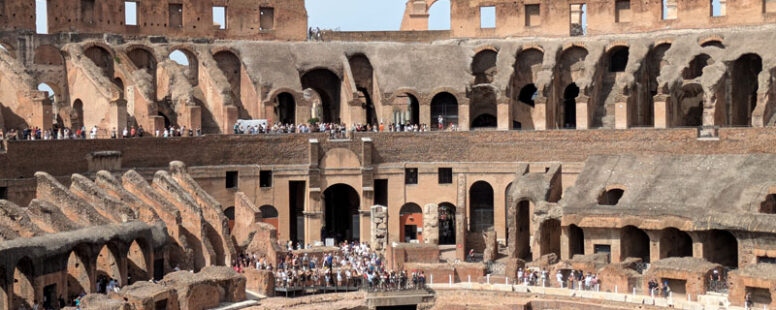
The Colosseum is an iconic ancient Roman amphitheater located in the center of Rome, Italy. Officially known as the Flavian Amphitheater, it is a renowned symbol of Imperial Rome and one of the New Seven Wonders of the World. The Colosseum was built between A.D. 70-80 under the emperors Vespasian and Titus of the Flavian dynasty. It was used for gladiatorial contests, public spectacles, animal hunts, executions, re-enactments of famous battles, and dramas based on Roman mythology.


The massive stone structure could hold an estimated 50,000 to 80,000 spectators, who were seated according to their social standing. Unlike earlier amphitheaters built into hillsides, the Colosseum is a freestanding structure made of travertine, tufa, and brick-faced Roman concrete, showcasing advanced Roman engineering. The exterior featured three stories of arches with Doric, Ionic, and Corinthian columns.
The Neronian Valley
After the fire of 64 AD the Neronian Valley changed its aspect: from having been a public space and a residential quarter, it became part of the Domus Aurea, Nero’s monumental imperial residence.
The Valley was at the center of the project, surrounded by three principal structures on the Oppian, Velian, Palatine and Caelian hills, and housed an artificial lake. According to a recently proposed reconstruction, a number of terraces descended from the slopes of the Velian hill, where the vestibule-atrium was situated, towards the artificial lake, where the Colosseum now rises. A covered way ran through the structures which formed the base of the terraces and were reserved for service rooms and passages: some remains are still visible in the flowerbed in front of the Arch of Constantine. The upper terraces were taken up by porticoes and loggias, while the base of the lower terrace presented two avant-corps at the end and a portico on the front facing the lake.
In order to carry out this magnificent project, the remains from the fire were buried and the ground level was raised by about 4 metres. Even the road axes of the Valley were changed: the east-west axis, which used to rise to the Palatine and join the via sacra at the spot where the Arch of Titus rises, was slightly corrected, provided with a portico and given a monumental entrance to the hill; the road which crossed the Valley in a north-south direction lost, by contrast, its function of connection between the southern entrance to the city and the central quarters and probably became a service road via tecta (covered way) for the various buildings of the Valley; two other routes were suppressed.
The vestibule – no longer visible today- contained the colossal bronze statue of Nero, c. 35 metres high, made by the sculptor Zenodoros on the model of the famous Colossus of Rhodes by Chares of Lindos. The statue, which is depicted on some coins, was a standing figure with the features of Nero, identified as Helios (the Sun), with rays coming from his head, the right hand perhaps leaning on a support and a globe in his left.
On the death of Nero (68 AD) the project, which was never finished, was interrupted and then abandoned, and the structures which had already been built were demolished or re-used to set up the great Flavian building-yard of the Amphitheatre.
The amphitheater, was built by the Flavian emperors in the middle of the valley where once was the stagnum neronis, the artificial squared lake in the House of Nero. It was used for gladiatorial combats, animal huntings and fights. This four storeyed building was more than 170 feet high, and more than 590 feet long. The stage – called harena – covered the underground levels where service rooms were all around it in tiers for spectators, arranged according to their social status.
The Flavian Amphitheatre
The Flavian Amphitheatre was a public building used for shows, built in accordance with the wishes of the three emperors of the Flavian dynasty, Vespasian (69-79), Titus (79-81), and Domitian (81-96), and inaugurated in 80 AD.
The exterior was distinguished by four orders of architecture, one on top of the other, today only visible in entirety on the northern side, where the building is about 50 metres high, whereas the southern part was systematically looted from the 6th century AD onwards.


The building has an oval plan with a major axis of 188 metres and a minor one of 156 metres. In the centre was the arena, a wooden platform on which the games took place, today partially reconstructed on the west side: its surface was covered in sand, arena, from which its name derives.
The seating area (cavea) could contain between 40,000. and 70,000 spectators and was subdivided into 5 horizontal sectors (maeniana) separated by corridors. The public were seated according to their social rank. Senators occupied the part nearest to the arena (podium): they sat on moveable chairs (subsellia) placed on the marble surface and unlike the other spectators, had the right to their own named seats. The next sector was reserved for the knights, and the upper ones for progressively less elevated social classes. The worst places, both for visibility and difficulty of access, were in the maenianum summum, the colonnaded portico which crowned the cavea, furnished with wooden seats reserved for the plebs. Columns and capitals from the portico are visible along the ground floor.
The Amphitheatre had 80 arches providing access, of which 76 were intended for spectators, and 4, positioned at the end of the principal axes and marked by monumental avant-corps, were reserved for the emperor, the political and religious authorities and the protagonists of the games. The imperial box was situated on the minor axis of the monument, corresponding with the southern entrance.

From the top of the Amphitheatre, the sailors from the fleet at Misenum operated a mobile structure of wood and canvas called the velum, which was used to protect the public from the sun. The masonry structures visible today in the centre of the building originally belonged to underground service areas covered by the arena floor: constructed after the inauguration of the Amphitheatre during the reign of Domitian, this was restored several times in the course of the Colosseum’s period of activity which lasted almost five centuries.

Beneath the wooden arena floor (which has largely disappeared) lies a labyrinthine network of underground tunnels and rooms, known as the hypogeum, used to house animals and gladiators before they were brought into the arena via a system of ropes and pulleys. Today, the Colosseum is Rome’s most popular tourist attraction, welcoming millions of visitors annually. Restoration efforts have been ongoing since the 1990s to preserve the monument.
City of Jerusalem Fresco
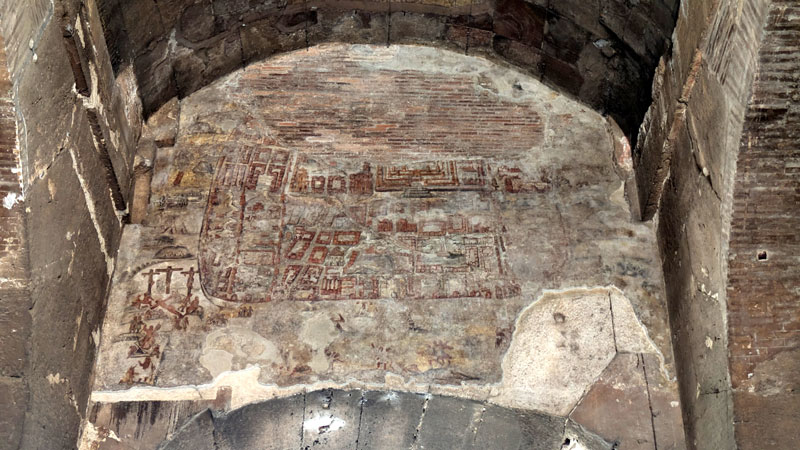
On the arch at the back is a partially preserved fresco. The painting, by an unknown artist, depicts an ideal view of the city of Jerusalem, facing towards the east and executed with a combination of horizontal projections and perspective vision.
High in the centre is the Temple of Herodes, today damaged in the upper part, distinguished by a series of turreted enclo-sures, inscribed one within the other. Inside is a multitude of buildings and blocks of houses crossed by the Cedron torrent. The presence of triple city walls along the left side of the plan indicates a synchronous vision of the city from its origins up to the age of Christ: the civitas superior or the city of David, the civitas inferior and the secunda civitas. Some military encampments disposed inside the walls and scene of combat on the lower edge of the fresco record the victories of David over the Philistines. On the lower left is the scene of the crucifixion on the hill of Golgotha. Visible, in anti-clock-wise order, are the placing of Jesus on the cross, the raising of the crosses, the deposition, and the division of the tunic; lower down, within an enclosed space, are depicted the resurrection and the apparition of the risen Christ.
The picture copies a plan of the Holy City which was commissioned by the Dutch theologian Christian van Adrichom and published for the first time in 1585 in a book describing the sacred places of the city and its history, including the stations of the via Crucis. The book, published in Cologne also had fame and diffusion at Rome, and the plan was reproduced several times
The reasons for the picture inside the Colosseum can be connected both with the sacred representations of the Passion of Christ and with which the Confraternity of Gonfalone had put up in the monument from 1490 until approximately the mid 16th century, as well as with renewed religious interest invested in the Colosseum in the 17th century which led to the consecration of the monument to Christ and the Chris- tian martyrs during the pontificate of Pope Clement X, in the jubilee year of 1675.
Thanks to the alter ego role of Christian Rome, perhaps depicted in the eastern entrance, the city of Jerusalem thus appears newly linked to the story of the Colosseum many centuries after the looting which ultimately funded its construction.
The Colosseum, a place of devotion
No certain information exists concerning the martyrdom of Christians in the Colosseum, something which also happened in buildings such as the Circus Maximus and the Circus of Nero. The only piece of evidence which can perhaps be linked to the Amphitheatre concerns bishop Ignatius of Antioch, who lived in the time of Trajan, and convicted of treason, was condemned to be torn apart by wild beasts.
Indeed, in the numerous guides to Rome from the 11th and the 14th century, the Colosseum is not recorded as a place of martyrdom, and thus the memory of its use as such had been lost.
Use of the space by religious bodies began during the Popes’ period of residence at Avignon (1309-77), when the Confraternity of SS. Salvatore assumed control of the area. In 1381 the Roman Senate assigned a third of the monument on the west side to the Confraternity, where a hospital dedicated to S. Giacomo was set up.
In 1490 Pope Innocent VIII authorized the Confraternity of Gonfalone to perform the Passion of Christ on Good Friday. These performances, which were very popular with the Roman people, took place at irregular intervals until 1539 banned them on account of disorderliness, a ban which was reasserted in 1561 by Pius IV. Meanwhile, in 1519, in the area where the sacred performances were staged, a chapel was built, dedicated to S. Maria della Pietà, which is still standing and in use.
The idea of the Colosseum as a place of martyrdom spread in the popular imagination in the course of the 17th century. During the Jubilee year of 1675, Clement X, thanks to the letters of father Carlo Tomasi, consecrated the monument to the Passion of Christ and the Martyrs. There was also a suggestion that a church might be built in the centre of the arena, dedicated to the Martyrs: Gian Lorenzo Bernini and later Carlo Fontana worked on the project, but it was never built.

With the collaboration of San Leonardo da Porto Maurizio, a supporter of the devotional practices of the people, Benedict XIV inaugurated the celebrations of the via Crucis by the Pope in the course of the Jubilee of 1750: the 14 shrines built around the arena some years previously were restored, while a cross was place in the centre. A little later, plenary indulgence was established for anyone present at the rite. After the excavations of 1874, the shrines were dismantled.

Overlooking the area is a modern cross in front of which the Pope stops, when he completes the via Crucis each Good Friday, which nowadays involves the first 4 stages inside the monument and the subsequent ones outside, ending up on the terrace of the temple of Venus and Rome.

Cleaning was being carried out on the travertine arches of the first ambulatory at the time of our visit. Dust of all kinds was deposited on these surfaces for centuries, produced by traffic, atmospheric pollution, or residues from activities taking place since the middle ages in these areas, used as shelters, storerooms, and stables (fig. 1). Travertine surfaces are cleaned with water spray only with droplets that dissolve the surface dust (fig. 2) Beneath the layer of dirt the stone is in excellent condition.


Entering into the open and the seating area, the Colosseum took on an entirely new and different character. Passages provided access to the different seating sections. Scenographic views of the entire amphitheater opened.


Typical barrel vaulted passages. Some wider and some narrow to accommodate different flows of people to different sections.

Less common groin vaults in the Colosseum on lower levels where barrel vaults meet.


Brick vaulting springing from travertine blocks. In another section the brick vaulting overhead has entirely been lost, with only the rough travertine blocks remaining.

Fragments on display in an exhibit case on the upper level. At one time the Colosseum was covered in decorations like this.

As we were preparing to leave, modern day workers were laying stone near the exit to create a flat and accessible approach to the building.