
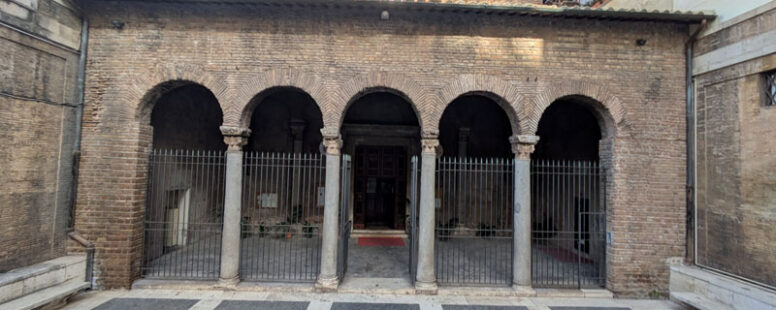
Basilica di San Vitale al Quirinale – Rome, Italy


The Basilica of San Vitale (Basilica dei Santi Vitale e Compagni Martiri in Fovea) is a very ancient church located on the Via Nazionale.

The ceiling is a modern, flat, coffered ceiling made of varnished wood. It was installed relatively recently in 1938 as part of a significant restoration of the basilica. The ceiling features painted and gilded decoration within its coffers. The central panel, partially visible in the image, is designed to feature a portrait of the church’s patrons. The basilica’s interior is notable for having a single nave, with walls covered entirely in 17th-century frescoes that depict the martyrdoms of various saints.
The church’s location is unique because the modern Via Nazionale was built in the late 19th century, leaving the original ground level of the basilica significantly lower than the surrounding city. A staircase is required to access the entrance.

The original portico from the 5th century is preserved, but the ground level of the church is now several meters below the current street level of Rome’s Via Nazionale.
The portico with five arches and ancient columns seen in the image is the most ancient part of the church, possibly dating back to the 5th century. The basilica was founded around 400 AD by a wealthy widow named Vestina and was consecrated by Pope Innocent I in 401/402 AD.
It has undergone several major restorations over the centuries. A significant one occurred before the Jubilee of 1475 under Pope Sixtus IV, which reduced the original three naves to a single nave. While the exterior is simple, the interior is extensively covered in 17th-century frescoes depicting the martyrdoms of various saints, including St. Vitale and his family.


This painting is in an altarpiece located in the Basilica di San Vitale (Basilica of Saints Vitalis, Valeria, Gervase and Protase in Fovea) in Rome, Italy. The altarpiece is a work attributed to the Jesuit artist and sculptor Giovanni Battista Fiammeri (1530-1606), painted around the year 1550. The painting depicts the Immaculate Conception of Our Lady, with the Virgin Mary surrounded by angels and various symbols associated with her purity. The artwork incorporates several symbolic elements: the mirror symbolizes the speculum iustitiae (mirror of justice), the rose bush represents the rosa mystica (mystical rose), the door is the porta caeli (gate of heaven), a small caravel (ship) is depicted at the bottom, an unusual element that some believe references the ships used by Spanish missionaries returning from Mexico with news of the apparitions of Our Lady of Guadalupe.

The Altar of the Crucifix, is the second altar on the left side of the church’s single nave. The altar is constructed of red and white marble, with the striking circular opening in the front a key design feature. This specific style of altar matches the one opposite it in the church. The wooden crucifix stands above a framed background of patterned marble panels.


“Torture of Saint Vitalis on the Rack”, was painted by the artist Agostino Ciampelli (1595 ca.). The fresco illustrates the martyrdom of Saint Vitalis, who was tortured on a rack. The painting is characteristic of the late Mannerism style, known for its light colors and decorative quality, even when depicting gruesome subjects like martyrdom. The fresco is one of many similar large paintings that cover the walls of the church’s single nave, all depicting various martyrdom scenes of saints. The depiction of the rack was particularly impactful for viewers in 1600, as it was an instrument routinely used by Roman prosecutors at the time, reminding them of contemporary trials and executions.