

Spanish Steps – Rome, Italy

This historical image is an 18th-century copperplate etching titled “Scalinata in Piazza di Spagna”, created by the famous Italian engraver and architect Giuseppe Vasi around 1740–1752. It was published as part of his monumental ten-volume work, Delle magnificenze di Roma antica e moderna.

The Fontana della Barcaccia sits at the foot of the iconic Spanish Steps in the heart of Piazza di Spagna. Sculpted between 1627 and 1629 by Pietro Bernini and his legendary son, Gian Lorenzo Bernini, the fountain takes the shape of a half-sunken ship. Its name literally translates to “Fountain of the Ugly Boat”. The low placement of the boat was a brilliant engineering solution. The water pressure from the ancient Acqua Vergine aqueduct was too low to create dramatic vertical sprays. Instead, water elegantly overflows its sides into a surrounding basin. Directly behind the fountain is Europe’s widest staircase, featuring 135 travertine steps leading up to the 16th-century Trinità dei Monti church.

Fontana della Barcaccia in Piazza di Spagna, looking eastward into the square rather than up toward the steps. In the far center background, you can see the Column of the Immaculate Conception (Colonna dell’Immacolata Concezione), topped by a bronze statue of the Virgin Mary. The right side of the frame showcases classic Roman buildings featuring traditional scaffolding, commonly seen during ongoing historic restoration projects across the city. The foreground highlights the fountain’s massive stone basin lip, a popular gathering spot where tourists and locals sit to enjoy the night air.
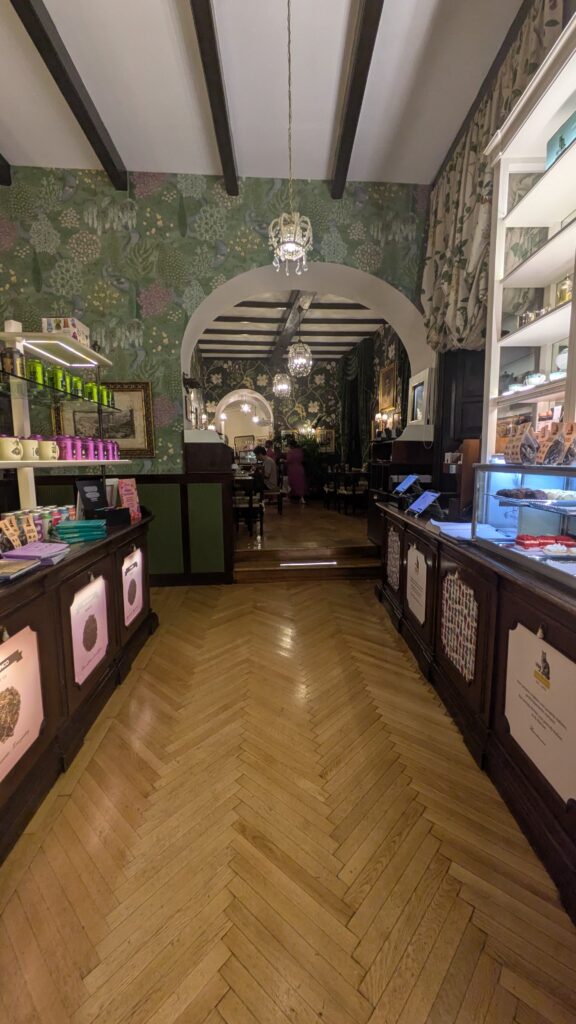
At the foot of the steps is Babbingtons, a tea house dating to 1893. Immediately upon walking in the retail space is vibrant and colorful. Herringbone wood floor pattern pulls you forward and exudes feelings of warmth.


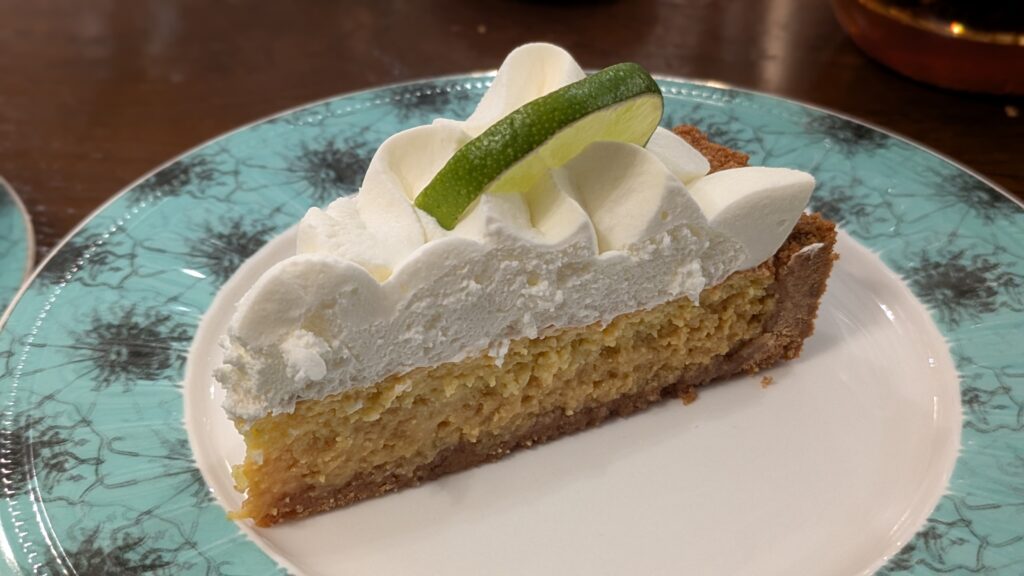
Tea is the star and has a unique all glass service. After a few minutes the glass strainer can be taken out. We opted for some bites that made a nice late night snack. Baking is done on site and is evident. We had the biscuit with ham and cheese, and the lemon curd pie.

As we departed Babbingtons, the carefully curated display area caught our eye. Each of the bags represents a tea themed after Rome. A small number of other carefully curated articles that can easily be placed in a bag for a flight, give customers an opportunity to add to their order or just to drop in to by a quick gift.

A few steps up from the fountain reveals the sweeping curves of the Spanish Steps (Scalinata di Trinità dei Monti), looking halfway up the monumental staircase. This perspective beautifully emphasizes the theatrical, alternating convex and concave curves designed by architect Francesco de Sanctis between 1723 and 1725. The unique terraced design allows the massive stone structure to blend organically into the steep hillside slopes. In the upper right corner is the the peach-colored building lit up by a streetlamp is the historic building where the legendary English Romantic poet John Keats lived and spent his final days, passing away there in 1821. Today, it operates as the Keats-Shelley House museum.
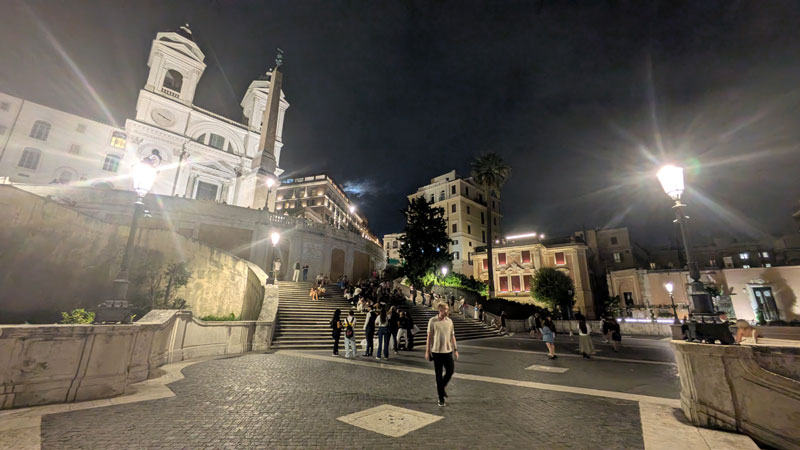
Several more steps up is the central landing toward the Trinità dei Monti church and the illuminated Sallustiano Obelisk at the top. Unlike Rome’s massive ancient Egyptian obelisks, this one is a Roman copy carved in the late 2nd or early 3rd century AD for the Gardens of Sallust. It was moved to its prominent position atop the steps in 1789. The Renaissance church looming above features distinctive twin bell towers, creating one of the most recognizable city skylines in the world.

Looking straight down from the upper tiers of the Spanish Steps, offers a panoramic view of Piazza di Spagna and the beginning of Rome’s premier luxury shopping street, Via dei Condotti, extending directly into the background. The brightly lit corridor splitting the buildings in the center background is Via dei Condotti. It is famously home to flagship haute couture boutiques like Armani, Bulgari, and Prada. The building immediately to the left is the Keats-Shelley House, while the building on the right houses the historic Babington’s Tea Room, which has been serving English tea at the foot of the steps since 1893.

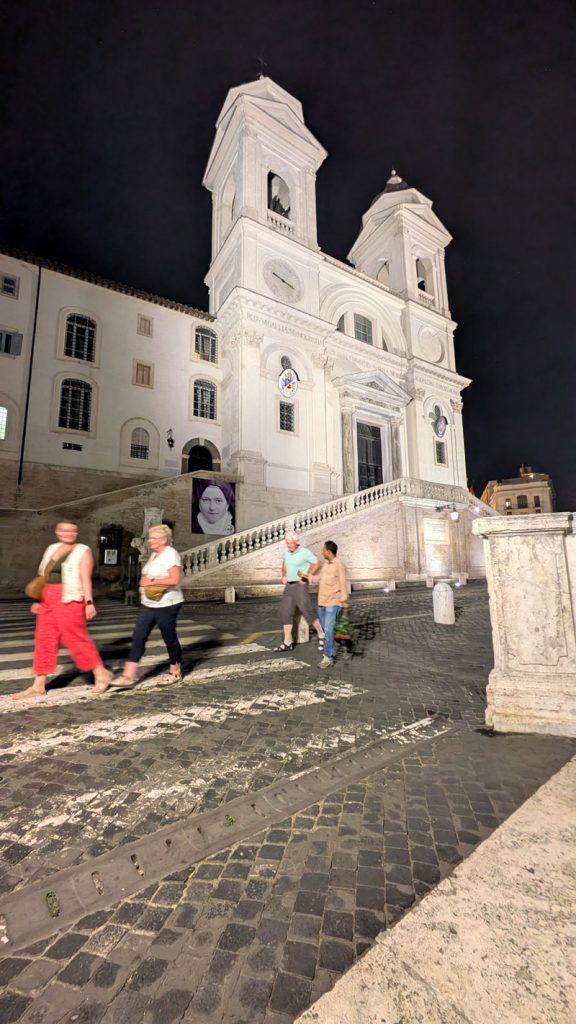
One final close up view of the obelisk at the top of the steps puts into perspective the scale and size of the steps. The same obelisk is barely discernible at the base, but is towering at the top.