
Metropolitan Opera – New York City, New York

The iconic Lincoln Center for the Performing Arts complex located on the Upper West Side of Manhattan in New York City. The three major buildings framing the central courtyard (Josie Robertson Plaza) are:
- Center: The Metropolitan Opera House, easily recognizable by its five grand architectural arches and signature crystal chandeliers hanging inside.
- Left: David Geffen Hall, home to the New York Philharmonic.
- Right: The David H. Koch Theater, home to the New York City Ballet.
The night of our visit, Modest Mussorgsky’s opera Boris Godunov was playing at the Metropolitan Opera on October 17, 2021. This performance was the closing night of the production’s run of the original 1869 version.
Performance Details
- Opera: Boris Godunov by Modest Mussorgsky (Original 1869 version)
- Date & Time: Sunday, October 17, 2021 (Matinee performance)
- Key Cast & Crew: Headlined by bass René Pape as Tsar Boris, with conductor Sebastian Weigle and director Stephen Wadsworth
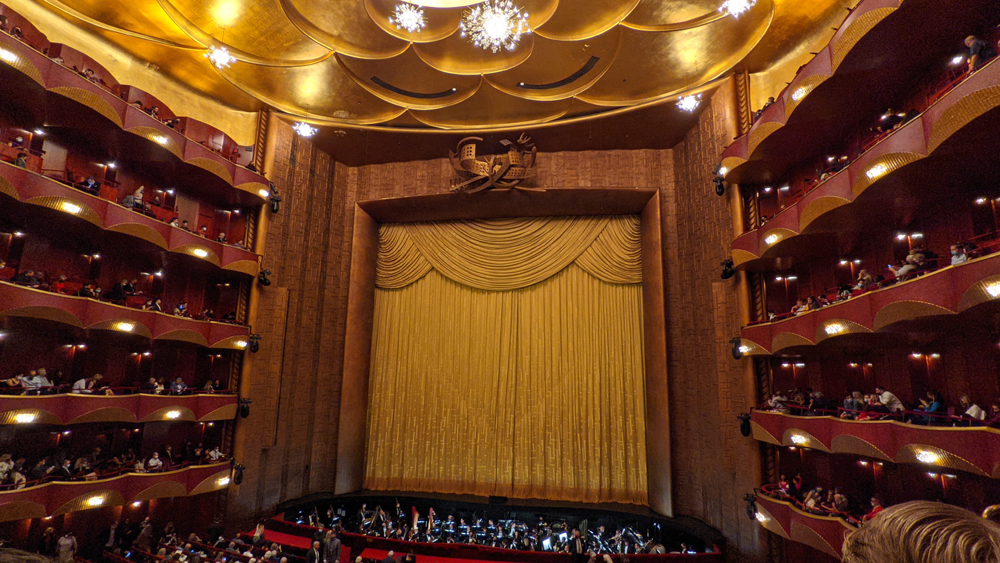
The Metropolitan Opera House auditorium at Lincoln Center has a scalloped, gold-leafed ceiling that resembles an open flower or concentric waves radiating from the center. The massive, custom-woven gold damask curtain is one of the largest theater curtains in the world. At the bottom, musicians can be seen tuning up and getting into position ahead of the show.

Visible near the top, these iconic “starburst” Swarovski Crystal Chandeliers chandeliers are designed to rise toward the ceiling right before the performance begins to unblock the audience’s view. The chandelier measures approximately 18 feet in diameter (about 5.5 meters). Created by Hans Harald Rath of J. & L. Lobmeyr in Vienna. Presented as an official gift from Austria to the United States. Contains thousands of Swarovski crystal bursts.
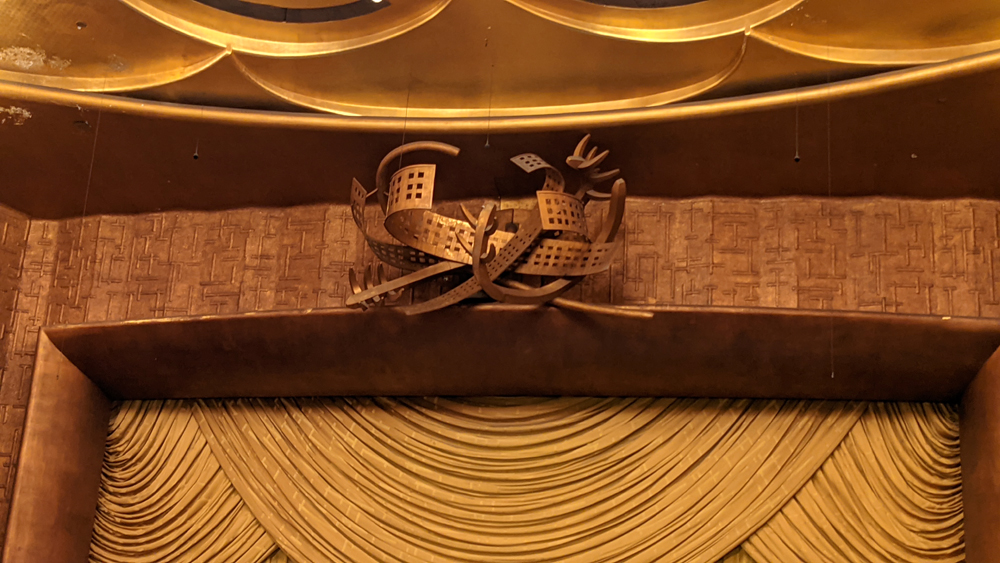
The abstract bronze artwork hanging directly above the stage’s proscenium arch is an untitled sculpture by American artist Mary Callery. Commissioned by the theater’s architect, Wallace Harrison, it is officially described as “an untitled ensemble of bronze forms creating a bouquet of sculptured arabesques”. Mary Callery was a prominent Abstract Expressionist sculptor who spent a decade working closely in Paris with legendary artists like Pablo Picasso, Henri Matisse, and Fernand Léger. Despite its elegant description, members of the Metropolitan Opera Company and theater insiders affectionately refer to the complex shape as “The Car Wreck”. Less frequently, it is called “Spaghetti Spoon in Congress with Plumbers Strap”.
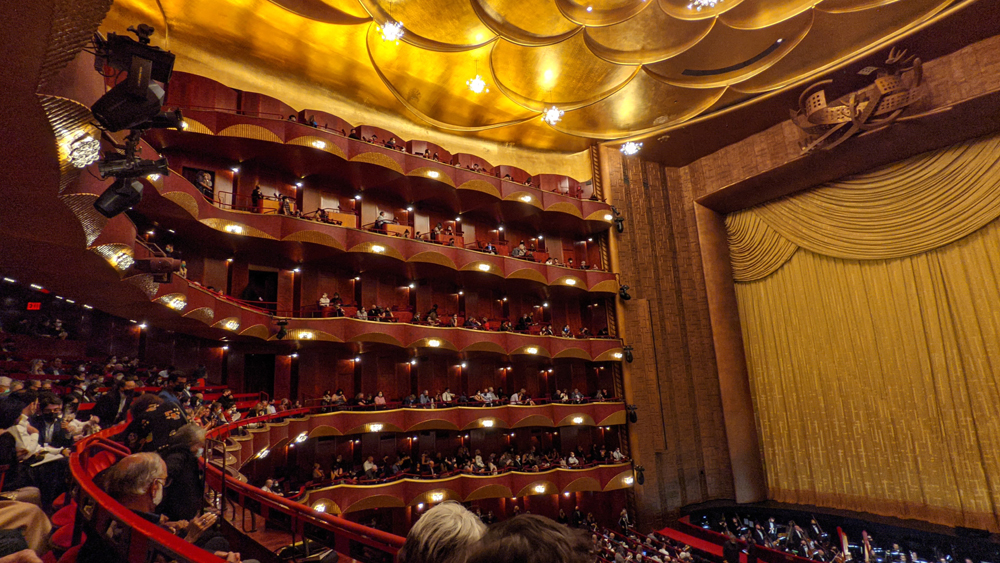
The Metropolitan Opera House features six distinct seating levels configured in a horseshoe layout to optimize acoustics and sightlines. From bottom to top, the levels are structured as follows: [1, 2]
| Seating Level | Description |
|---|---|
| 1. Orchestra | The main floor layout, sloping gently upward toward the rear. |
| 2. Parterre | The lowest tier of private boxes, highly exclusive and wrapping around the orchestra. |
| 3. Grand Tier | Widely considered to have the premier acoustics and visibility in the theater. |
| 4. Dress Circle | A mid-level tier balancing a commanding stage view with excellent sound dynamics. |
| 5. Balcony | The second-highest tier, offering a distant but panoramic view of the entire house. |
| 6. Family Circle | The topmost level, providing the most budget-friendly seats and a steep view. |
The entire auditorium can accommodate nearly 4,000 patrons for a single performance

The iconic grand lobby staircase of the Metropolitan Opera House is a cantilevered, terrazzo-faced staircase with no visible supports. It curves upward seamlessly to link the lower plaza lobby to the main Grand Tier level. Like the ones inside the auditorium, these lobby “starbust” chandeliers are part of the original gift from Austria. While hidden from this angle behind the upper balconies, the lobby walls house two massive, famous murals by artist Marc Chagall (The Sources of Music and The Triumph of Music).
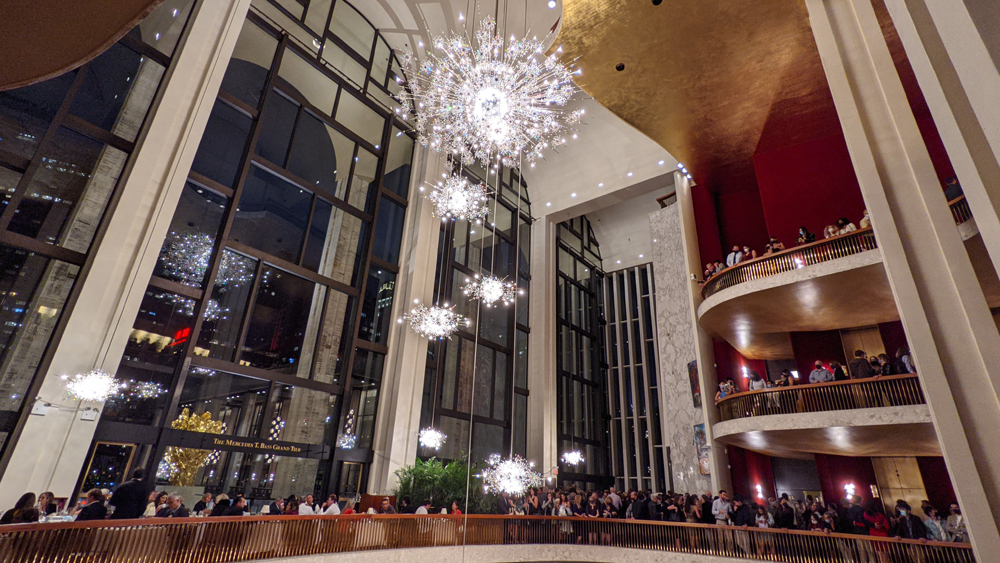
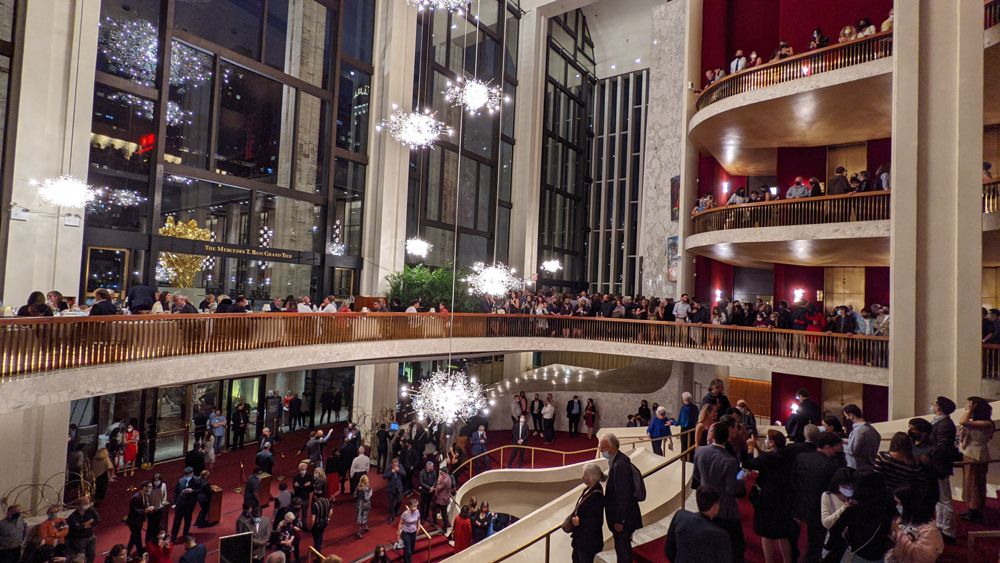
This vantage point looks out over the bustling main lobby from the upper level of the Metropolitan Opera House grand staircase. The prominent balcony terrace on the left houses the elegant The Mercedes T. Bass Grand Tier restaurant and bar area, where patrons gather for pre-show and intermission refreshments. The massive 71-foot-tall glass bays face directly onto Lincoln Center’s Josie Robertson Plaza, looking out toward Manhattan.

That striking gilded piece behind you is “Constellation of Voices,” a monumental sculpture by contemporary American artist George Condo. Installed on the outdoor terrace balcony of the Metropolitan Opera House, this 11-foot-tall abstract sculpture is cast in aluminum and leafed entirely in brilliant 24-karat gold. George Condo created the piece to resemble a “constellation of voices,” serving as a metaphor for a diverse community of individuals coming together to be heard. Its highly textured, fragmented surface evokes abstract human facial profiles and classical deities. The sculpture was purposely designed to catch and reflect New York City’s night lights, gleaming like a beacon of light directly above Lincoln Center’s main plaza.