“These are they who arranged the settlementfrom which we are sprung. Little except anxiety, toil and financial loss cameto them from it. But they were honoruable men: they played a conspicuous part in the great events of a great time, and wrought for that liberty under law which both England and America today enjoy. It is fittingthat we should remember and give thanks for them.”
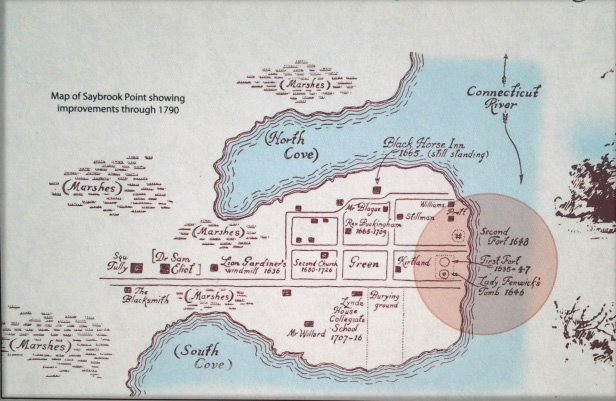
At the mouth of the Connecticut River stood the first English for in the colony of Connecticut built in 1635. It was destroyed by fire in 1647. Beyond it, on the bank of the river stood a secondfort built in 1648. The earthworks of this fort were demolished in 1870.
Efforts to improve navigation along the Connecticut River date backto 1773 when the legislature approved a lottery for marking the Saybrook bar. Today the Army Corps of Engineers maintains a 15-footchannel. For three centuries the river served as a ready-made highway for trade and travel. Ferry service between Saybrook and Lyme began in 1662. Shipbuilding along the river was once a major industry, accounting for over 1,000 vessels. By 1824, there was regular steamboat service between Hartford and New York. The eight-town Gateway Commission protects the estuary as far as 17 miles upstream by means of a conservationzone.
Panoramic photo of the Fort Saybrook Monument Park.
English Efforts at Settlement
The Earl of Warwick, President of the Council for New England, received from King James I, the righttosettle the areafrom Narragansett Riverto the Pacific. In 1631 he conveyed the Patent to 15 Puritan Lords and Gentlemen for refuge in case the Puritan Revolution failed and King Charles I was restored to the throne. Three leading Patentees were William Flenner, Lord Brooke, and Colonel George Fenwick.
John Winthrop, Jr., son of the Governor of Massachusetts, was commissioned Governor of the River Colony by Patentees. He arrived in Boston in October, 1635 and learned that the Dutch were planningto occupy the mouth of the river. So he dispatched a smallbarkwith 20 carpenters and other workmen under Lieutenant Edward Gibbons and Sergeant Simon Willard to the mouth of the river with directions totake possession of the place and raise a building.
They landed November 24, 1635, and tore down the Dutch Coat of Arms and mounted a shield on which the painted a grinning face. In a few days a Dutchship approached but when they saw the soldiers and twowell-placed cannon they withdrew. Winthrop changed the name of the pointto Sayebrooke in honor of Viscount Saye and Sele (William Fiennes) and Lord Brooke.
Gardiner designed a fort at Saybrook in the European tradition as a square, palisaded fortification containing several structures, surrounded by an earthen embankement and moat. A movable drawbridge crossed the moat at the entrance on the western side. Cannon platforms were placed in each corner. The fort was well positioned toguard against an attack from upriver orfromLong Island Sound. Its cannon could fire a mile away as far as Poverty Point on the opposite side of the river.
The English settlers found it impossible to pacify the Pequots, who in 1633 murdered a party of nine Englishmen at the mouth of the River. After Fort Saybrook was built, three hundred Pequot warriors constantly harassed the Fort, wounded Lion Gardiner, butchered livestock and burned storehouses and haystacks outside of the palisade. In May 1637, the Hartford and Saybrook colonies declared war on the Pequots. Aforce of ninety men under Captain John Mason was joined by Uncas, a renegade Pequot chieftain and his braves. They launched an attack by seafrom Fort Saybrook and destroyed the Pequots’ main encampment near Groton. Following his service in the Pequot War Captain Mason was named the second Commander of the Fort.
When Gardiner’s contract expired in 1639, he bought the island between the north and south forks of Long Island, thatlater became known as Gardiner’s Island. Gardiner himself died in Easthampton, New York.
George Fenwick, who was the only Warwick Patentee tosettle in Saybrook, arrived here in 1639 to become its second Governor and to replace Lion Gardiner. With his wife and son, two sisters and servants, he took up residence in the great hall within the fort. Lady Alice Fenwick was a lovely auburn-haired widow of a nobleman. Governor Fenwick sold the Saybrook Colony to Hartford in 1644. The terms were an annual payment to him of 180 pounts – one-third in good wheat, one-third in peas, and one-third in rye or barley. The Saybrook seal eventually became the official seal of the State of Connecticut.
Lady Fenwick died in 1648. She was the daughter of Sir Edward and Lady Elizabeth Apsley, the widow of Sir John Boltier, and wife of George Fenwick who was the Governor of Saybrook Colony from 1639 to 1644. The brownstonemonumentover her grave was made by Mathew Griswold, a stonecutter. In return for agreeing that his family would perpetually care for the grave, Griswold received a large gift of land across the Connecticut River in Old Lyme. Lady Fenwick was moved to the Cypress Cemetery when the railroad was built in 1870.
In 1647, Gardiner’s fort burned to the ground, and a new, less elaborate fort was built nearer the river. George Fenwick returned to England the next year and died March 15, 1657.
Panoramic shot showing the originalsite of Yale University, founded in 1701.
Yale College was founded on this storied peninsula in 1701. This makes Yale the third-oldest institution of higher education in the United States, after New College (later Harvard University) that was founded in 1636, and The College of William & Marythat was founded in 1693. Later the college pulled up roots and relocated to New Haven, leaving their original campus behind.
Coming of the Railroad to Saybrook
The Connecticut Valley Railroad obtained their State Charter on July 17, 1868. Surveys for the route along the Connecticut Riverfrom Hartford to Saybrook Point were completed in 1869. Track construction followed and was completed in the summer of 1871. The early earthworkfortifications at Saybrook Point were leveled during the construction of a turntable, a roundhouse, and railroad yards at the Point. The first ceremonial train traveled forty-five miles from Saybrook to Hartford on July 29, 1871.
In 1882, the Valley Railroad was acquired by the New Haven Railroad. Five trains daily provided service each way between Saybrook and Hartford withrunning times of twoto three hours. Service was terminated in 1922 on the tracks from Saybrook Junction to Saybrook Point.
Prior to the construction of a railroadbridge in 1862 and an automobile bridge in 1911, ferries provided the only passenger servicefrom Saybrook across the Connecticut River. The ferry was chartered in 1662 by the General Court at Harford. John Whittlesey and his brother-in-law William Dudley were the first ferrymen, a business that the two families maintained for several generations. When the railroad opened in 1872, the ferry SHAMPISHUE carried the railroad cars across the River. By 1888, the steam-powered LADY FENWICK had replaced the old sail-bearing ferries. The COLONIAL was the last Saybrook ferry tocross the Connecticut River and made her final run in 1911.
The Monument and Memorialization Phase
The heirs of Alfred E. Wolcott purchased the land where Yale College got its start and donated this to the Town of Old Saybrook on April 1914 with the stipulation that it never by used for burials.
Stones commemorating the site of Yale College, 1701, later Yale University.
Fort Saybrook Monument Park consists of nearly 18 acres, about eleven of which are marshland. The park adjoins the mouth of the Connecticut River, a major New England estuary and tidal river. It has been recognized by an international convention as globally significant and contains one of the least developed ordisturbed large-river tidal marsh systems in the U.S., and the most pristine large-river tidal marsh system in the Northeast. The lower Connecticut River has been identified by the Nature Conservancy as one of the 40 Last Great Places in the Northern Hemisphere. This site has great ecological, historical and cultural significance and is presently maintained by the Fort Saybrook Monument Park Association. Fort Saybrook Monument Park offers a rare opportunity for all visitors to learn about the rich and varied past of this important place in the world.
If anything the park suffers from its relative anonymity being just far enough off the beaten pathto be overlooked and lacking clear directional signs to attract visitors there. Secondly, the many interpretive markers withoverlappingcontent and themes, make it challenging for visitors to fully grasp the significance of the site and what it is all about. Lastly, complex stories such as the Pequot War and the struggle between the English, Native Americans, and Dutch for control of this area, go largely untold. This site has amazing significance on many levels from the 17th century forward. Hopefully thoughtful efforts will be made to give this important site its rightful place among similar attractions liningLong Island Sound.