

Visit to South Street Seaport – New York City, New York
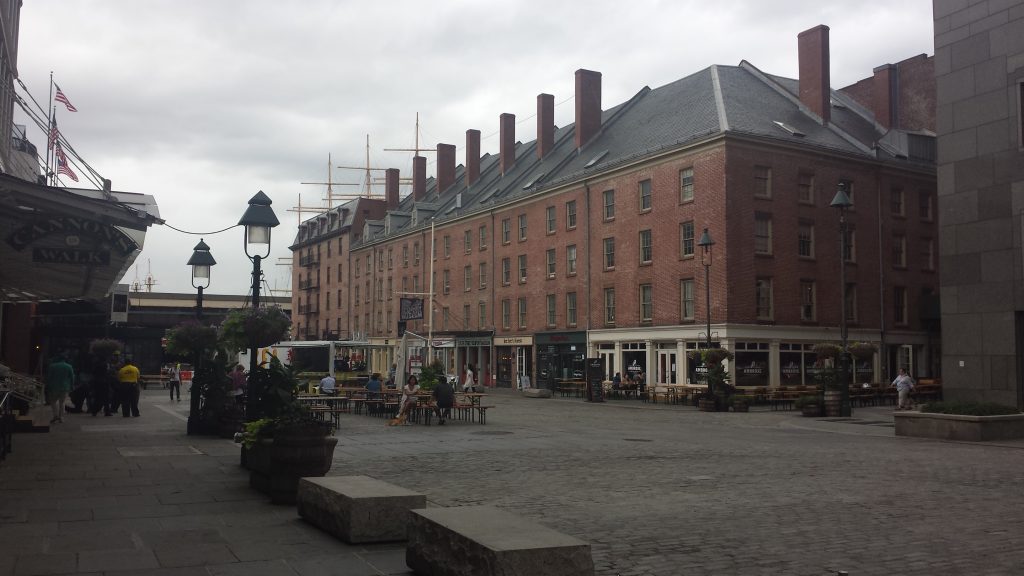
This waterfront district with distinctive multi-story brick buildings with hipped roofs and chimneys. Connecting them are ample public spaces made that much more enjoyable by the near total elimination of automobiles.


Wayfinding helps to orient and navigate people through the district. Nine city blocks and several piers anchor this neighborhood.

Shipping container scaled temporary buildings help to activate the public spaces with food and drink businesses. The Seaport Smorgasburg is one of several.


Garnet Hill is a mobile boutique that is heavy on design and light on marketable and salable merchandise and product. Creating a welcoming place is the strategy to build awareness of this brand.


In one of the street level storefronts is Kikkerland Pop-up Shop. This activates a vacant storefront and makes product available for purchase in the lead up to the holiday shopping season.


The freestanding pergola structure with lush greenery gives a green oasis in the city, much like the beer gardens in Philadelphia.

Movable tables and benches provide additional opportunities for people to informally socially gather in the South Street Seaport neighborhood.


This circular plaza has movable furniture. It also provides a buffer or edge between the busy street and historic buildings nearby.


The evening of September 6, 2016, a talk was given on tactical urbanism to a small group of fewer than 40 people.
History is the backdrop for this vibrant and innovative district:

- 21-25 Fulton Street. Late examples of Greek Revival-style stores – built in 1845-46 for merchant George W. Rogers – have the traditional trabeated granite storefronts, with their posts and lintels more massive than those found in decade-earlier examples around the corner at 207-209 Water Street. The commonly used Greek Revival device of small, square, top-story windows gives the impression that the buildings are taller than they really are.
- 206 Front Street. Built in the late 1790s and remodeled a century later, No. 206 Front Street was the location of the Howell family businesses for well over 100 years. It first served as a grocery, providing staples such as flour, sugar, and spirits to customers who bought fresh produce at the Fulton Market. It later house the Howell’s famous military store, one of New York’s leading suppliers of guns and gunpowder at the turn of the century.
- Cannon’s Walk. This tiny court enclosed by 19th- and 20th-century buildings marks the location of John Cannon’s wharf in the mid-18th century. Cannon, born of Huguenot parents on Staten Island in 1670, filled the land to Water Street by 1721, and his dock remained one of the most active of the northern range of Manhattan wharfs through the second half of the 18th century. The wharf was incorporated in further landfill before 1790, and mercantile buildings were constructed on the newly made land. John Cannon’s grandson was Peter Schermerhorn, who filled land to build the row bearing his name just south of here a century after his grandfather had filled land to build Cannon’s wharf.


The Seaport Museum and historic buildings further reinforce a historic sense of place.