Strong Towns Talk – Huntington, West Virginia
During our Better Block Middlesborough event with Mike Lydon in October 2013, he suggested I look up Chuck Marohn with Strong Towns. I saw he was speaking in Huntington a few weeks later, so I took off on a 400 mile plus road trip to see him.
My first stop in Huntington was with the Tri-State Community Foundation. Previously I had become familiar with their work through the Appalachian Rural Development Philanthropy Initiative. They had an extensive track record of success serving communities of Ohio, Kentucky, and West Virginia.

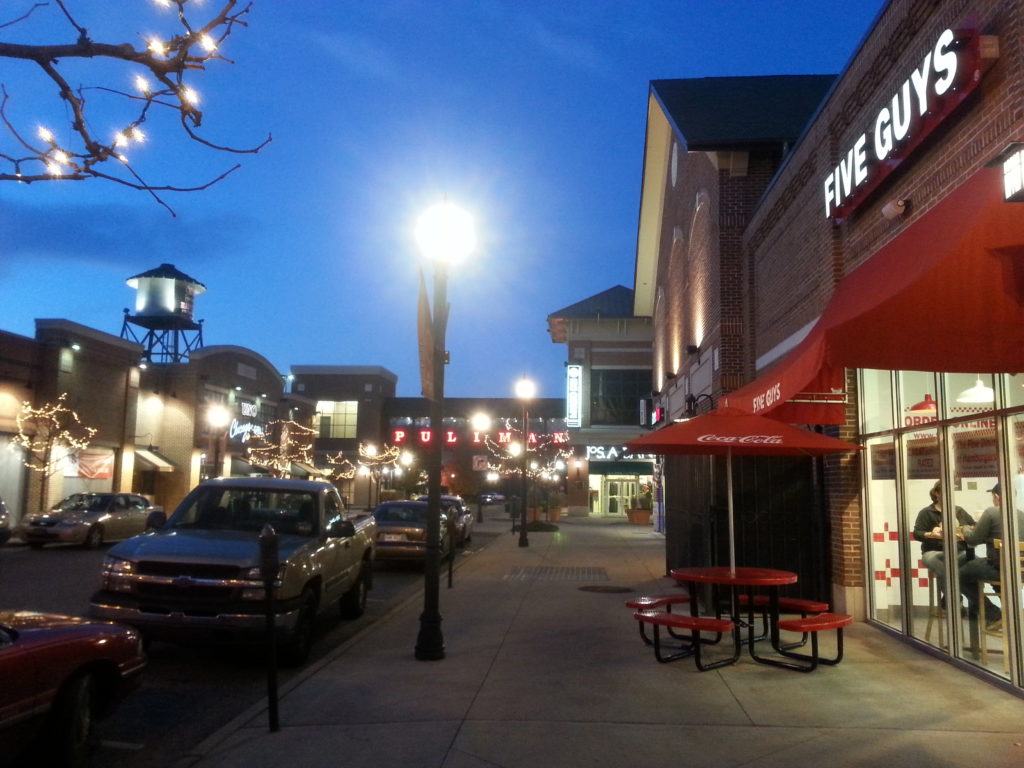
From there I did a quick tour of town. Pullman Square stood out as a walkable type of District. Mostly it was dominated by chains and franchises. After taking a few pictures I looked out for some local dining options.



Jim’s Steak and Spaghetti House at 920 5th Ave was what I found. The meal was memorable if for nothing else learning how President John F. Kennedy once dined here. From there it was a quick walk to Chuck’s talk. Early on he set the tone about the need for high return investments, juxtaposing big box stores with traditional downtown areas. By the numbers he was able to show how downtowns generated more property taxes per acre, support more residents, and have more jobs.

Pulling on the work of Joe Minnicozzi from Asheville, next he was able to show the total value per acre of property and how this was also concentrated in traditional downtown acres. The creative illustration with bar charts overlaid on an aerial map is below.

This led Chuck to the observation that we need to measure the public’s REAL return on investment for all of the infrastructure needed to support new development. He made a point of the need to account for the second life cycle costs after a property is initially developed. Basically Chuck made the case for whether public investment can ever be paid off. For new development he concluded it cannot, and this is what he refers to as the Ponzi Scheme of Development.
As an alternative to big box projects on the periphery of cities, Chuck advanced ideas for how to foster local innovation. One of his concepts was how innovation that happens from the top-down tends to be orderly but dumb. In comparison innovation that happens from the bottom-up tends to be chaotic but smart. Then he showed an example from his hometown of Brainerd, Minnesota, where Strong Towns is based. Their they had a “Neighborhoods First” plan and report for how to carry out low-cost short-term interventions to make places perform better.
Chuck concluded by sharing these big concepts:
- The current path cities are on is not financially stable.
- The future for most cities is not going to resemble the recent past.
- The main determinant of future prosperity for cities will be the ability of local leaders to transform their communities.
What was refreshing about the talk overall is how control sought to be put back in the hands of local leaders, especially those willing to incorporate Strong Towns thinking into policy making. Doing so favors investing in the center rather than new development in outlying areas. Further, this development would tend to be incremental rather than a silver-bullet approach like a stadium, aquarium, or whatever the latest big fix fad is.
That evening following the talk we had a nice discussion. As I walked back to my hotel I admired both the attractive historic buildings that were repurposed for contemporary uses, and some of the sensitive infill that brought vitality to the street life.


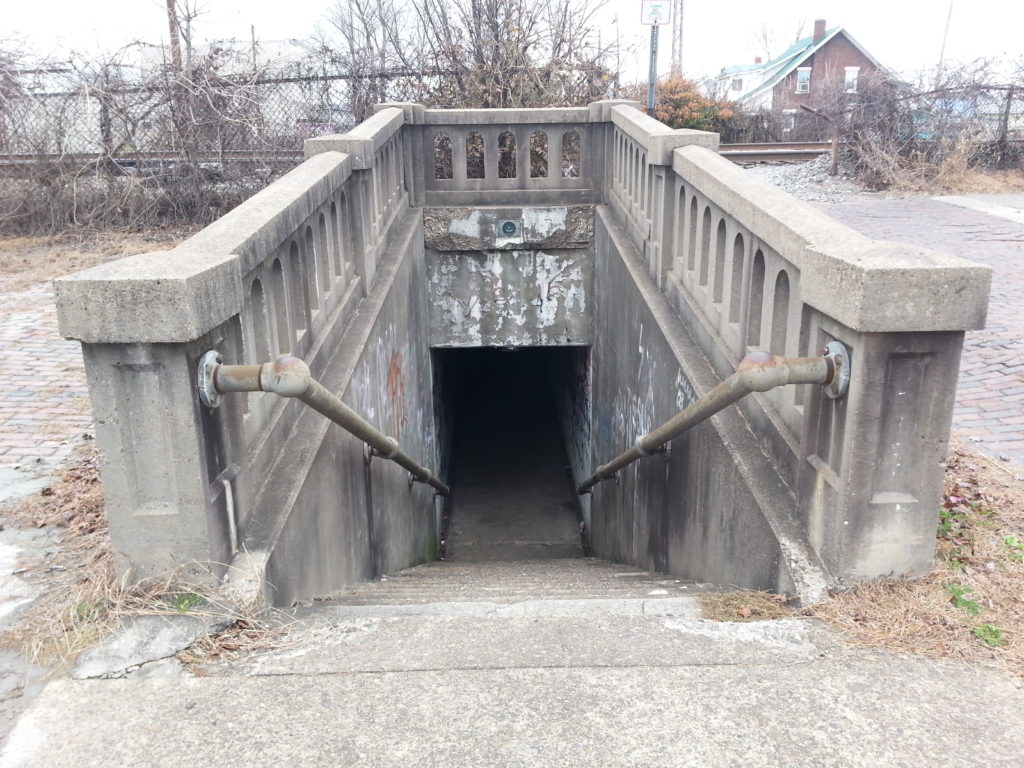
The following morning I connected with Chuck and did a quick driving tour. While we saw several neighborhoods throughout Huntington, a few observations left a bigger impression than others. The Applebee’s at 1135 3rd Ave was an example of the typical suburban development that Chuck criticized. This restaurant was transplanted in the city center as a single-use building with no residential component and extensive parking. Clearly this model if carried out to its extreme would make the downtown area it is in untenable. The other site that grabbed my attention was an underpass and tunnel near the railway constructed by the WPA in 1937. Though somewhat worse for wear, this piece of infrastructure has been creating and returning value to Huntington from the time it was built by supporting pedestrian activity and circulation. This type of thoughtful public investment reinforced and strengthened the city, rather than sapping its energy economically, fiscally, or from an urban design perspective with incompatible design. If the Strong Town message is heard we want more of these WPA styled investments from the public sector than those that underwrite the type of development that does not promote a vibrant civic, social, and economic life.