

Visit to the Metropolitan Museum of Art – New York City, New York
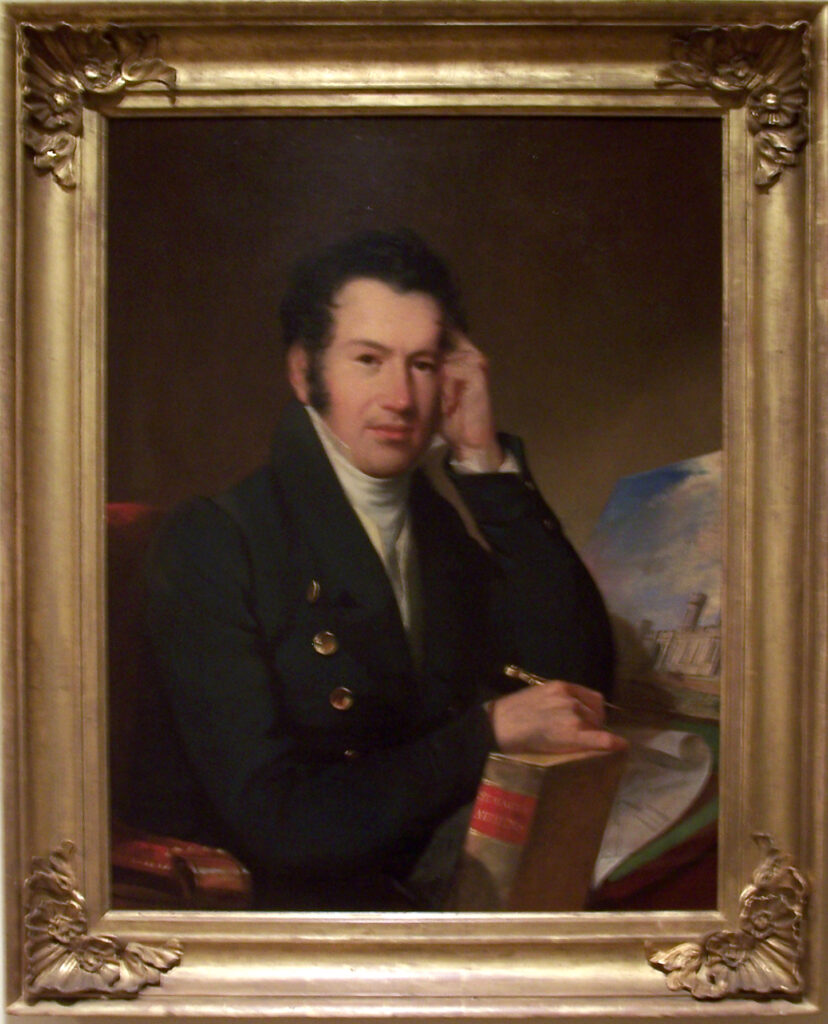
John Haviland (1792-1852) was one of Philadelphia’s leading architects, responsible for a number of important monuments of American architecture, including the Deaf and Dumb Institute, 1824-1825, and the New York Hall of Justice (the Tombs), 1835-38. Painter John Neagle shows Haviland sitting in front of a drawing of his best known building, the neo-Gothic Eastern State Penitentiary in Philadelphia, 1823-29, which was under construction at the time.

This Diana is a half-size model of a 13-foot finial once installed on the tower of the original Madison Square Garden. The architect, Standford White, designed the Garden’s tower after the Giralda, the tower that adjoins the Cathedral of Seville in Spain. Diana remained on the tower until Madison Square Garden was demolished in 1925. The full-size sculpture was presented to the Philadelphia Museum of Art in 1932. The sculpture had billowing drapery to allow the figure to rotate in the window. Gusts proved too strong and eventually the drapery on one version below off and the statue was bolted in place. After the second version of Diana was installed, Saint-Gaudens capitalized on the successful redesign by producing reproductions, without the original flowing draperies.

The Angel of Death and the Sculptor from the Milmore Memorial by Daniel Chester French was executed in marble after a bronze of 1889-1893. This is one of the most creative and moving funerary monuments executed during the late nineteenth century. The original bronze relief, cast in Paris, marks the Milmore family plot in Forest Hills Cemetery in Jamaica Plain, Massachusetts. The memorial represents Death interrupting the activity of Martin Milmore, a sculptor who died in 1883 at the age of thirty-nine. Milmore is shown carving a sphinx, which he actually did for Mount Auburn Cemetery in Cambridge, Massachusetts. The poetic form and content of the sculpture, with its successful integration of the real and the ideal, make the Milmore Memorial a profound statement on the creation of art and the cessation of life. French hired Piccirilli Brothers Studio to carve this marble replica for the Metropolitan Museum of Art. It was completed in 1926 with a few compositional refinements.

Portrait of Queen Victoria.

August St. Gaudens in his studio.

Mrs. Schuyler Van Rensselaer was designed by August Saint-Gaudens in 1888 and cast by the Henry-Bonnard Bronze Company in 1890. In the background of the above portrait of this bas relief is the phrase animus non opus translated to “the spirit, not the work” is above the portrait. This refers to Mrs. Schuyler Van Rensselaer high-minded aesthetic ideals. She was an influential author, critic, and reformer who championed Saint-Gaudens in articles on his public monuments and relief structures. The bronze is encased in a carved oak frame designed by Stanford White. The floral medallions on the frame cleverly echo those at the bottom of the relief.

Forms in Space No. 1 by John Henry Bradley Storrs from 1927 is one of about twenty architectonic sculptures that emulated the lines of Art Deco skyscrapers. With these works, he sought to create “an expression of today” equivalent to “that strength and will to power, that poise and simplicity” that he perceived in modern buildings. These sculptures experiment with volume and space, the balance of vertical and horizontal masses, and the play of light on polished surfaces.


Victory by August Saint-Gaudens is adapted from the full-size figure of Victory on Saint-Gaudens’s equestrian monument to the Civil War general William Tecumseh Sherman (1892–1903; Grand Army Plaza, Manhattan), this winged allegorical figure is depicted as a triumphant guiding force. Her classicizing gown is emblazoned with an eagle, and she wears a crown of laurel and holds a palm frond—both traditional emblems of victory. The windblown pose recalls that of the Hellenistic marble “Nike of Samothrace” (Musée du Louvre, Paris). The principal model for Victory was Hettie Anderson, an African American woman who was a favored artists’ model in New York during the 1890s.
Finally, we visited Astor Court and the moon-viewing terrace. The interpretive sign there was particularly enlightening – painting a rich portrait of the use of this space and its components.
On the moon-viewing terrace before you, the master of the house might have gathered with a few friends to write poetry, to asmaple a new tea, or to enjoy a full moon. The Ming Room, or Scholar’s Retret, beyond would have provided a place for work or entertainment within view of the garden. Indeed, the courtyard was an extension of the residence and was used, weather permitting, as another room of the house. To enhance buildings and vistas, garden owners chose poetic names that evoke a particular feeling or literary association. The plaque over the moon gate outside the Astor Court reads “In Search of Quietude” (Tanyou), while the plaque over the doorway across the courtyard reads “Elegant Repose” (Yashi). Four kinds of wood have been used in the Astor Court. The lattice and railings of the Ming Room facade are of gingko and camphor; the beams are of fir. Nan wood – a rare species of broadleaf evergreen – was used for the pillars. Impervious to insects, nan wood is prized for its durability and honey brown color.
The Cloisters


While visiting Northern Manhattan we made a quick visit to the Cloisters. As we approached it was impressive to see how the main tower dominated its park setting. Inside, the fragments from many different medieval era buildings made for a wonderful experience connecting with another place and time without having to leave Manhattan.