
Chronology
1860-ca.1890 (McAlester)
1855-1875 (Baker)
1860-1890 (Whiffen)
1862-c.1880 (Roth)
Description
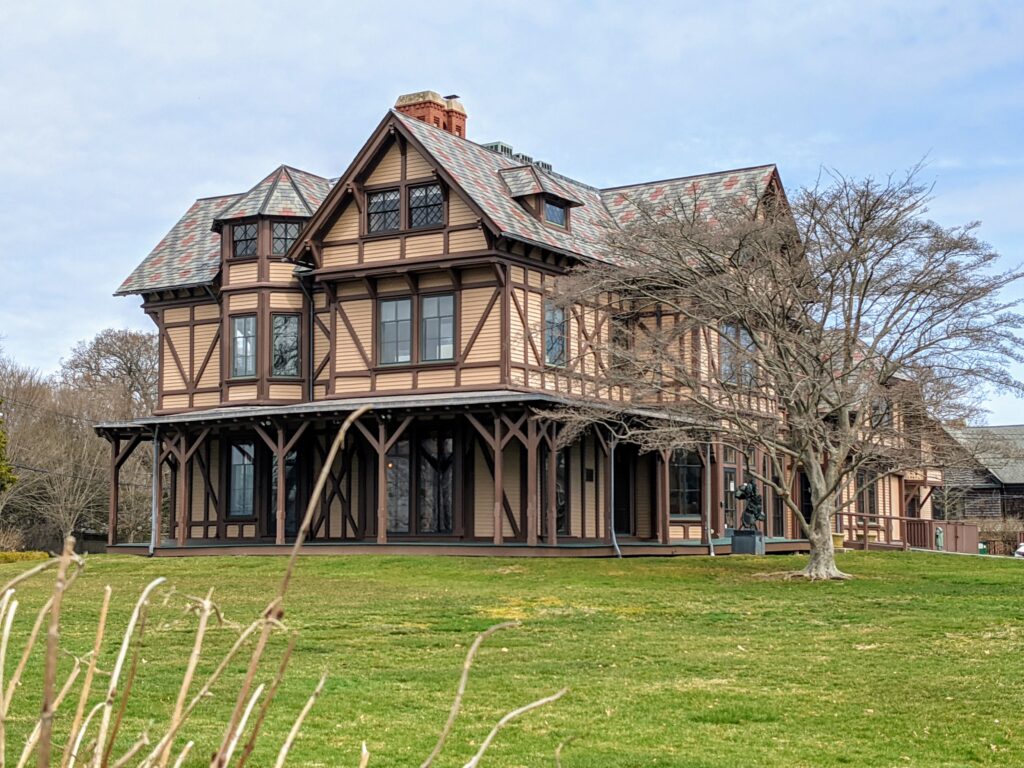
Evolving out of the Carpenter Gothic, the Stick Style flourished in the mid-19th century. This style of wood construction was characterized by angularity, verticality and asymmetry. Roofs were composed of steep intersecting gables. Verandas and porches were common and were often decorated with simple diagonal braces. (Poppeliers, 56)
In keeping with the idea that architecture should be truthful, the principle characteristic of the Stick Style was the expression of the inner structure of the house through the exterior ornament. Most often found on gable ends and upper stories, this stick work was usually a series of boards intersecting at right angles and applied over the clapboard surface to symbolize the structural skeleton. Sometimes diagonal boards were incorporated to resemble half-timbering. (Poppeliers, 56)
Leading Examples
The Griswold House (1862-63, Richard Morris Hunt), Newport, Rhode Island. Intersecting boards are superimposed on the clapboard sheathing to suggest the interior framing. All trim is simple and angular. (Poppeliers, 56)
Dr. Emlem Physick House (1879, Frank Furness), Cape May, New Jersey. The bold design, tapering chimneys, steeply hipped roofs, tall proportions, structural framing overlay and irregular silhouette are typical of Furness’s work. (Poppeliers, 56)
The David King House (1871-72), Newport, Rhode Island. Has diagonal braces and exposed Stick Style framing. (Poppeliers, 56)
Sources Cited
- Poppeliers, John C.S., et al. What Style Is It? A Guide to American Architecture. Washington, D.C.: The Preservation Press, 1983.
Also see Architecture / Style index.