

Downtown – Leland, Michigan
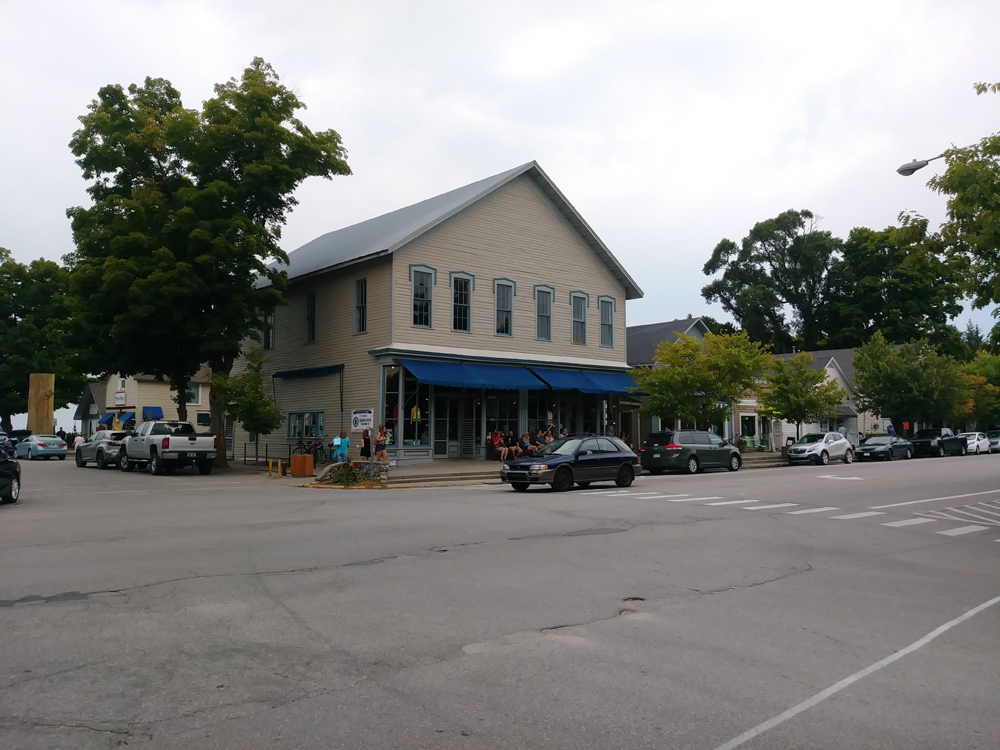
Leland Harbor House, located at 101 N Main St. This historic, gable-front commercial building is a prominent fixture in downtown Leland. It serves as a combined retail shop and seasonal dessert stop, situated just a short walk away from the historic Fishtown waterfront district.

Leland Champion Cottonwood Tree Monument, a preserved 14-to-15-foot stump located on West River Street right outside Two Fish Gallery. Planted around 1901 by Ozzie Cordes, this Eastern Cottonwood grew to a massive size, standing 100 feet tall with a 20-foot circumference, officially earning it the title of Michigan State Champion. Due to aging, structural decline, and safety risks from falling limbs, the community raised significant funds to save it but ultimately had to cut it down on November 8, 2011. Rather than clear it entirely, a towering section of the trunk was preserved as a historical landmark. A bronze memorial plaque is mounted directly to the bark, detailing the tree’s significance to the town. Before it was removed, scientists snipped buds from the crown to create 60 identical genetic clones, which were planted throughout Leelanau County to carry on its legacy.
The plaque recognizing the tree reads:
This trunk remains as evidence of the Champion Cottonwood Tree that watched over the entrance to historic Fishtown
for more than 100 years. The tree was planted circa 1901 by Ozzie Cordes, and was taken down on November 7, 2011.
The tree was designated a “State Champion” by Champion Tree Project International in 2004. Sixty clones were created by the
Project in 2008 by snipping off newly grown buds, and using them to make genetically identical copies. This Champion Cottonwood Tree stood 100 feet tall, with a 20 foot circumference and a 76 inch diameter. Local funding to support and maintain the Champion Cottonwood Tree has been graciously provided by the Leland Champion Tree Group, the Little Garden Club, and the Leland Chamber of Commerce, with the cooperation of the Leelanau County Road Commission.

Carlson’s Fishery, located at 205 W River St. This is one of the most famous stops in historic Fishtown and a crucial part of keeping the area a working waterfront. The Carlson family has operated this fishery for well over a century, tracing its roots back to 1904 when Swedish immigrant Nels Carlson began fishing out of Leland. The business operates directly out of the historic, weathered wooden shanties lining the Leland River, utilizing authentic on-site smokehouses. Carlson’s is one of the last standing commercial fishing operations of its kind on the Great Lakes, surviving industry shifts by adapting its retail and wholesale markets.
Famous Specialties
- Artisanal Jerky: Hand-hung and smoked daily, their gourmet beef and turkey jerkies are incredibly popular with tourists.
- Smoked Whitefish & Trout: Caught fresh in local waters, the fish is cured and slowly cooked over wood smoke to achieve its signature copper hue.
- Smoked Whitefish Pâté: A legendary regional spread made fresh daily, commonly paired with crackers as the quintessential Fishtown snack.
- Smoked Fish Sausage: A unique, highly sought-after product developed on-site by the family that is very difficult to find anywhere else.

Tug Stuff is a popular boutique located right on the docks in historic Fishtown. Tug Stuff is a local Northern Michigan lifestyle brand famous for its signature apparel featuring a small fishing tug emblem. The logo represents the classic 1900s commercial fishing vessels that defined Leland’s maritime culture. The storefront operates out of one of Fishtown’s historic, weathered wooden fishing shanties along the Leland River. These preserved shanties are central fixtures of a working Great Lakes fishing district listed on the National Register of Historic Places.

The Otherside Shanty, located along the south bank of the Leland River in historic Fishtown. Its distinct name originates from its history as a storage facility for the Carlson family’s commercial fishing operations. Because the primary storefront sits on the north side of the river, workers were famously told to head to “the other side” to retrieve supplies. In recent years, high water levels from Lake Michigan and the Leland River severely threatened the integrity of the docks. The nonprofit Fishtown Preservation Society safely lifted the structure off its foundation to rebuild and raise its base, protecting it from long-term water damage. Unlike many of the surrounding shanties that house walk-in retail shops, this multi-windowed, weathered-cedar building has served as a highly coveted, unique weekly vacation rental. This allows visitors to sleep directly inside a piece of preserved Great Lakes maritime history.

This building is The Bead Hut (often referred to as the Rock & Bead Hut), located along the bustling wooden boardwalk in historic Fishtown. This boutique is well-known by visitors for its curated collection of unique, handcrafted jewelry. It primarily showcases pieces made from native Michigan stones, including regional favorites like Leland Blue stone and Petoskey stones. [1, 2] The shop operates out of a charming, smaller cedar-clapboard outbuilding equipped with a bright yellow canvas awning. The rustic Dutch-style door splits open to reveal jewelry racks and artisanal beach finds displayed directly on the wood panels. It is positioned right in the heart of Fishtown’s historic commercial district. It sits right across the boardwalk from other staple storefronts, making it a regular stop for tourists walking between the Leland River docks and the local eateries.

The Morris Shanty (center) and the historic fish tug Janice Sue (right), located along the south bank of the Leland River. Built in 1903, this two-story weathered wood structure is one of the most photographed shanties in Fishtown. It was originally used to store and mend large commercial fishing nets. The Fishtown Preservation Society completely restored and stabilized this building to protect it from rising river levels. Today, the ground floor serves as a working space for local maritime operations, while the upper level remains a private residence.
Docked right next to the shanty, the Janice Sue is a 1958 state-of-the-art steel-hulled gill net fish tug. It is one of the last remaining active commercial fishing vessels on the Great Lakes, famously used by Carlson’s Fishery for decades to harvest local whitefish and trout. Along with the Joy, it is officially recognized on the National Register of Historic Places as a vital asset to Michigan’s living maritime heritage.

The historic commercial fish tug Janice Sue is docked directly in front of the Carlson Net Shanty along the south bank of the Leland River channel. Built in 1958 by the T.D. Vinette Company in Escanaba, Michigan, the Janice Sue is a 38-foot vessel that features a fully enclosed steel hull. This distinctive “turtleback” design was engineered specifically to protect Great Lakes fishermen from freezing spray and rough winter waters. Purchased by Carlson’s Fishery in 1968, the Janice Sue spent decades pulling gill nets filled with local whitefish and chub. It is one of the oldest continuously operating commercial fishing vessels on Lake Michigan and is listed on the National Register of Historic Places.
The long, low-slung weathered cedar structure directly behind the boat is the Carlson Net Shanty. It was built in the early 1900s primarily for drying, mending, and storing large cotton and nylon fishing nets. Like the Otherside Shanty visible further down the dock, this building was meticulously raised and stabilized by the Fishtown Preservation Society to protect its historic timbers from fluctuating Great Lakes water levels.

This panoramic perspective of the south bank shanties and docks from the main Fishtown boardwalk. The multi-story structures across the water include the Leland Lodge water-facing suites and the private residential upper decks of the historic Morris Shanty. In the upper left background, the Leland River Dam waterfall is visible, which separates Lake Leelanau from the lower river channel flowing into Lake Michigan.
Near Fishtown is a plaque recognizing earlier uses and history of the site:
THIS PLAQUE MARKS THE SITE OF
THE LELAND LAKE SUPERIOR IRON COMPANY
BEGAN OPERATING AS A BLAST FURNACE IN 1870
DEDICATED BY
THE LEELANAU COUNTY HISTORICAL SOCIETY
MAY 9, 1958

This high-angle view overlooks the main public parking lot and boat launch area at the western end of West River Street, directly bordering Lake Michigan and historic Fishtown. To the far right, the paved boat launch ramp and trailer turnaround loop allow charter boats and recreational anglers direct access to the harbor. The Lake Michigan background opens up to the shoreline, offering direct views out toward the Manitou Islands.

Benjamin Maier Ceramics, located at 104 N Main St. Since 2003, local artist Ben Maier has been creating elegant, functional stoneware and wheel-thrown ceramic art. His pieces are praised for balancing everyday usability with high-end aesthetic appeal. The shop showcases a variety of custom-glazed home goods, including his popular signature “dimple cups,” serving dishes, sugar bowls, pitchers, and large decorative vases. Many of his unique glazes utilize traditional soda and wood-firing techniques. Located right in the heart of downtown Leland, the gallery operates seasonally, welcoming visitors from Memorial Day weekend through Halloween each year.
Here is a recap of the coastal landmarks along the downtown Leland and Fishtown walking route:
| Image Stop [1, 2] | Landmark Name | Key Highlight |
|---|---|---|
| Stop 1 | Leland Champion Cottonwood Monument | 15-foot preserved trunk of a historic 100-ft state champion tree. |
| Stop 2 | Tug Stuff Shanty | Iconic local apparel shop operating out of a rustic, weathered dock shanty. |
| Stop 3 | Carlson’s Fishery | Five-generation fresh and smoked fish market operating since 1904. |
| Stop 4 | The Otherside Shanty | A preserved historic fishing structure transformed into a waterfront rental. |
| Stop 5 | The Bead Hut | Boardwalk boutique showcasing custom jewelry made from local Leland Blue stones. |
| Stop 6 | The Morris Shanty & Janice Sue | A 1903 net-mending shanty alongside an active 1958 steel-hulled fish tug. |
| Stop 7 | The Janice Sue Fish Tug | Close-up of one of the last active commercial gill-netters on the Great Lakes. |
| Stop 8 | Leland River Dam View | Looking up-river toward the waterfall separating Lake Leelanau from the harbor. |
| Stop 9 | Leland Public Boat Launch | The western turnaround loop overlooking the harbor and Lake Michigan horizon. |
| Stop 10 | Benjamin Maier Ceramics | The beautiful Main Street gallery showcasing local wheel-thrown pottery. |