
Lower Town – Ann Arbor, Michigan
A wooden bridge was built nearby in 1828 to carry traffic from Detroit and Pontiac to the village of Ann Arbor. Lower Town is near where the trails of the Potawatomi and other Indian tribes crossed the Huron River.


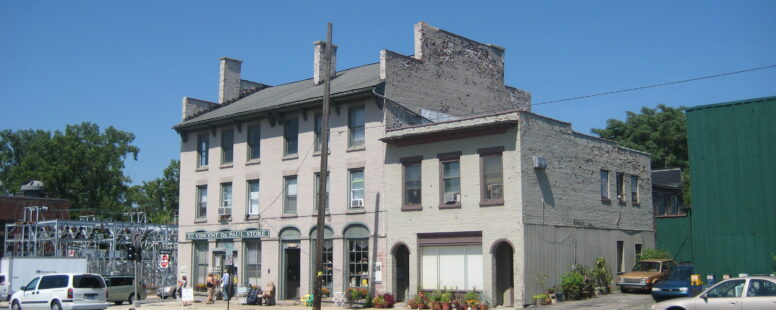
Anson Brown’s Exchange Block was built in 1832. This is the oldest surviving commercial building in Ann Arbor. New York native Anson Brown erected the Exchange Block in what was called Lower Town. He was determined to make this side of the river Ann Arbor’s center.
The Washtenaw Hotel, a famous tavern on the stage coach route from Detroit and Pontiac to Chicago, also followed the old Indian trails. It was opened in 1832 with a ballroom and bar. Distinguished guests from throughout Michigan visited including Stevens T. Mason, Michigan’s first governor. A rooming house by 1878, it was torn down in 1927.
Brown and his partners dammed the river upstream and built a flour mill next to the bridge. Later Edison built the substation at the same location. Brown’s partner slaid out streets with New York City names: Broadway, Maiden Lane, Canal, and Wall. Brown succeeded in being appointed postmaster, forcing upper-village “Hill-Toppers” to come to Lower Town for their mail. His ambitious dreams died with him in the cholera epidemic of 1834, but Lower Town survived as a distinct neighborhoods with its own school, industry, and commercial center. It was incorporated into the City of Ann Arbor as the fifth ward in 1861.

In the foreground of the above picture is the Arco Substation built by The Detroit Edison Co in 1905.

Dr. Daniel Kellogg’s building was where Lower Town had a “clairvoyant physician.” He purchased a building in 1865 where he performed his medical wizardry by “communicating” through the disembodied spirits of two Native American medicine men, Walapaca and Owosso. During trances, Kellogg claimed to see patients’ internal organs in glowing electric tints. Letters arrived from all over the country seeking his aid. All that was needed for a mail order diagnosis was the patient’s name, age, address – and the usual fee. To answer the demand for Dniel’s cures, he and his brother Leverett marketed a line of family medicines, which included Kellogg’s Liver Invigorator and Kellogg’s Magic Red Drops. After Daniel died in 1876, Leverett continued the patent medicine business. Daniel’s son Albert served as the new medium.
Another Lower Town resident, Rev. Guy Beckley was a “conductor” on the Underground Railroad. While it was a federal crime to help escaping slaves, his house on Pontiac Trail was one of several secret “stations” in the area. Michigan’s Anti-Slavery Society was established in Ann Arbor in 1836. Starting in 1841, its newspaper, The Signal of Liberty, called for abolition of slavery in the U.S. This was published in the Huron Block located in the Lower Town neighborhood.

In 1866 Lewis Moore and his son Eli began building an agricultural implement factory on the north bank of the river on the site of an old paper mill. By 1896 the Ann Arbor Agricultural Works covered three acres. It was one of the largest employers in town with a machine shop, warehouse, lumberyard, and its own railroad spur. The machinery was powered by water from the millrace, later supplemented by steam. The headrace ran under Broadway and the tailrace flowed out next to the foundry. Sixty-five men manufactured a line of horse-drawn agricultural implements including “the Advance Hay Tedder, Advance Iron Mower, the Advance Sulky Rake, the Columbia Hay Press, the Advance Chilled Plow, and the Improved Cummings and Clipper Feed Cutter.”
Eli Moore was the plant’s supervisor until 1903, when the business became the Ann Arbor Machine Company, manufacturing many of the same products. Edison acquired the property and built a warehouse on the site in 1928.

This handsome glass wayfinding sign has interpretive text and images that allow visitors to stare through and see where actual buildings being discussed stand today. This allows a comparison between historic images and present-day buildings.


This distinctive two-story brick building has a bracketed cornice with dentil course. Signage on the doors windows and spandrel greatly detracts from the historic architecture and character of the building.