
Visit to the Metropolitan Museum of Art – New York City, New York

The Alexandria Room was intended for public assemblies and balls. The room was on the second floor of the City Hotel, built for John Wise in 1792 at the corner of Cameron and North Ryoal streets in Alexandria, Virginia. Today the building is open to the public as Gadsby’s Tavern. In this room in 1799, George Washington attended his last birthday ball, and in 1824, the Marquis de Lafayette was entertained during his triumphal American visit. The chimneypieces are simplified, uncarved versions of designs in Abraham Swan’s British Architect. The modillion cornice and paneled dado capped by a pierced-fretwork frieze – represents an equally plain pre-Revolutionary approach to architectural design.

While in the America Wing, this 1818 portrait of Mrs. John Biddle by Thomas Sully caught our eye. We had previously known about John Biddle and his role in Michigan. The portrait of his wife helped to complete the picture of the two of them together.
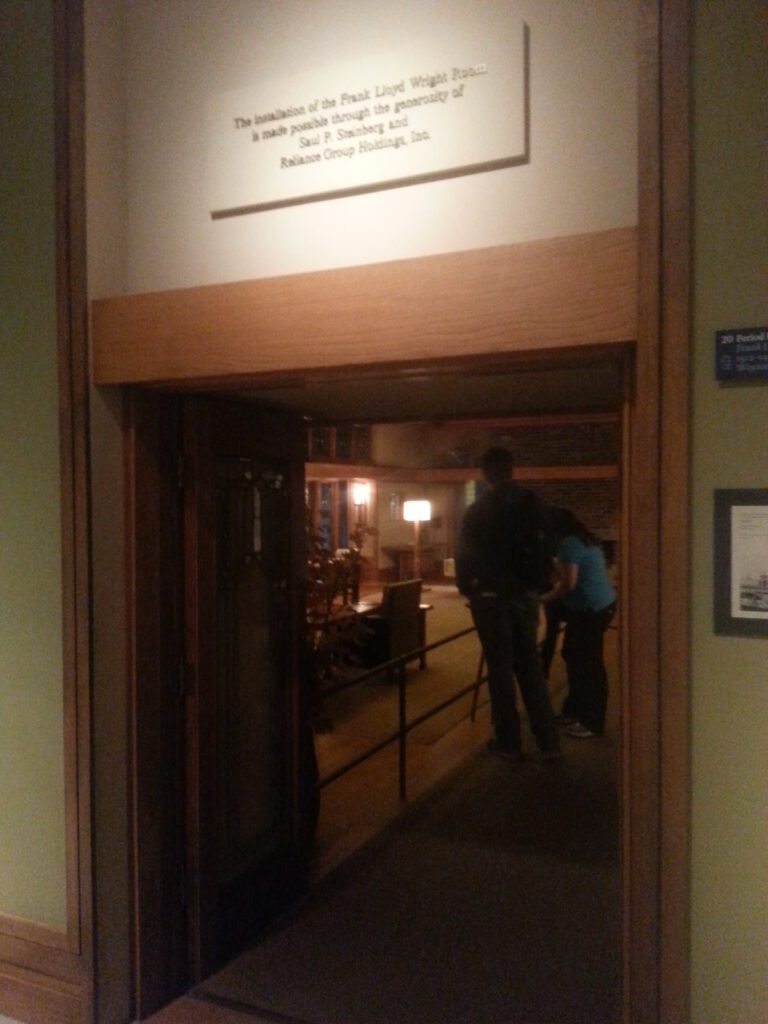
The Frank Lloyd Wright Room was another personal favorite of mine in the American Wing. Architect Edgar Tafel was influential in helping to get this room donated to the Metropolitan Museum of Art. Saul P. Steinberg and Reliance Group Holdings, Inc. helped to provide the funding to make the installation possible.
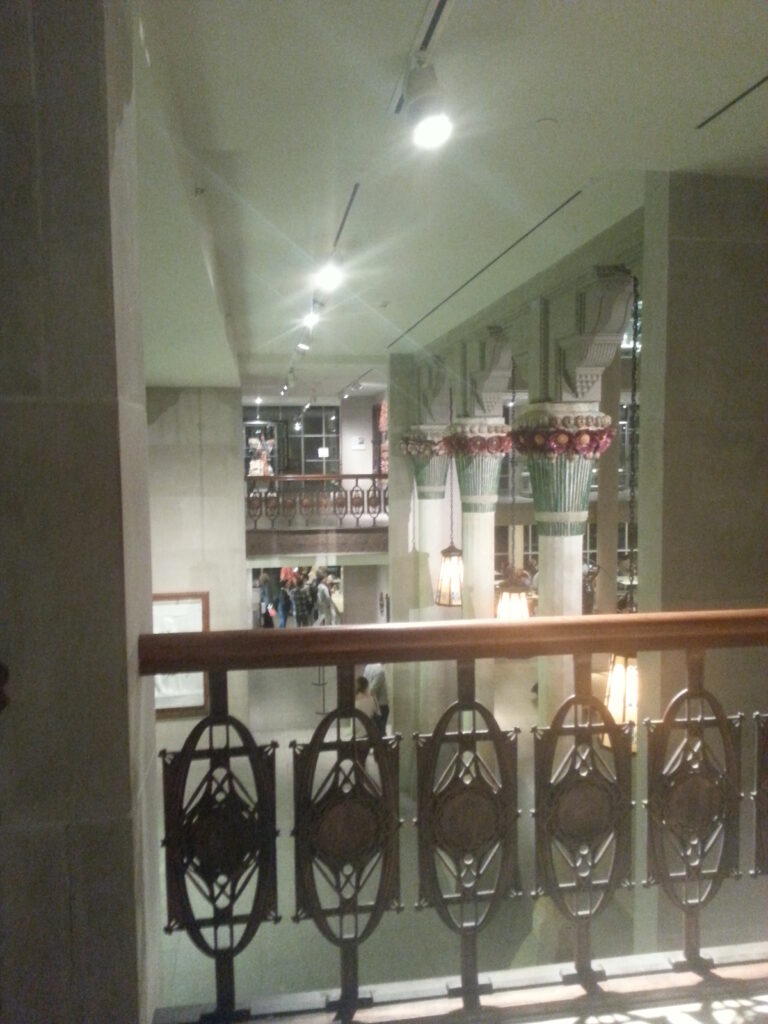
Another favorite architect of ours is Louis Sullivan. Here in the American Wing are installations from one of his famous buildings. The elaborate geometric patterns of the stair railing are characteristic of his work.

The Angel of Death and the Sculptor from the Milmore Memorial by Daniel Chester French was executed in marble after a bronze of 1889-1893. This is one of the most creative and moving funerary monuments executed during the late nineteenth century. The original bronze relief, cast in Paris, marks the Milmore family plot in Forest Hills Cemetery in Jamaica Plain, Massachusetts. The memorial represents Death interrupting the activity of Martin Milmore, a sculptor who died in 1883 at the age of thirty-nine. Milmore is shown carving a sphinx, which he actually did for Mount Auburn Cemetery in Cambridge, Massachusetts. The poetic form and content of the sculpture, with its successful integration of the real and the ideal, make the Milmore Memorial a profound statement on the creation of art and the cessation of life. French hired Piccirilli Brothers Studio to carve this marble replica for the Metropolitan Museum of Art. It was completed in 1926 with a few compositional refinements.

The moon-viewing terrace was a place for the owner of the house and a few friends to gather, write poetry, sample a new tea, or enjoy a full view. The Ming Room, or Scholar’s Retreat, provided a place for work or entertainment within view of the garden. The courtyard was an extension of the residence and was used, weather permitting, as another room of the house.

Finally, we caught one last view of the Temple at Dendur as we were preparing to leave. The dramatic lighting at night gave a heightened presence to this impressive architectural installation.