

Joan Garry and Main Street America

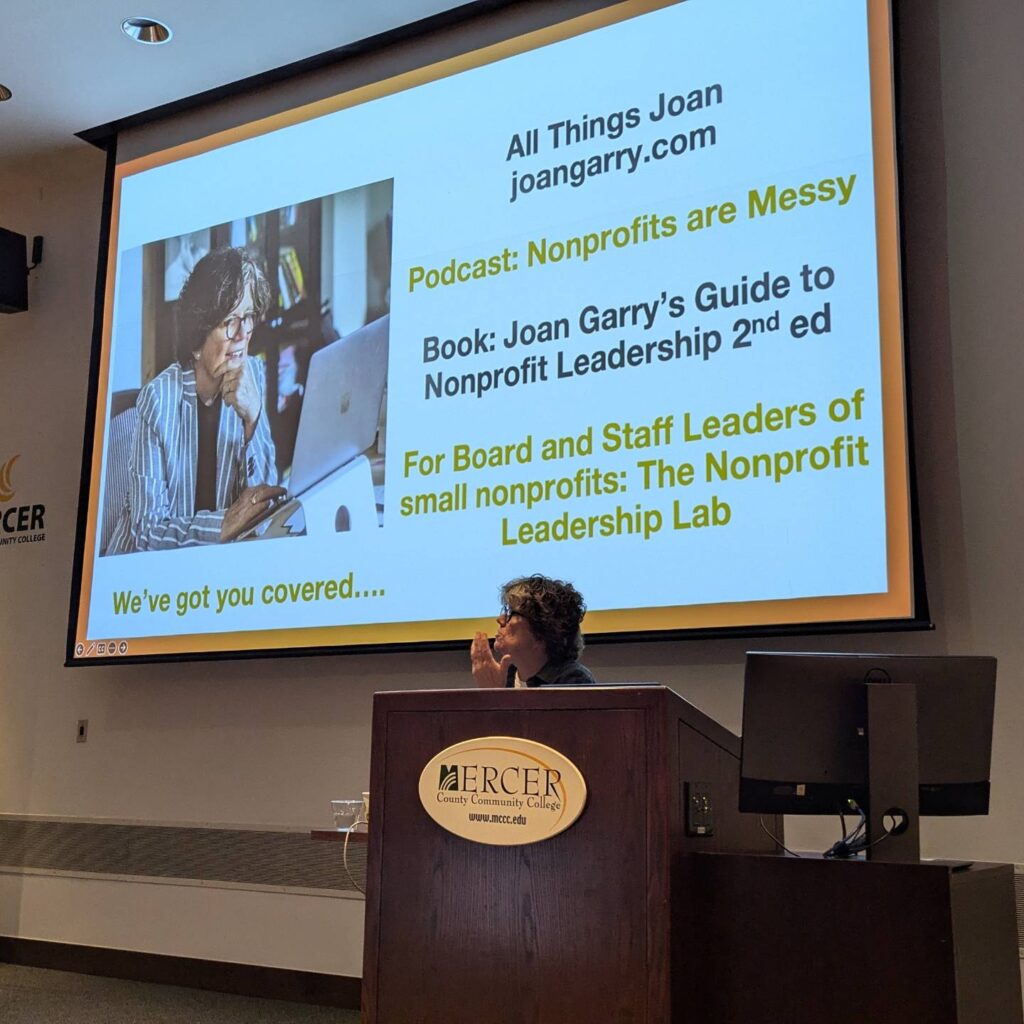
On Tuesday, October 22, 2024, Joan Garry had a talk on The Joy, Privilege and Responsibility of Nonprofit Leadership at Mercer County Community College in Princeton NJ. Joan grasps the challenges that nonprofits face at a deeper level than nearly anyone I’ve met. She also has a better understanding of the potential of the nonprofit sector to change lives. I saw my work as a Main Street revitalization professional mirrored in her recommendations – to utilize pilot projects, take risks, and to dream impossible dreams (or going to Disneyworld as she said).
I was first introduced to Joan and her work during the COVID-19 pandemic in 2020. At that time I was struck by her passion that came out of every pore. In retrospect a few months period that year was one of the greatest teaching and learning moments of life with an endless succession of webinars on different topics.
The first contact was a Nonprofit Livestream with Linkedin on April 3, 2020. The pandemic was very early stages. Already she was talking about how to pivot, the importance of virtual events to replace physical ones, and fundraising strategies to close gaps. Showing the universality of her concepts and how they are unchanged during and after the pandemic – she emphasized 3 things at the hart of the non-profit sector:
- Relationships – being a good neighbor
- Connection – connect to world around them
- Purpose – meaning and purpose
Her closing remarks from that talk still resonate with me:
People do not always really think that local nonprofits provide a backbone for society, are absolutely ways as nonprofit leaders that you can do this. Paint a picture of what life looks like when recover, look inward at what possible, emerge stronger in the long term. How everyone can make small contribution, how can I be helpful? People want to feel a sense of meaning and purpose – can deliver to them. This period of time is not to hibernate or for paralysis. Look at what it means to be a citizen in this society. The other side of epidemic feel a greater sense of generosity and gratitude. Never take anything for granted again. Create a kinder, gentler, world.
Joan Garry, “Business Unusual” webinar on Linkedin
My next contact with Joan was just over 3 years later. During another webinar on June 27, 2023, Joan laid out how to create better functioning boards. Once again she had outlined the benefits of doing so:
- You will not have to go it alone
- You will make richer, smarter decisions
- Your organization will be more powerful
The pillars of a high-functioning board are people, partnerships, and a proactive champion. For people, the more people an organization reaches builds power. Partnerships are facilitated through helping people know about the good work the organization is doing and sharing with others in their network. Finally, proactive champions serve as catalysts helping to tip the board in the right direction.
Next she laid out seven steps of designing the ideal board:
- Gather a small group – board or nonboard and exec director for a recruitment taskforce
- Brainstorm the skills, expertise, lived experience that need that you can’t afford and know will add value – make list, organize by category
a. Journalist whose brother wrongly convicted
b. HR professional - Diversity is critical but not a box to check. If that is the only box checking and not bring any other skills, experience, attributes that need – not only checking boxes, not setting up for success.
- Slot in current board members where fit and highlight the gaps. Some board members check boxes. Also yellow highlighted gaps.
- Prioritze the gaps. Which most important.
- Reach consensus about work. Present to the board. Even get to approve the matrix, approve goals for task force efforts.
- Start convo with task force and board about how to fill gaps – prospects and leads to prospects. Ponds can fish in for candidates. Lots of approaches can take to diversify candidate pool.
The importance of building a posse or what some might call a team is at the heart of Joan’s work. She used a metaphor of concentric circles. Starting with those most directly impacted by the work of your nonprofit and then moving outwards. A perfect illustration was provided of the Boys and Girls Club starting with current little, then current bigs, then alumni bigs and littles, and finally friends and family. Further developing the theme she suggested how other circles might include mental health professionals, social justice advocates, educators, and others. Knowing the people you serve and who is impacted by your work is key.

The most basic distillation of this point is that people = power. The role of the nonprofit professional, the board, and volunteers is then to bring more people into the organization.
Joan concluded her remarks pointing to the need for collaboration between nonprofits. Getting in the way of this is a perceived sense of competition for limited resources. Collaboration on the other hand provides the opportunity to uplift and mutual benefit for all. She pointed to the benefit of convening like the one she was speaking at for bringing nonprofit leaders together. The hope for more like this was expressed by many.
There is a high degree of correlation between the ideal nonprofit as Joan describes it and the work of the over 1,200 Main Street programs nationally. Improvement districts as a subset also stand to benefit.
Joan mentioned to me after her talk wanting to get more active with Chambers, IDs, and Main Street programs. This makes a lot of sense. A slight tweaking of her message might help and a few other thought leaders might help guide this effort.
At a practical level tactical urbanism is a concept that also connects with Joan and her work. The language of pilot projects is shared with tactical urbanism. They go even deeper and talk about demonstration projects. The difference between the two is that demonstration projects are unsanctioned when pilot projects are sanctioned. Both serve the function to build a constituency of supporters and to plant the seeds for longer term and more capital intensive changes.
Fundraising is central to Joan’s message as most nonprofit directors have this as a core responsibility. Main Street is different in the sense that fundraising responsibilities within Main Street are the responsibility of the Board and not the Executive Director. Otherwise, I’d think Joan would be excellent to introduce to Main Street and other organizations working on downtown revitalization.