
Saint Teresa Benedicta Stein
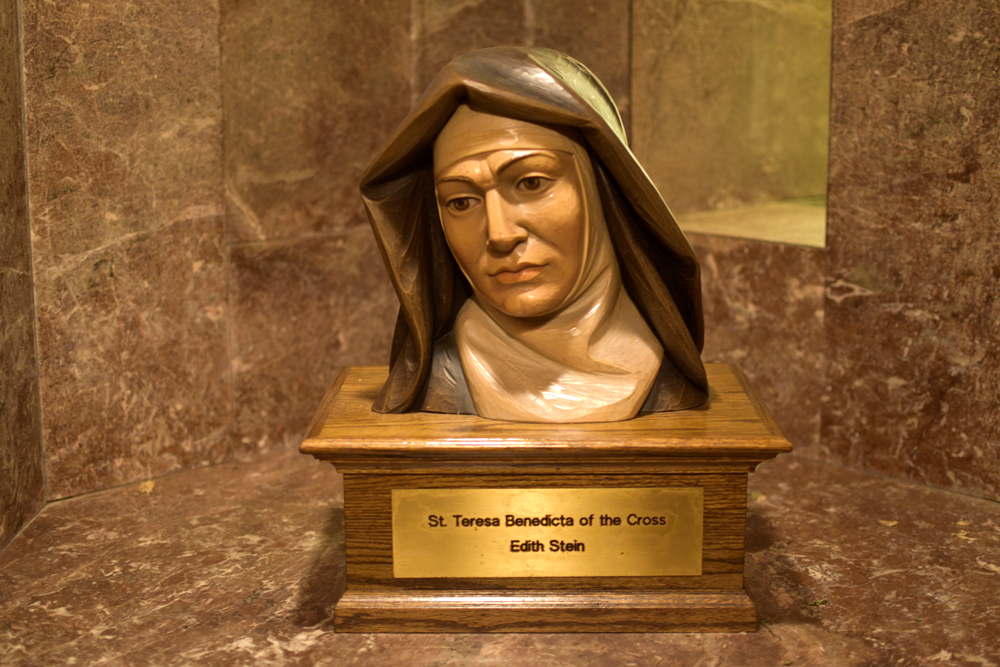
Edith Stein was born into a Jewish family in Breslau, Silesia on October 12. 1891, on the day of Yom Kippur that year. As a student she entered a phase of “radical unbelief” and was an active feminist. She attended three universities, Breslau, Gottingen and finally Freiburg where she earned her doctorate in philosophy summa cum laude under the direction of Edmund Hasserl, founder of Phenomenology. She then became his assistant.
Contributing to her decision to be baptized a Catholic on January 1, 1922 was the influence of her Christian professors and friends, also Max Sheler, and the reading of Saint Teresa of Avila’s autobiography.
Unable to obtain a university teaching position because she was a woman, Edith taught at a Catholic girls’ school and teachers’ training collage. For about a year she lectured at the German Pedagogical Institute in Munster, but left in 1933 because of anti-Semitic legilsation.
During the 1920s and 1930s she published essays and did lecture tours in support of women’s education and professional status. She translated writings of Saint Thomas Aquinas and Cardinal Newman.
She entered the Carmelite monastery of Cologne on October 14, 1933. Because of Nazi persecution threats in 1938 she transferred to a Carmelite monastery in Holland. In retaliation for a public letter of protest of the Dutch Catholic bishops against discriminatory Nazi policies against Jews, she and other Catholics of Jewish background were sent to concentration camps where they were executed. She died on August 9, 1942, in the Birkenau section of the Auschwitz death camp. Some of her family members fled to the United States and to South America, but others died in concentration camps.

On May 1, 1987, Pope John Paul II beatified her as a martyr of the Church in Cologne during a pastoral visit to Germany. Then on October 11, 1998, he canonized her a saint of the Catholic Church before tens of thousands of the faithful assembled in Saint Peter’s Square in the Vatican. In his homily he stressed the importance of her example in these terms: “Gradually, through her life, as she grew in the knowledge of God, worshipping him in spirit and truth, she experienced ever more clearly her specific vocation to ascend the cross with Christ, to embrace it with serenity and trust, to love it by following the footsteps of her beloved Spouse. Saint Teresa Benedicta of the Cross is offered to us today as a model to inspire us and a protectress to call upon. We give thanks to God for this gift. (National Shrine of the Little Flower Basilica, 2025)