

Santa Maria Maggiore – Rome, Italy

Santa Maria Maggiore is one of the four major papal basilicas and the largest church in Rome dedicated to the Virgin Mary. It is a masterpiece of Christian art and architecture with origins dating back to the 5th century. As one of the four major papal basilicas in Rome, it has a special status and is a significant pilgrimage destination.
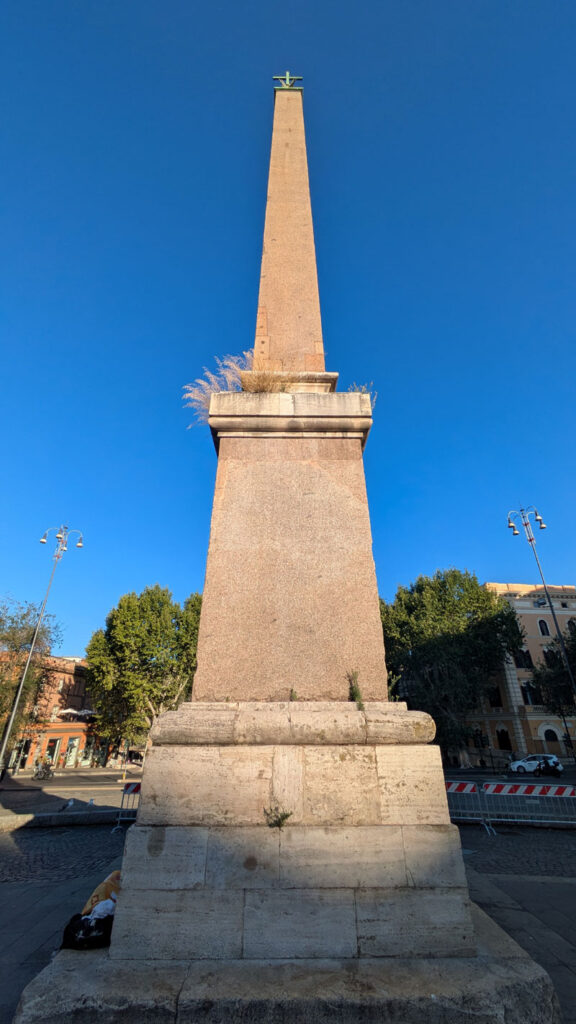
This is the Esquiline Obelisk (Obelisco Esquilino) located in the Piazza dell’Esquilino, at the rear of the Basilica di Santa Maria Maggiore. The obelisk is a Roman imitation of an ancient Egyptian obelisk and does not feature any hieroglyphics. It was likely carved in the 1st century AD from Aswan red granite. It was originally erected on the western side of the Mausoleum of Augustus, paired with a twin obelisk which now stands on Quirinal Hill. After falling and being buried for centuries, it was rediscovered in the 16th century. Pope Sixtus V had it re-erected in its current location in 1587, as a focal point for the new streets leading to the Basilica di Santa Maria Maggiore. The obelisk itself is about 14.75 meters (48.4 feet) tall, but with its base and the bronze cross added by Pope Sixtus V on top, it reaches a total height of approximately 25.53 meters (83.8 feet).

The Borghese Chapel (Paolina Chapel) is inside the Papal Basilica di Santa Maria Maggiore. The central icon is the revered image of the Virgin Mary and the Christ Child known as the “Salus Populi Romani” (Salvation or Health of the Roman People). This ancient, a-typically large Marian icon is a Byzantine-style image, traditionally attributed to St. Luke the Evangelist, though art historians date it to around the 6th or 7th century. It has been Rome’s most important and venerated icon for centuries, carried in processions to pray for deliverance from plagues and other hardships. The opulent Borghese Chapel was commissioned by Pope Paul V and built between 1606 and 1612 to enshrine this specific icon. It features rich marble decoration, gilded bronze angels surrounding the image, and a blue background made of lapis lazuli. Pope Francis had a strong personal devotion to the Salus Populi Romani, visiting the basilica to pray before the icon before and after every international trip he made. According to his will, he is buried in a niche near this chapel.

The grand, baroque-style canopy over the altar was designed by Ferdinando Fuga and completed around 1750, commissioned by Pope Benedict XIV. It is supported by four columns made of rare red porphyry, a type of stone highly valued by Roman emperors. The area directly beneath the altar and baldachin is called the “Confessio” or Crypt of the Nativity. This crypt houses relics believed to be pieces of the Holy Crib of Jesus, which makes the basilica a central pilgrimage site, especially around Christmas. Pope Francis holds a special devotion to the basilica and, according to his will, chose to be buried in a niche there, near the famous Salus Populi Romani icon.

This magnificent interior features a grand staircase leading down to a crypt beneath the main altar of the Papal Basilica of Santa Maria Maggiore (Saint Mary Major) in Rome, Italy. The Crypt of the Nativity, or Bethlehem Crypt, is situated directly beneath the high altar of the basilica. This sacred space houses five sycamore wood boards believed to be from the Holy Crib (or manger) where the infant Jesus was laid after his birth in Bethlehem. These relics were brought to Rome in the 7th century. The large marble sculpture depicts Pope Pius IX (reigned 1846–1878) kneeling in prayer before the reliquary containing the Holy Crib. Santa Maria Maggiore is known as the “Bethlehem of the West” and the “Christmas Basilica” due to these significant relics.


This interior view is of the nave of the Papal Basilica di Santa Maria Maggiore (Basilica of Saint Mary Major) in Rome, Italy. The magnificent, coffered wooden ceiling was designed by Giuliano da Sangallo the Elder and constructed under the orders of Pope Alexander VI (a Borgia pope) in the late 15th century. It is famously gilded with some of the first gold brought back to Europe from the Americas by Christopher Columbus. The central nave and triumphal arch feature original 5th-century mosaics, which are among the oldest representations of the Virgin Mary in Christian Late Antiquity. The basilica maintains its original paleochristian basilica plan. The nave is separated from the side aisles by 40 ancient columns (36 of cipollino marble and four of granite) which were repurposed from earlier Roman buildings. The floor is an intricate 12th-century Cosmatesque mosaic work.

This bronze relief carving depicts Saint Francis of Assisi and illustrates a passage from his renowned prayer, the Canticle of the Creatures. The inscription reads: “LAUDATO SIE SIGNORE / GUO TUCTE LE TUE / CREATURE” which translates from Umbrian Italian to “Praise be to you, my Lord, for all your creatures.” The word “GUO” in the inscription is an old spelling variant of “cum” or “con” (with). Saint Francis is shown with his arms raised toward symbols of the sun and moon, representing the first lines of the Canticle (“Praise be to you, my Lord, with all your creatures, especially Sir Brother Sun”). Flames or rays emanate from his left hand, and a dove is near his right hand. At his feet is a wolf, likely symbolizing the famed Wolf of Gubbio, which St. Francis is said to have tamed. The background includes fields, trees, and clouds, reinforcing the theme of nature and creation. The relief is part of a set of doors commissioned for the basilica and placed there during renovations leading up to a Jubilee year. The basilica has a strong association with the Franciscan tradition.

This is the Column of Peace (Colonna della Pace) located in the Piazza di Santa Maria Maggiore in Rome, Italy. The column stands in the square in front of the Basilica di Santa Maria Maggiore, one of Rome’s four major papal basilicas. It is a Roman Corinthian column made of Proconnesian marble, dating back to ancient Rome. It was originally one of the eight columns that supported the central vault of the Basilica of Maxentius and Constantine in the Roman Forum. The column was moved to its current location and erected at the behest of Pope Paul V in 1614. Atop the column is a bronze statue of the Virgin Mary and the Christ Child, sculpted by Guillaume Berthélot and Orazio Censore. The column is called the “Column of Peace” because the ancient Basilica of Maxentius where it originated was known in the Middle Ages as the “Temple of Peace.”

The Papal Basilica di Santa Maria Maggiore (Basilica of Saint Mary Major), is considered the largest and oldest church in Rome dedicated to the Virgin Mary. The building displays several architectural styles, from its original 5th-century Paleochristian floor plan to its 18th-century Baroque facade, designed by Ferdinando Fuga. The Romanesque bell tower, visible rising behind the main facade, dates back to the Middle Ages.