

Pompeii Archaeological Park – Pompeii, Italy
<blank" >target="_blank" >figure class="wp-block-image size-full">We visited Pompeii on a day when the only cloud in the sky cast shadow over the long glossary/dormant-tree/" class="glossaryLink" data-cmtooltip="238fd518b0017993fad091f9f64b95fb" target="_blank" >dormant volcano on Mount Vesuvius that put Pompeii into the historical record as the world’s largest and longest continuously excavated archaeological site. The city was buried under volcanic ash, freezing a slice of Roman life in time. Initial excavations began in 1748 and have never ceased, with new discoveries still being made. The site provides a unique window into the ancient world, showcasing buildings, artifacts, and even human plaster casts.
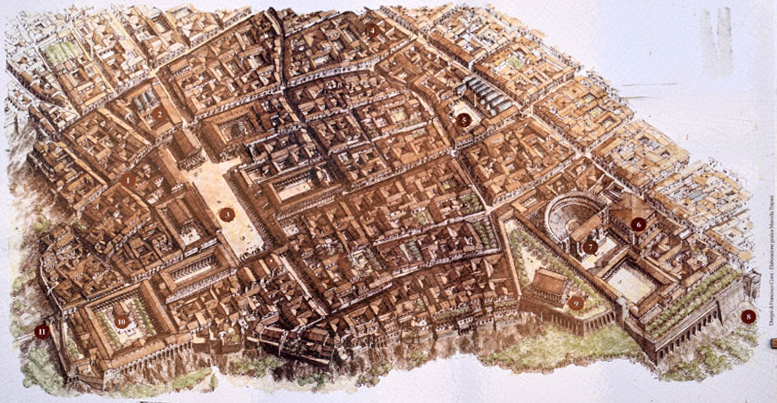
Upon passing through the entry gates, right away a wide avenue opened with the arena to the right.


Throughout the site are sites for distribution of food. There are counters close to the street with large pots or vats within which soup or other foods could be served.


Streets had various widths and size of walkways and curbing. Large sections of pavement rose above the level of the road to prevent the passage of carriages with horses.


House of the Faun has a peristyle (colonnaded courtyard). This was one of the largest and most luxurious aristocratic residences in the ancient Roman city. Dating back to the 2nd century BCE, the house is a prime example of Hellenistic architecture. It is named after a famous bronze statue of a dancing faun found in the impluvium of the Tuscan atrium, which is now a replica on site. The original structure featured two atria, two peristyles, and a private bathing complex.


This structure is a stepped fountain or water feature located in the large garden area of the House of Octavius Quartio (also known as the House of Loreius Tiburtinus) in Pompeii, Italy. The structure is part of an euripus, a long water channel or canal that runs through the garden. The design of the fountain features a series of steps leading to a central, raised frame/" class="glossaryLink" data-cmtooltip="a264fd4a462aa2af526b8cf3f279e443" target="_blank" >platform, which would have been a focal point for water displays in the wealthy villa/" class="glossaryLink" data-cmtooltip="37f12293ff215ff31118368a56073bb4" target="_blank" >Roman villa’s garden. The white material covering the steps and tops of the low walls is marble or a similar high-quality stone, which was a sign of status and wealth in Roman architecture. The lower, older looking stonework with an arch forms the base or sub-structure of the feature.


The atrium of the House of Fabius Amandus in Pompeii. The opening in the foreground is an impluvium, a basin designed to collect rainwater from an opening in the roof (compluvium). In front of the impluvium sits a replica of a marble table on a single pedestal, which would have been a common furnishing.
The walls feature preserved sections of Roman wall-paintings/" class="glossaryLink" data-cmtooltip="09e3726add759aa1c95a6a96b75627ae" target="_blank" >wall paintings, a common decorative element for wealthy homes, though much of the original plaster and vibrant color has degraded over time.

This structure is part of the Stabian Baths (Terme Stabiane) in Pompeii, specifically the stucco finish/" class="glossaryLink" data-cmtooltip="b7fc4184b5bfaa02ddf6636d8f6eb38f" target="_blank" >exterior walls of the destrictarium and nymphaeum located in the south-west bead/" class="glossaryLink" data-cmtooltip="578cb1a0f618c79c0949cc78c076b63f" target="_blank" >corner of the palaestra (gymnasium). The baths are in Regio VII, Insula 1, number 8 (VII.1.8) and are one of the oldest bath complexes in Pompeii, dating back to the 2nd century BCE, and were expanded after the town became a Roman colony. The complex featured typical Roman bath components, including a palaestra (gymnasium) for exercise, changing rooms (apodyterium), and rooms with varying temperatures (tepidarium, caldarium, frigidarium). The specific wall shown in the image features preserved stucco decoration, with relief panels depicting figures from Greek mythology.


House of Julia Felix is a large and significant Roman property in Pompeii. The red-painted walls with columns are characteristic architectural features of the period. The distinctive deep red color, known as “Pompeian red,” was an expensive pigment at the time. Some studies suggest that while some walls were painted this color, the intense heat from the eruption could also transform yellow-ochre/" class="glossaryLink" data-cmtooltip="37454ac49cb670ccd257916e75490305" target="_blank" >yellow ochre pigments into this red hue. The House of Julia Felix (also known as the Praedia of Julia Felix) is situated on the Via dell’Abbondanza. The house originally belonged to Julia Felix, an influential businesswoman. After the major earthquake of 62 AD, she adapted her property by converting portions into rental apartments and luxurious public baths, a precursor to the catastrophic eruption of Mount Vesuvius in 79 AD. The building combined residential, commercial, and recreational areas. A portico with elegant columns opens onto a garden area. The walls were adorned with vibrant, high-quality frescoes, typically in the Fourth Style of Roman painting/" class="glossaryLink" data-cmtooltip="51943e9bd1c89f2b6e753067deac8df4" target="_blank" >wall painting, to display wealth and sophistication. An elaborate floor of opus-sectile/" class="glossaryLink" data-cmtooltip="2158a2181b3967ec9275ebb133d63db7" target="_blank" >opus sectile further displayed the wealth of the owner.


The Lupanar Grande is a brothel known for intact drawings.

One of the main commercial streets had storefronts evenly spaced from one another.


The Forum has monumental temples and other public buildings.


A selection of frescoes from throughout Pompeii show the range of subject, scale, and artistic skill. Some depict demetric figures and shapes, other landscape scenes, and some even show the human figure.


Signage and other commercial graphics have been preserved in situ. This gives a fascinating glimpse into how Romans would use visual communication.


The Villa of the Mysteries is a well-preserved suburban ancient Roman villa on the outskirts of Pompeii, southern Italy. It is famous for the series of exquisite frescos in Room 5, which are usually interpreted as showing the initiation of a bride into a Greco-Roman mystery cult. These are now among the best known of the relatively rare survivals of Ancient Roman painting from the 1st century BC.

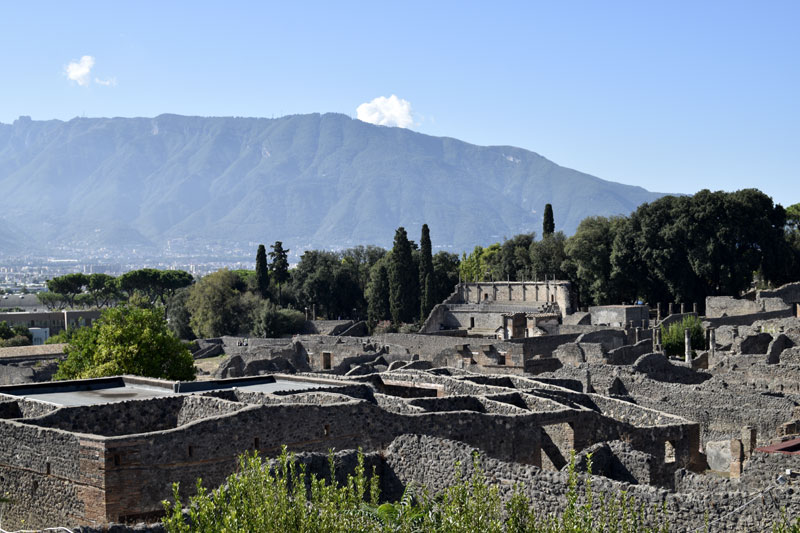
Looking out over the ruins it was fascinating to see an approximation of the city as it once was. Pompeii must have been remarkable with rooftops instead of the maze of walls today. One can get an approximation of what life might have been like prior to destruction of the city.