

Detroit Riverwalk – Detroit, Michigan
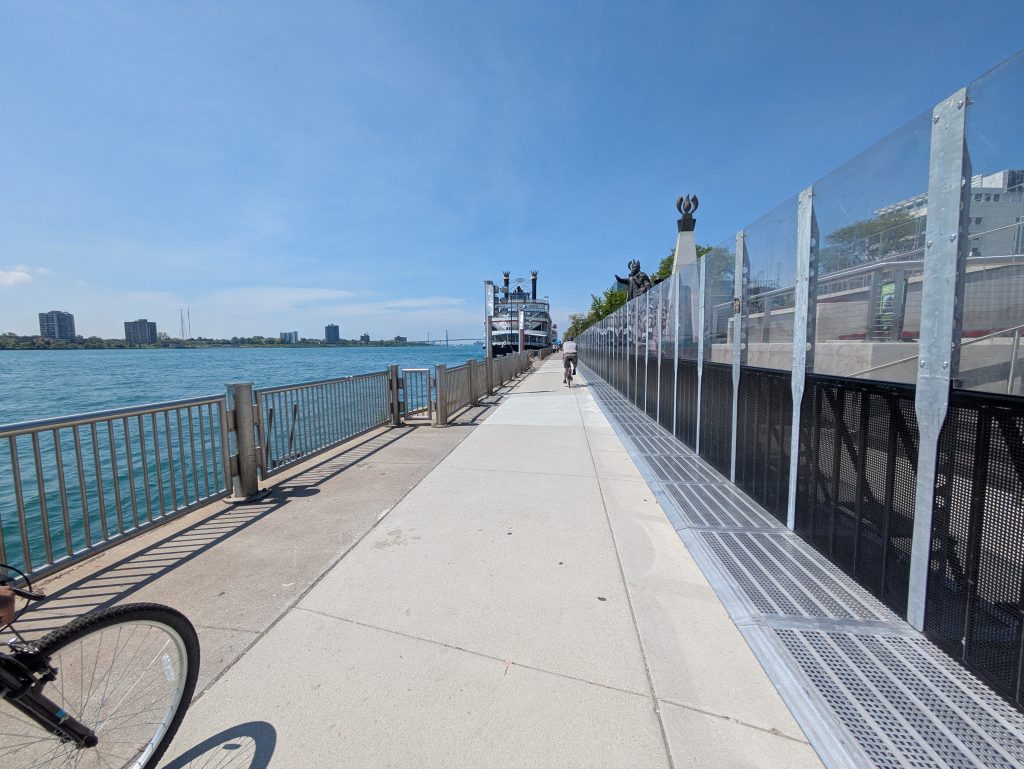
The Detroit Riverfront Conservancy continues to expand in both directions between the Belle Isle bridge and the Ambassador Bridge. Not too great an imagination is needed to see future expansions beyond that. This perspective showcases a newer, modernized stretch of the award-winning Detroit Riverwalk. Distinct structural elements right next to Hart Plaza include a steel mesh and glass panel partition. This design provides security and clear scenic visibility, while also serving as integrated flood prevention. Docked ahead along the riverwalk is the Detroit Princess Riverboat, a massive 5-story 1800s-style paddlewheel riverboat popular for scenic dinner and music cruises on the water. Looking downriver past the boat, you can see the faint outline of the historic Ambassador Bridge stretching across the international border to Windsor, Ontario, Canada.

This “Walk to Freedom” marker was installed in 2023 and commemorates a march by Rev. Martin Luther King, Jr.
WALK TO FREEDOM
At 3:00 P.M. on June 23, 1963, at the corner of Woodward Avenue and Adelaide Street, the Walk to Freedom began.Dr. Martin Luther King Jr. called it “the largest and greatest demonstration for freedom ever held in the United States” to date. It was the anniversary of the 1943 Detroit Race Riot. More than 125,000 people walked down Woodward Avenue toward Cobo Hall in quiet support of the civil rights protests in Birmingham. Alabama. The march also denounced housing segregation and economic discrimination that African Americans faced in the North. Led by the Reverends C. L. Franklin and Albert Cleage Jr. and organized by James Del Rio and the Detroit Council for Human Rights, the march was funded in part by the United Auto Workers led by Walter Reuther.
MICHIGAN HISTORICAL COMMISSION, MIGHIGAN HISTORY CENTER, SITE NO. 784.

Senator Carl Levin was a driving force behind the riverfront improvements.
Senator Carl Levin, 1934 – 2021
Senator Carl Levin ww a visionary force behind the creation of the Detroit Riverwalk. As a proud son of Detroit and a member of the Detroit City Council from 1970 to 1977 Levin was one of the first community leaders to advocate for the creation of public trails and parks along the Detroit River. During his time representing Michigan in the Senate, Levin was
instrumental in many projects along the Detroit Riverfront including the acquisition of 22-acres on the West Riverfront, the
construction of Mt. Eliot Park and the final connection and completion of the East Riverfront along the former Uniroyal property. He also led efforts to reconstruct the Bates Street Platform, which connected the East Riverfront to Hart Plaza.
While serving on the Detroit Riverfront Conservancy board from 2015 to 2021, Levin personally engaged with residents of Riverfront Towers to advance a shared vision for the development of the boardwalk that connects the East Riverfront to Ralph C. Wilson, Jr., Centennial Park. He also advocated for the development of a partnership between the Detroit Riverfront Conservancy and the Huron-Clinton Metroparks, which was established in 2020. The Detroit Riverfront Conservancy will be forever grateful to our friend and champion, Senator Carl Levin.

Ralph C. Wilson, Jr. (1918-2014), was born in Columbus, Ohio and grew up in the Detroit area, where he would live the rest of his life. He studied at the University of Virginia and the University of Michigan law school, going on to serve in the naval forces during World War II. Ralph returned from military duty in both the Atlantic and Pacific theatres to work in the insurance business owned by his father. He became a serial entrepreneur known for his success across multiple industries, including manufacturing, construction, television, and more.
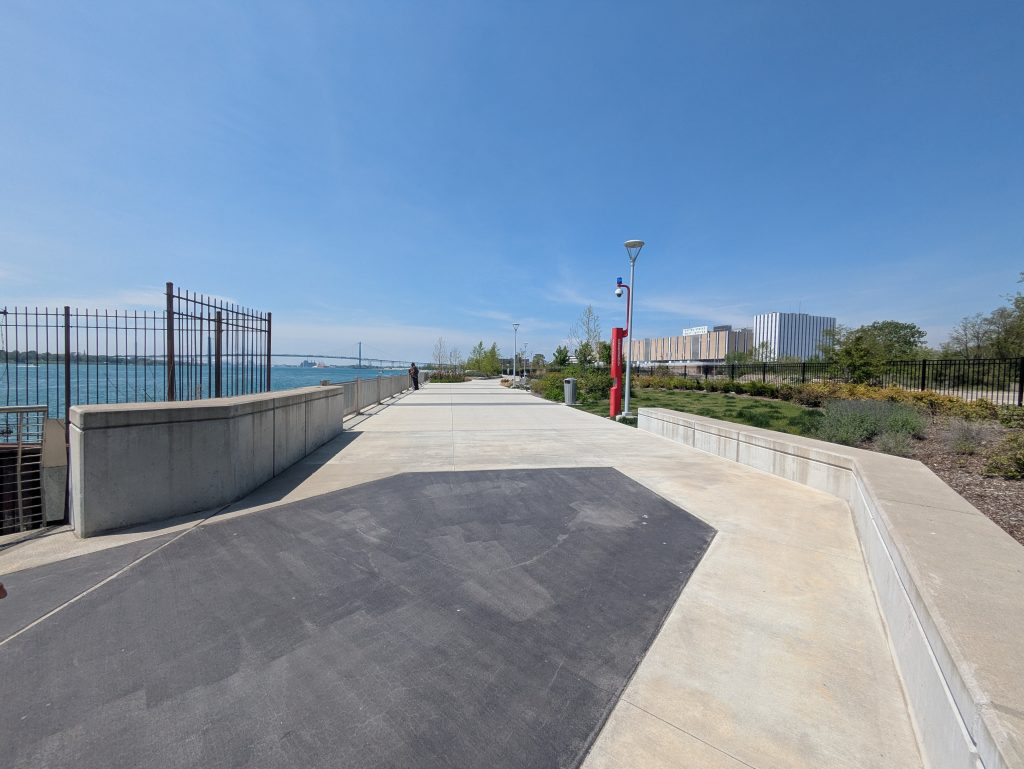
This final and newest section of the Detroit Riverwalk concludes at Ralph C. Wilson, Jr. Centennial Park, a major 22-acre public destination along Detroit’s West Riverfront. The wide, pristine concrete path is a vital segment of the continuous Detroit Riverwalk, which now allows visitors to travel continuously along the waterfront. Looking west down the river, you can spot the distant structure of the Ambassador Bridge crossing over to Canada.
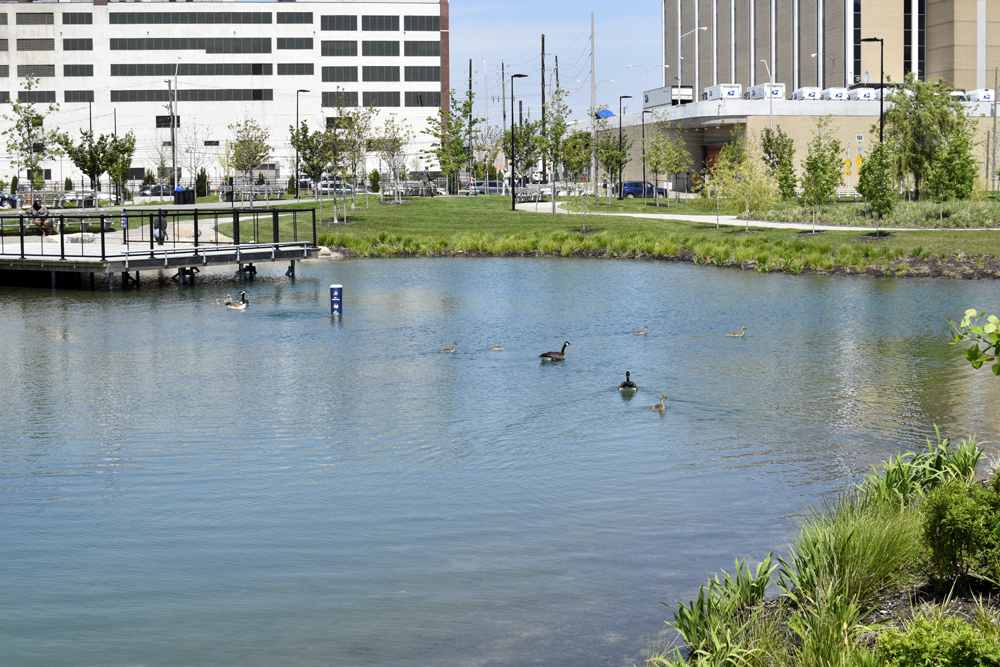
The Huron-Clinton Metroparks Water Garden, a distinct 2.5-acre attraction located inside the larger 22-acre Ralph C. Wilson, Jr. Centennial Park. This major public destination serves as the very first Metroparks location built inside the City of Detroit. The tranquil pond water seen here is engineered to function as a natural filtering environment. The wooden architectural overlook projecting into the pond features a modern black steel security railing, offering visitors a prime lookout platform for viewing native waterfowl like the Canada geese swimming in the foreground. The tan building complex visible on the upper right is the backside of the massive USPS Detroit Main Post Office complex on Fort Street, showing how closely this green space integrates with the surrounding urban framework.
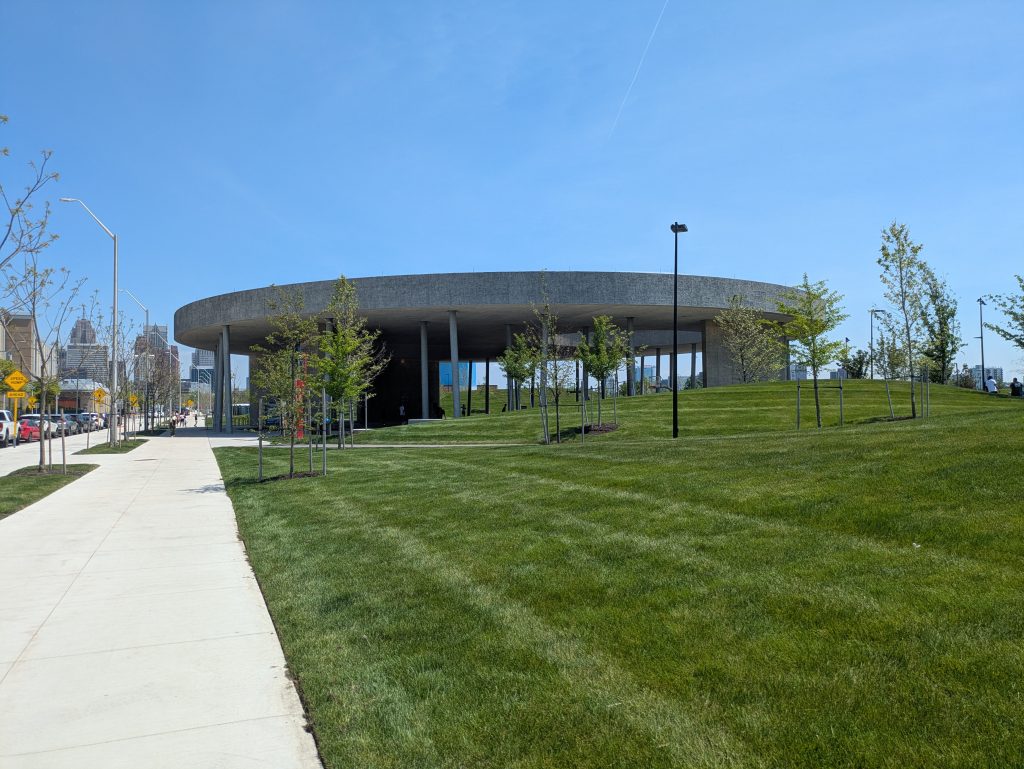
This architectural landmark is the William Davidson Sport House, serving as the main athletic and recreational centerpiece of Ralph C. Wilson, Jr. Centennial Park. The open-air pavilion uses an advanced, adaptable enclosure system. This allows it to stay completely open to the river breezes during hot summer days but easily close off to shield community events, youth clinics, or winter markets 365 days a year. The striking pavilion was designed by the world-renowned Ghanaian-British architect Sir David Adjaye (famed for designing the National Museum of African American History and Culture in Washington, D.C.). Spanning 28,000 square feet, the fluid, circular structure features a massive cast-in-place concrete canopy roof supported by 33 angled steel columns. Hidden beneath the sculptural concrete roof and a large 2,000-square-foot central skylight are two full-sized public basketball courts custom-branded with the Detroit Pistons logos.

The foreground showcases engineered bioswales, native prairie grasses, and stone borders designed to naturally collect and filter urban rainwater runoff before it reaches the river channel.

This view looks west down the Detroit River from the promenade of Ralph C. Wilson, Jr. Centennial Park, showcasing two international border crossings side by side. The massive suspension bridge dominating the frame is the historic Ambassador Bridge. Opened in 1929, it connects Detroit, Michigan (right) to Windsor, Ontario, Canada (left) and stands as the busiest international land border crossing in North America. Visible further downriver beneath the span of the Ambassador Bridge is the signature cable-stayed design of the new Gordie Howe International Bridge. Once active, it will feature the first dedicated international multi-use pedestrian and bike lane in the region.