

Archbasilica of Saint John Lateran – Rome, Italy

The building in the image is the Archbasilica of Saint John Lateran (Arcibasilica di San Giovanni in Laterano), located in Rome, Italy. It holds the title of the cathedral of Rome and is considered the “mother and head of all the Churches of the Urbe and Orbe” (the city of Rome and the world). It is the highest-ranking and oldest of the four major papal basilicas in Rome.
The Archbasilica of Saint John Lateran is the official ecclesiastical seat of the Pope and the cathedral of Rome.
The colossal eastern facade was designed by Alessandro Galilei and completed in 1735. Crowning the facade are fifteen large, seven-meter-tall statues. The central figure is Christ the Redeemer, flanked by Saint John the Baptist and Saint John the Evangelist. The remaining statues depict various Doctors of the Church. The basilica stands on the site of a Roman fort that was demolished by Emperor Constantine the Great, who then gave the land to the Bishop of Rome. It was consecrated in 324 AD. To the right of the main facade is the Lateran Palace, and in the square in front of the basilica stands the Lateran Obelisk, the largest standing ancient Egyptian obelisk in the world.


This basilica is highly significant as it is the cathedral of Rome, the official ecclesiastical seat of the Pope as the Bishop of Rome, and the “mother and head of all the Churches of the city and the world”. The magnificent, gilded ceiling was designed by Giuliano da Sangallo in the 16th century under the commission of Pope Alexander VI (Rodrigo Borgia). It is traditionally said that the gold used to gild the ceiling was the first gold brought back to Spain from the Americas by Christopher Columbus and then presented to the Spanish Pope. The semi-dome of the apse features a large mosaic, portions of which date back to the 13th century, depicting the Triumph of the Cross. The mosaic portrays Christ the Savior, flanked by the Virgin Mary, Saint John the Baptist, and other figures, set against a backdrop of flowing, decorative vines that symbolize the Tree of Life. The vast central nave is an example of early Christian design, lined with ancient marble and granite columns that support the structure. The entire structure has survived several fires and extensive renovations over the centuries. Founded in 324 AD by Emperor Constantine the Great, it is the oldest public church in Rome and the oldest basilica in the Western world.

The Altar of the Holy Sacrament (Altare del Santissimo Sacramento), is located in the right transept of the Archbasilica of Saint John Lateran. This altar is a centerpiece of the transept, an area renovated in the late 16th century by Pope Clement VIII. The inscription on the pediment above the altar reads “CLEMENS VIII P. M. ANNO VII” (Clement VIII Pontifex Maximus, in the 7th year of his reign). The altar is notable for incorporating four rare, fluted, gilded bronze columns. Tradition holds these columns may have been repurposed from the ruins of the Temple of Jupiter on the Capitoline Hill and date from antiquity. The most significant feature is located within the large framed structure above the tabernacle: the relic of the table at which Jesus Christ and his apostles are believed to have celebrated the Last Supper. The large painting above the altar depicts the Ascension of Christ, where Jesus is shown rising to Heaven surrounded by angels and apostles. This mural is attributed to Giuseppe Cesari, known as Cavaliere d’Arpino.

The Gothic Ciborium (or baldacchino) over the Papal Altar was created by Giovanni di Stefano in 1368 under the commission of Pope Urban V. The high altar beneath the canopy is one of the most sacred in Rome. It is reserved exclusively for the Pope to celebrate Mass. The most significant feature of the ciborium is at the very top. Within two silver reliquary busts, the purported skulls (or relics touched to the remains) of Saints Peter and Paul are enshrined. These relics were placed there to emphasize Rome’s foundation by both apostles. Inside the marble altar itself is a fragment of the ancient wooden table upon which, by tradition, Saint Peter and early popes celebrated the Eucharist.


The symbol of an all-seeing-eye is placed above Jesus on the crucifix.
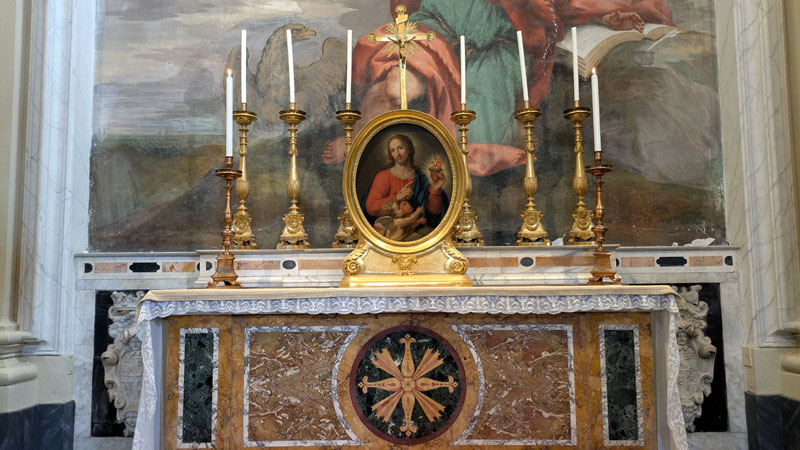
The specific altar is one of the four original 5th-century altars that still stand in the church. The altar is dedicated to “The Holy Confessors” or simply “Confessors”. The central oval painting depicts the Sacred Heart of Jesus and is attributed to the Jesuit artist and sculptor Giovanni Battista Fiammeri (1530–1606). While the central focus is the oval painting, the larger fresco above it, partially visible in the background, depicts saintly figures associated with the altarpiece, such as Saint Francis on the right. The marble altar frontal features a prominent central roundel with an inlaid starburst or floral motif in polychrome marble, a style known as Cosmatesque or Roman inlay work. The church and its altars have undergone numerous restorations; the current appearance of the single nave and its frescoes dates largely from the late 16th and early 17th centuries.
Cloister


The medieval cloister is renowned for its beautiful, twisted columns crafted by the Vassalletto family.

The Altar of Mary Magdalene
In February of 1297 Cardinal Gerardo Bianchi from Parma consecrated the new Altar of Mary Magdalene which had been erected in the Lateran basilica at the command of Pope Boniface VIII, The work was carried out by the Roman sculptor Deodato di Cosma who left his name on one of the pediments (no. 44). The altar was situated at the centre of the Canons’ choir, that is the space reserved for their prayer in the central nave. We are able to deduce its original aspect from ancient descriptions and prints. It was a complex and imposing structure on two levels placed on a podium of six steps. The lower part was the proper altar, containing remains believed to be those of Mary Magdalene. The upper part rested on four granite columns and had at the centre a tabernacle containing other important relics exposed for the veneration of the faithful on particular feast days. During the reworking of the naves by Francesco Borromini the Altar of Mary Magdalene was dismantled, with many of its parts disappearing and those surviving eventually finding their final collocation in the cloister. Some elements of this altar were assembled to form a canopy over the sedes stercorata, or stercoraria, which was also transferred to the cloister following the 17″ century works. This is a marble seat dating from Roman times which in the Middle Ages came to be placed in front of the Lateran basilica and used during the long and complex ceremony of the papal enthronement. The newly elected Pontiff was seated upon this seat during the reading of the Biblical verse (1 Samuel 2, 8) “the Lord raiseth up the needy from the dust, and lifteth up the poor from the dunghill (Latin de stercore), that he may sit with princes and hold the throne of glory”; hence the name of the chair. The biblical verse serves as a reminder of the transitory nature of earthly power and the need for humility. The seat was used as early as the enthronement of Paschal II in
1099 and was last used by Pius IV in 1560.


The Tomb of Riccardo Annibaldi
Riccardo Annibaldi, a Subdeacon and Papal Notary, died on 28 August 1289. He was buried in a splendid
marble tomb by Arnolfo di Cambio in the Lateran basilica. Riccardo belonged to one of the most noble and important families of late Medieval Rome and carried the same name as his uncle, the powerful Cardinal Riccardo Annibaldi. In the past Cardinal Annibaldi was wrongly considered the person for whom the tomb was constructed. The brother of our Riccardo – Annibaldo – was also a Cardinal, a man of learning and friend of St. Thomas Aquinas.
The elegant funerary inscription in Latin (no. 231) reminds us of the virtues of the deceased, namely that
he was wise, discreet, pious and learned in the law and letters. It should be noted that the first ten lines
are in verse, while the last five are in prose. They tell of the death of Riccardo and the commitment by the
Lateran Chapter to have mass celebrated every day in his memory. It is hardly surprising then that the
realization of the tomb of such an important man should have been entrusted to Arnolfo di Cambio, one of the most important artists of his age. In addition to the inscription there survive the figure of the deceased and two parts of a frieze representing the funeral ceremony. Riccardo is depicted as a young man, while his clerical status is indicated by his tonsured head and distinctive clothing. The frieze represents the deceased’s body being incensed and sprinkled with holy water as well as the reading of sacred scripture. The remainder of the tomb was probably lost during the 16″ century; hence it is impossible to reconstruct the original design of it, which was perhaps placed against a wall in the basilica. Restoration work undertaken in the 1990’s revealed traces of coloured paint (ochre, blue and malachite
green) on all the surfaces; this might suggest that the tomb was originally fully-coloured.

The fresco is a 13th-century painting of the Virgin Mary located in the cloister area. This particular piece is considered the only surviving structure of the former Benedictine convent that once occupied the area. The marble plaque below the painting is a later addition, dated by the Latin inscription at the bottom: “ANNO SALVTIS HVMANAE MD LXXVII,” which translates to the year 1577. The text indicates that a new altar was erected by Oratius Fuscus (Horatius Fuscus), a S.P.Q.R. scribe, in memory of his kinsman, Ancelotto Fuscus, a cardinal and archpriest of the basilica. It describes the original altar as having been pulled down to adorn the Chapel of the Holy Eucharist. The fresco panel was likely part of or associated with this earlier altar.
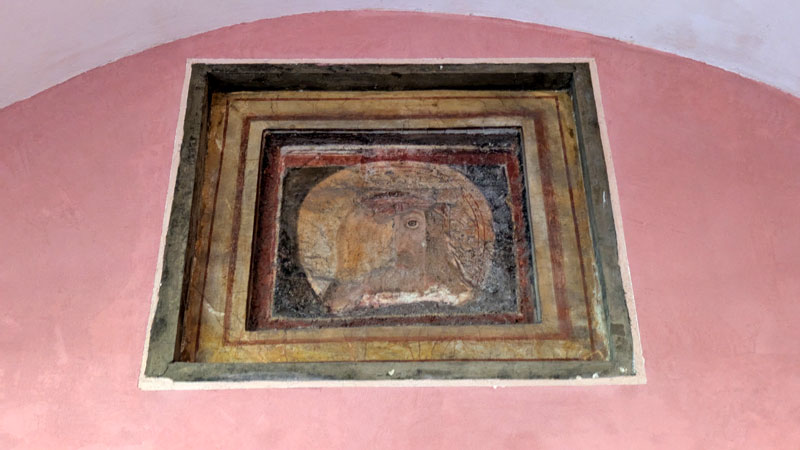
The painting is an ancient fresco medallion of Jesus Christ, known as the Acheiropoieton or a form of the “Holy Face” of Christ. This specific image is a 5th-century fresco of Christ, which was incorporated into a later, 13th-century apse mosaic by the artists Jakopo Toriti and Frajako Damino during renovations ordered by Pope Nicholas IV. By the 12th century, this image was believed to be a miraculous, “not made by human hands” (acheiropoieton) image that appeared to Pope Sylvester I during the dedication of the ancient basilica in the 4th century. The mosaic’s artists were instructed to extract the holy face from its original location and place it within the new mosaic, a process involving enclosing it in a travertine box within the vault. During its restoration in 1880, this box was found, confirming its unique status and veneration as a significant relic.

The Apostolic Place of the Lateran was an ancient palace of the Lateran family during the Roman Empire and later the main papal residence in Rome, until the principal residence moved to the nearby Vatican. The palace is now used by the Vatican Historical Museum, which illustrates the history of the Papal States. The palace also houses the offices of the Diocese of Rome, as well as the residential apartments of the Cardinal Vicar, the pope’s delegate for the daily administration of the diocese.

This was the second of four pilgrimage churches that I visited during the Jubilee year of 2025.