
water mill
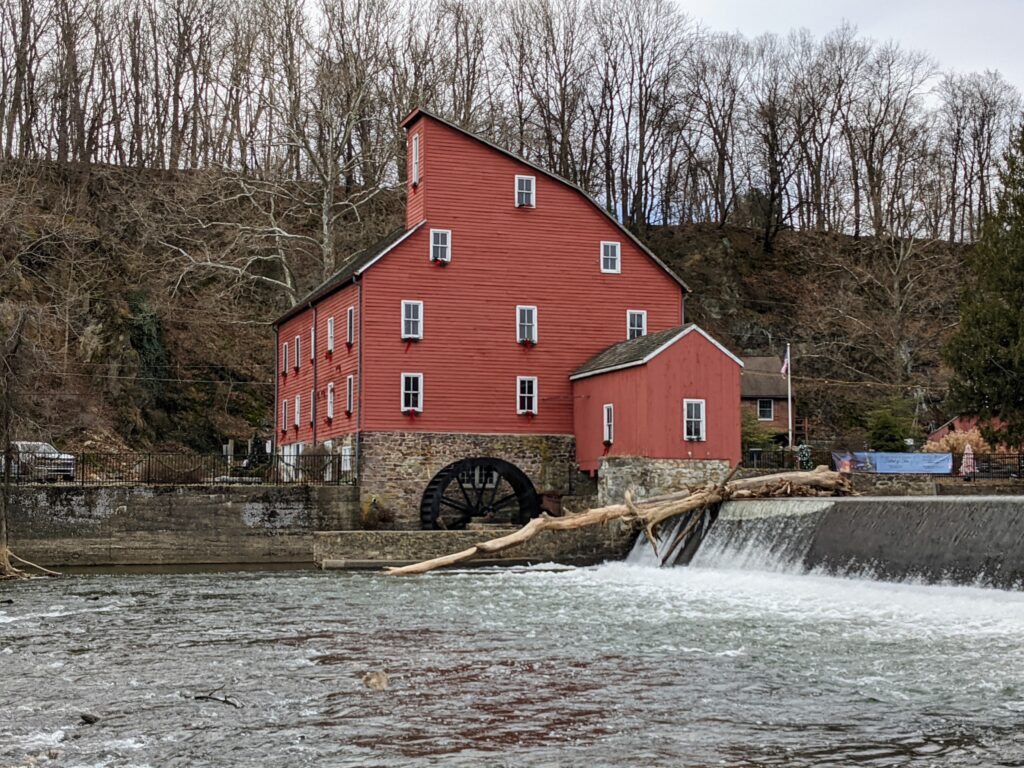
Any type of mill with machinery operated by water power; typically rotary power is supplied by a water wheel; related structures may include mill pond, mill race. (Bucher, 1996) Photo from Red Mill, Clinton, New Jersey, 2021.
Water wheels and water mills have roots dating at least to Roman times. The author and architect Vitruvius wrote in 15 BCE:
“1. Wheels on the principles that have been described above are also constructed in rivers. Round their faces floatboards are fixed, which, on being struck by the current of the river, make the wheel turn as they move, and thus, by raising the water in the boxes and bringing it to the top, they accomplish the necessary work through being turned by the mere impulse of the river, without any treading on the part of workmen. 2. Water mills are turned on the same principle. Everything is the same in them, except that a drum with teeth is fixed into one end of the axle. It is set vertically on its edge, and turns in the same plane with the wheel. Next to this larger drum there is a smaller one, also with teeth, but set horizontally, and this is attached (to the millstone). Thus the teeth of the drum which is fixed to the axle make the teeth of the horizontal drum move, and cause the mill to turn. A hopper, hanging over this contrivance, supplies the mill with corn, and meal is produced by the same revolution” (Vitruvius, 15BCE, Book X, Chapter 4).

Photo from Greenfield Village in Dearborn, Michigan, 2013.