

Visit to Pompeii, Italy
I arrived in Pompeii after dark. As I approached my phone was nearly out of power, making it challenging to find my room that had been reserved before arrival. This didn’t discourage me from exploring a bit.

Distinctive pavers with light and dark colors helped to make the sidewalk visible and easier to navigate, even after dark.

A mural showing Mt. Vesuvius on an otherwise nondescript building, helped to anchor the street and neighborhood within the overall story of the place.


The Pompeii Cathedral and a neighborhood church provided useful landmarks as I sought to navigate throughout the city.


As I was hunting for the room I booked there were loud banging sounds like gunfire. I turned around and could see the most dazzling fireworks going off above the nearby buildings. A few minutes later I saw the launcher for the fireworks discarded on the street.

After overshooting my destination I backtracked. A pathway to a beer garden caught my eye. And, sure enough, the smallest and most discreet as possible of signs indicated the stairs leading to my room were nearby.


Standing on the rooftop terrace outside of my room in the morning, I could see the city and the rugged mountains in the distance. It made for a perfect way to feel connected to the place and the land.


Focusing more on what was immediately at hand, the rooftop plantings added to the serenity of the site.


This wall had the rough exposed stones on the upper and lower registers while the middle was covered over with stucco.

Caffe Calabrese made effective use of a corner location with two tables and six chairs. This provides a visual signal of activities happening inside and also helps to bring the business out on to the sidewalk and into public spaces.

Another storefront had a small space out front for seating. And, while none was there, it is clear that efforts were made to support these small businesses.

The wayfinding here on a metal post with decorative metalwork and brown sign with white text helps to orient the pedestrian to their surroundings.


This pedestrianized street is near the Cathedral in Pompeii. Signs and signals allow for limited vehicle access by residents. Otherwise there is no parking or outside traffic allowed in. The central seating island is a product manufactured by trollo.it.

At the other end are large poured concrete planters that prevent vehicles from accessing the street altogether. At least one of these has been moved or displaced, making the barrier less formidable or easier to navigate by cars and service vehicles.
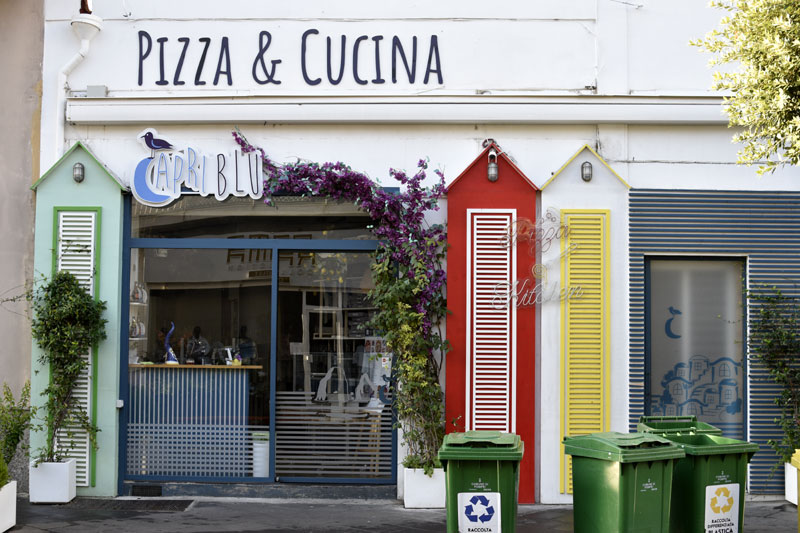
Pizza & Cucina has a lively design with creative use of color and texture. This draws the eye in and creates a sense of excitement for this storefront even after hours when the business is closed.

This outdoor dining space extends the business on to the street, giving a place for pedestrians to sit down. Protection from the sun provided by the umbrella is a further adaptation to the often sunny and hot environment.

Another storefront with retractable awning provides a protected area for people to dine beneath. Jeff Speck in his book Walkable City suggests that a touchable awning is best to create a sense of enclosure and an activated street.

This urban oasis with plants of various size, shape and texture delimiting the sides, creates a perfect place to dine outdoors. Square tables can be set individually or pulled together for larger groups. The awning finishes off the effect providing protection overhead.


One final building that caught our attention was this train station. The arcaded loggia on ground floor welcomes people in. While on the second floor the vertical windows with pediments and a cornice with attic story above, make for a tastefully designed classical composition. The front is degraded somewhat by car parking blocking the loggia, and pop-up tents and a kiosk of temporary character.