
Dossin Great Lakes Museum – Detroit, Michigan
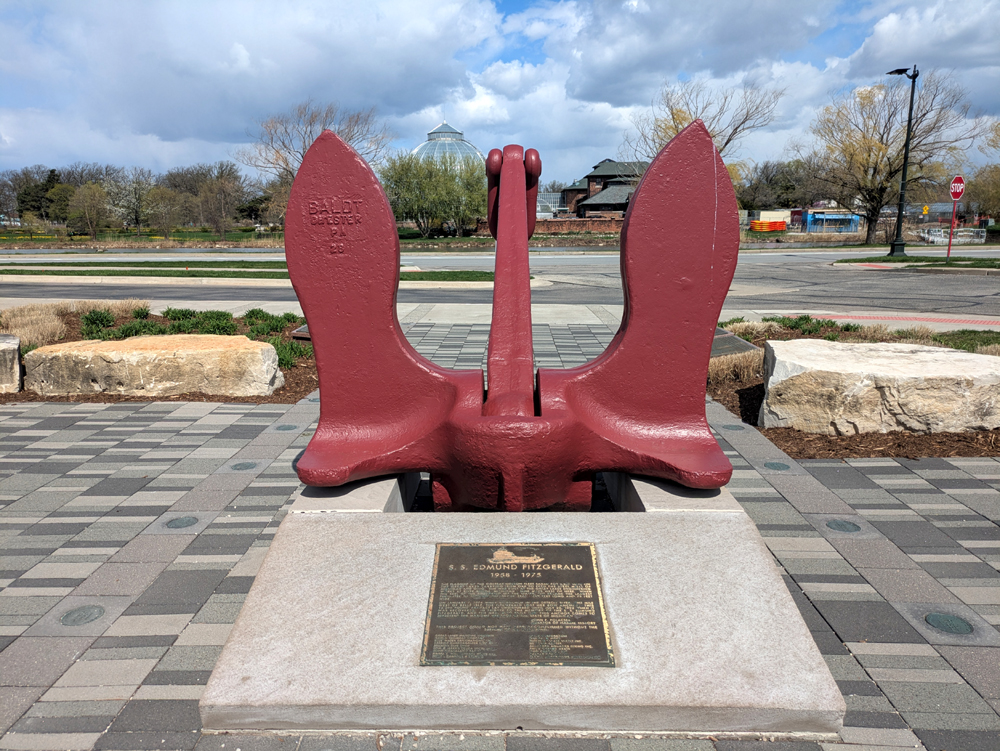
One evening in 1974, the S.S. Edmund Fitzgerald anchored at the Detroit River’s Belle Isle Anchorage, 800 feet off Riopelle Street, east of the Renaissance Center. The next morning, as the crew worked to raise the starboard bow anchor, a chain link separated. The 12,290 pound anchor remained on the bottom of the Detroit River. The following year the Edmund Fitzgerald was famously lost at sea during a storm on Lake Superior on November 10, 1975. The anchor was discovered by divers on May 20, 1992 with the help of a metal locating device called a proton magnetometer. After much planning, the anchor was removed from the water on July 20 and brought to the Dossin Great Lakes Museum the following day. The event was shown on live television, and thousands came to see the anchor in the following weeks.
Since November 10, 2000, the 25th anniversary of the Edmund Fitzgerald’s sinking, this anchor has been the centerpiece for memorial events honoring her crew and all mariners lost in service on the lakes. This anchor has been the focal point of the Lost
Mariners Remembrance program every November 10th. Participants have included over 30 Canadian and American organizations, making it the only international Fitzgerald remembrance.
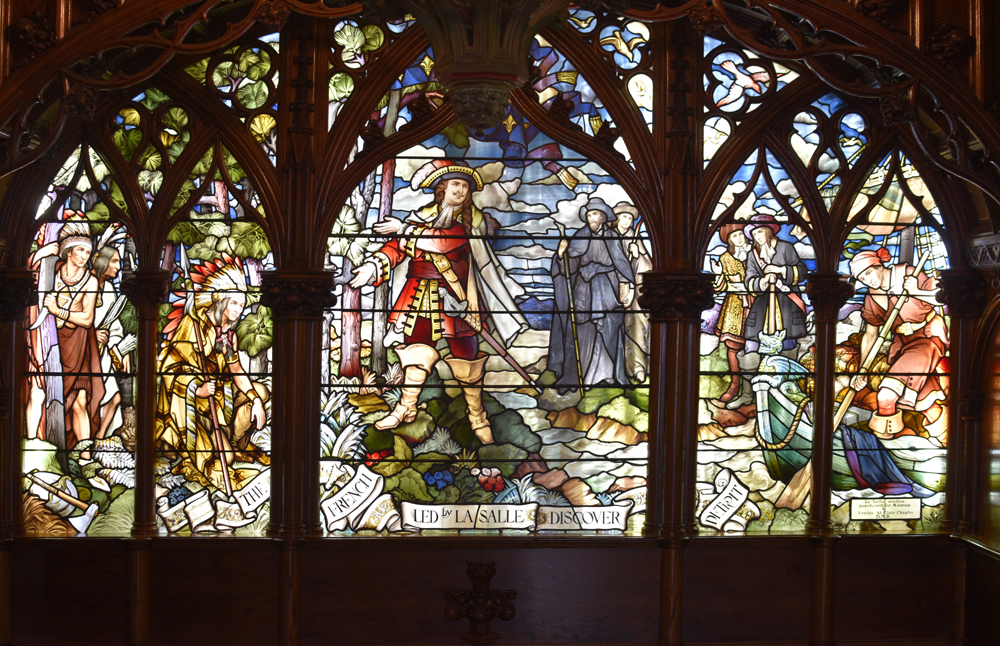
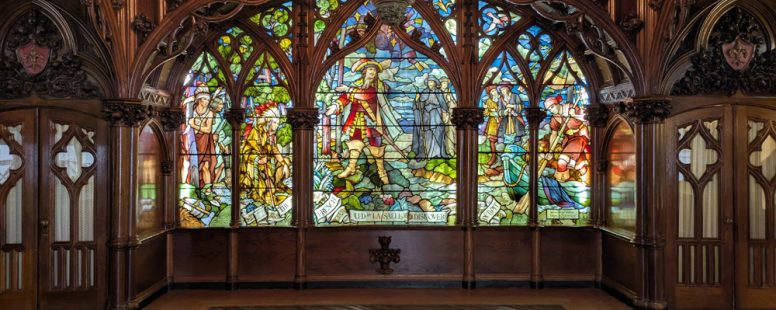
This stunning, five-panel stained-glass masterpiece is the La Salle Window, permanently exhibited inside the Gothic Room at the Dossin Great Lakes Museum. This window was not originally designed for a building ashore. It was commissioned in 1911 for the City of Detroit III, a massive, opulent side-wheel passenger steamship that sailed between Detroit, Cleveland, and Buffalo. The window served as the artistic centerpiece of the ship’s luxurious “Gothic Room,” an onboard gentlemen’s smoking lounge crafted from rich English oak to mimic a grand European cathedral. When the vessel was dismantled in 1956, dedicated local maritime preservationists salvaged the entire room. The carved woodwork and glass panels were stored in an Ohio barn for a decade before being fully restored and permanently reconstructed inside the museum in 1966.
The window illustrates French explorer Robert de La Salle and his crew landing along the Detroit River in 1679 aboard his historic ship, Le Griffon. The text reading “The French Led By La Salle Discover Detroit” arches across the bottom scrolls of the glass pane panels. The window was designed by architect Louis O. Keil and fabricated by the world-famous British stained-glass studio John Hardman & Co..
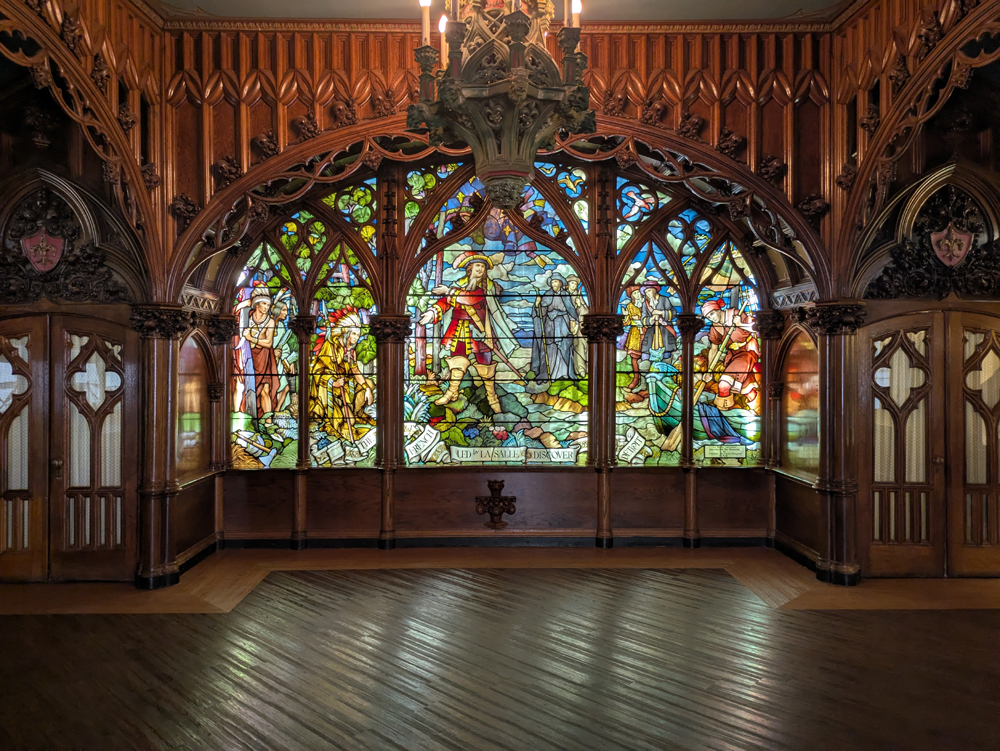
This wider view reveals the complete Gothic Room alcove enclosing the La Salle Window inside the Dossin Great Lakes Museum. The entire wall is framed in intricately carved English oak paneling, featuring Gothic Revival tracery, pointed arches, and clustered columns. A heavy, matching Gothic-style carved wood chandelier hangs directly in front of the window alcove. Two heavy wooden doors with quatrefoil window cutouts flank the stained-glass display. The room features diagonally laid hardwood plank flooring, matching the layout used on the original 1912 passenger steamship City of Detroit III.
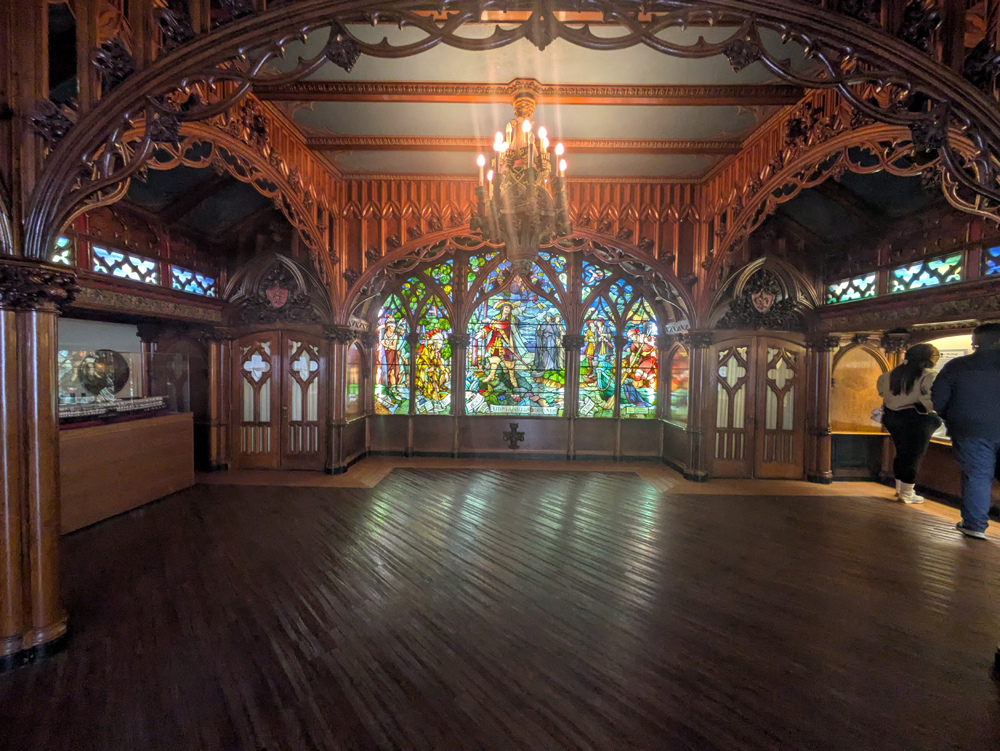
This broadest view captures the entire scale of the Gothic Room exhibit at the Dossin Great Lakes Museum, showcasing the surrounding architectural details and artifacts that flank the main stained-glass alcove. A ship model is visible inside a glass display case along the left wall. This case showcases scaled replicas of historic Great Lakes vessels, typical of the museum’s maritime collection. To the right, museum visitors are interacting with information kiosks and placards detailing the history of the City of Detroit III steamship, its designer Louis O. Keil, and its architect Albert Kahn (who designed other spaces on the ship). The top of the image highlights the immense carved oak archway spanning the entire width of the space, showing the true scale of what was once an onboard smoking lounge.
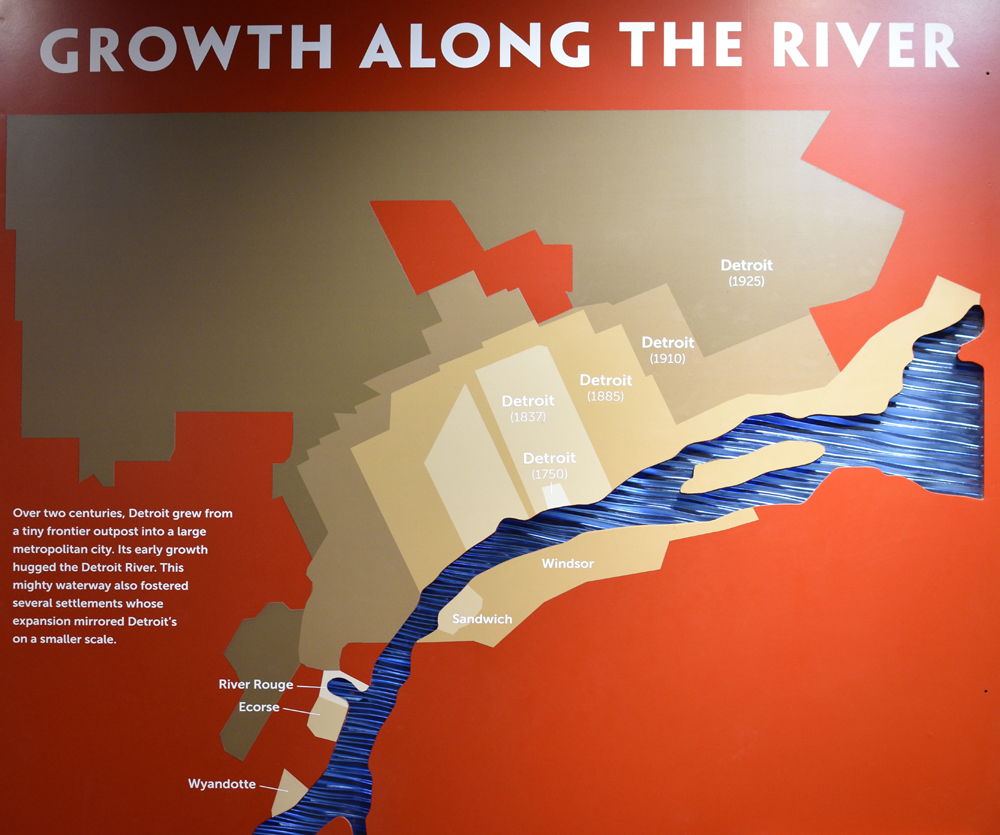
Over two centuries, Detroit grew from a tiny frontier outpost into a large metropolitan city. Its early growth hugged the Detroit River. This mighty waterway also fostered several settlements whose expansion mirrored Detroit’s on a smaller scale.
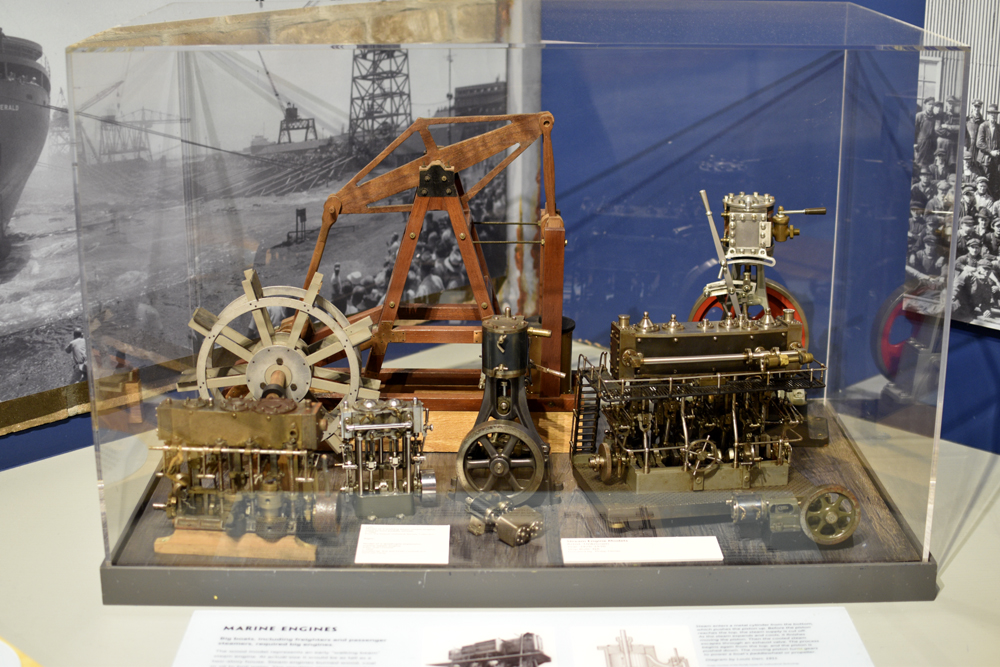
This exhibit display case at the Dossin Great Lakes Museum showcases detailed, scale-model marine steam engines. These miniature engineering replicas represent the massive propulsion systems that powered 19th and early 20th-century Great Lakes vessels. The large wooden and metal model features a prominent overhead pivoting walking beam connected to a paddle wheel. This mechanism represents a vertical beam steam engine, the dominant propulsion design used to drive early side-wheel passenger steamers across the Great Lakes. The smaller, intricate brass and steel models display multi-expansion reciprocating technology (such as double or triple-expansion engines). These systems reused steam across multiple cylinders to maximize fuel efficiency on long freighter routes. The black-and-white mural behind the glass captures a historic shipyard, showing the scale of the actual vessels these engines were built to propel.
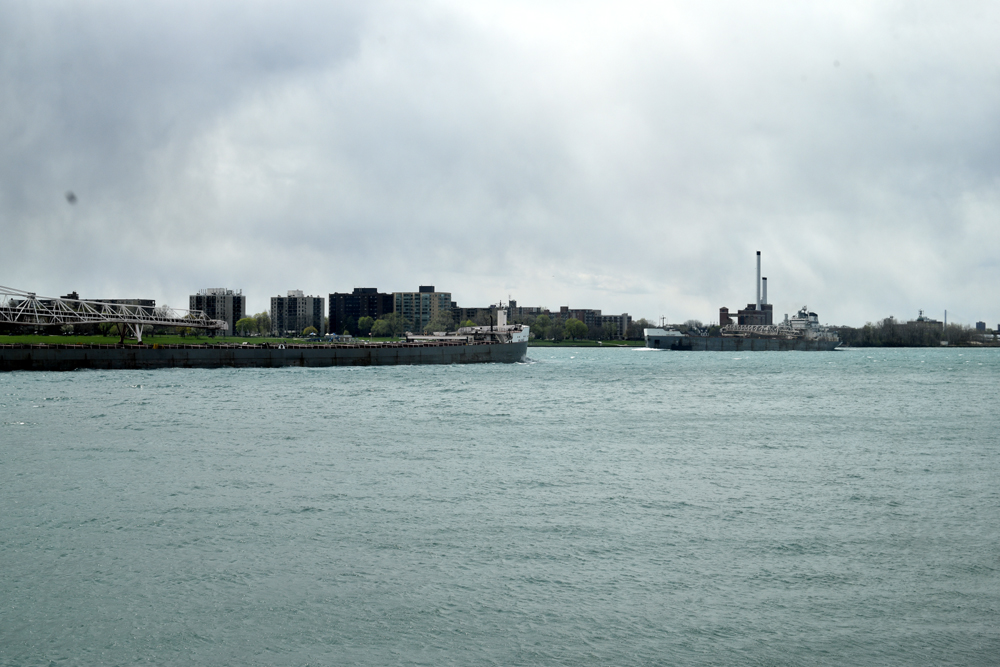
This view looks north from the shoreline of Belle Isle Park, capturing massive freighters navigating the Detroit River shipping channel. The image captures two large bulk carriers, including a self-unloading freighter on the left characterized by its long, iconic deck-mounted unloading boom. This stretch of water is one of the busiest inland waterways in the world, connecting Lake Huron to Lake Erie via Lake St. Clair and the Detroit River.
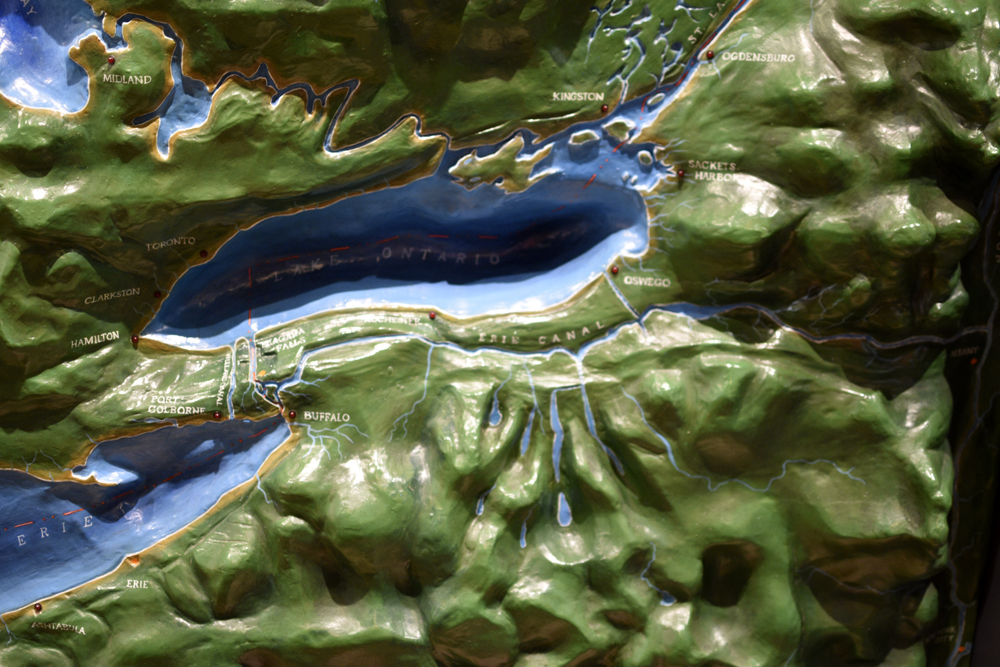
This 3D topographical map shows how the Finger Lakes feed in to the Great Lakes watershed. The Erie Canal is also shown running parallel to Lake Ontario and entering Lake Erie near Buffalo.
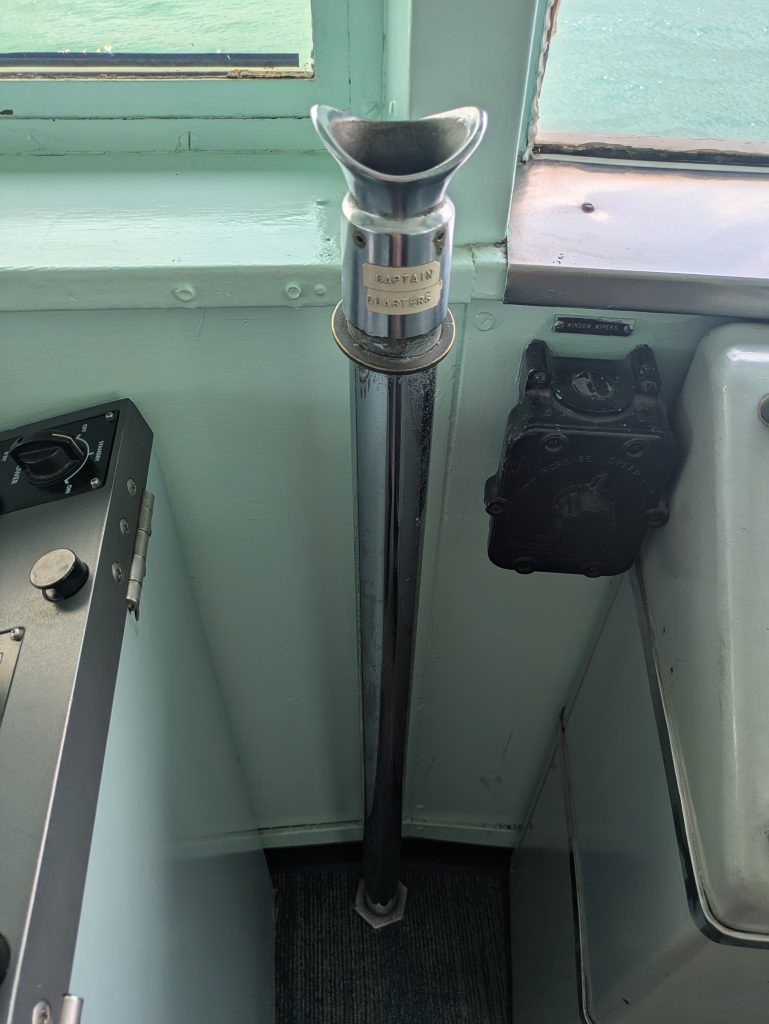
The pilot house is a room of the museum that opens up to the weather. That creates a real-life sense of being on the River as if having to navigate with modern day passing vessels.