

tall case clock
The word clock comes from the Latin word for bell, clocca. Since the 1300s, church and cathedral clocks chimed the hour, making them the first public timekeeping device. The tall case clock was born in the mid-seventeenth century, after Dutch astronomer and mathematician Christiaan Huygens designed a pendulum that could complete a swing in one second. To be accurate the pendulum needed to be a certain length, and, in turn, required a tall case to house it. Tall case clocks with pendulums and anchor escapements could reliably keep time within a few seconds a week.
Elements of a tall case clock follow:
- The Hood or Bonnet houses the clock movement
- The Spandrels are decorative corner frame elements that can be painted or applied
- The Hands indicate the minute, hour, and seconds
- The Dial is the face of the clock that displays hour numbers 1-12
- The Finial is a wood or brass decorative ornament at the top of the clock
- The Lunette is the arched upper portion of the dial which sometimes contains a moon phase
- The Winding Arbor is where a key is inserted to raise the weights that drive the clock movement
- The Calendar Aperture is the cutout in the dial face which reveals a revolving calendar wheel with the days of the month
- The Case is the wooden cabinet or “tall case” that holds the weights and pendulum. (Morven Museum & Garden, 2023)

Hood or bonnet. Photo from Princeton, New Jersey, 2023.
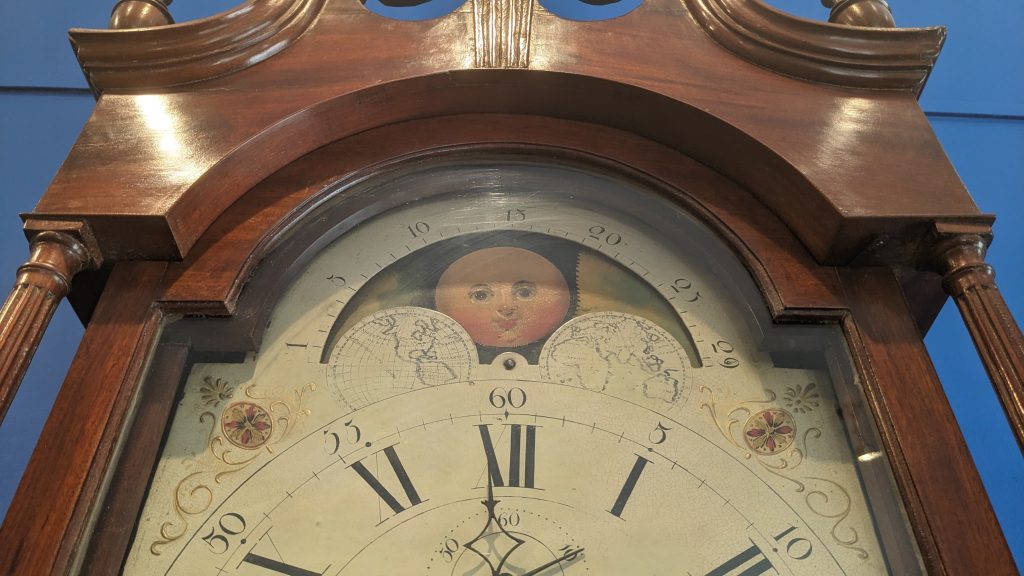
Lunette with moon phase. Photo from Princeton, New Jersey, 2023.