

Camposanto – Pisa, Italy
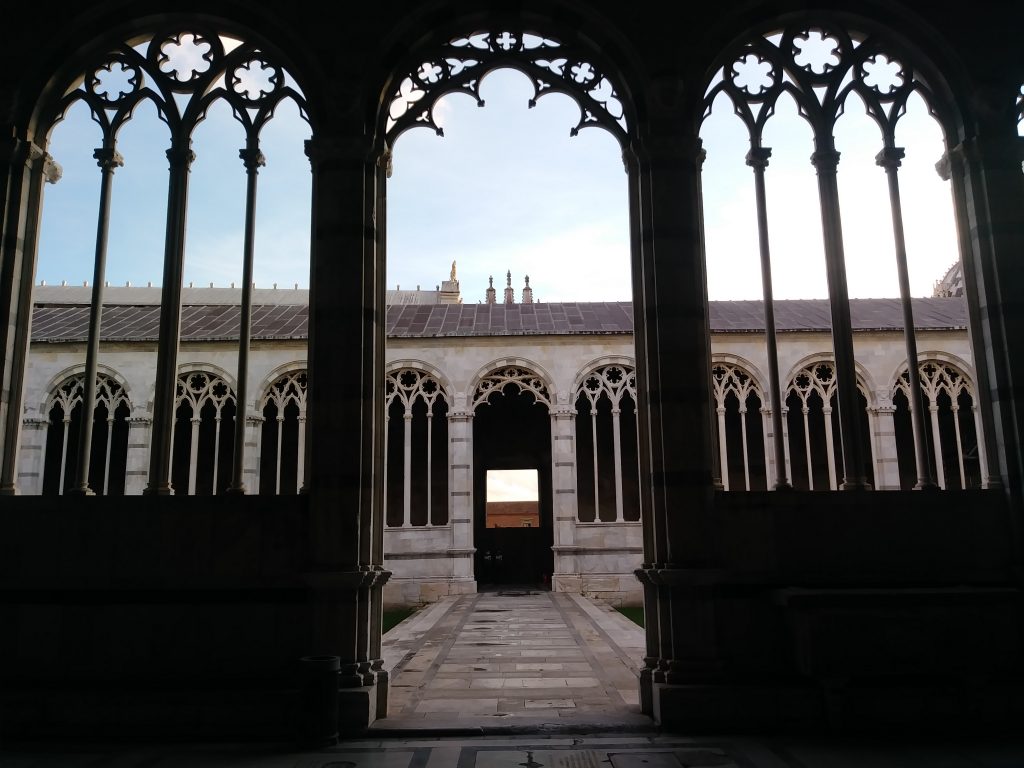
The burial ground lies over the ruins of the old baptistery of the church of Santa Reparata, the church that once stood where the cathedral now stands. Around 1278 tombs that surrounded the cathedral were brought here. Built from 1278-1465, the defining features are the cloistered interior courtyard, some ancient sarcophagi, and the large 14th century fresco The Triumph of Death.



The Monuments
The arcade floor is paved with coats of arms of 600 departed Pisans. Anyone may walk upon these tombstones. Scars on the marble flooring are the result of lead melting from the roof during bombing in World War II.


This Greek stele (tombstone) dates from the time of Alexander the Great (4th century B.C.). The seated woman has just given birth. The woman standing shows the baby as the mother gazes along.


Several links from the chain which once protected ships from entering Pisa Harbor now hang upon the wall of the Camposanto. Genoa attacked, broke the chains and took them off as a war trophy. Later they were given to Pisa’s archival Florence. Only after reunification were they returned to Pisa as a token of friendship.
Dal Pazzo Chapel

The chapel Dal Pozzo was commissioned by archbishop of Pisa Carlo Antonio Dal Pozzo in 1594. An altar here is dedicated to St. Jerome. A little dome rises above. In 2009 relics from the Cathedral were moved here including relics from eleven of the twelve Apostles, two fragments of the Truss Cross, a thorn from the Crown of Thorns of Christ, and a small piece of the dress of the Virgin Mary. Also in the Dal Pozzo chapel sometimes a Mass is celebrated.


The Frescoes
In the 14th and 15th centuries, the walls of the Camposanto were decorated with frescoes by Taddeo Gaddi, Spinello Aretino, Benozzo Gozzoli, Andrea Bonaiuti, Antonio Veneziano, and Piero di Puccio.


This fresco from c. 1340 displays the view of Pisans towards death. In the left half of the painting well dressed ladies and gentlemen are riding through the countryside where they encounter coffins with three corpses. Confronted with death they each have a different reaction.
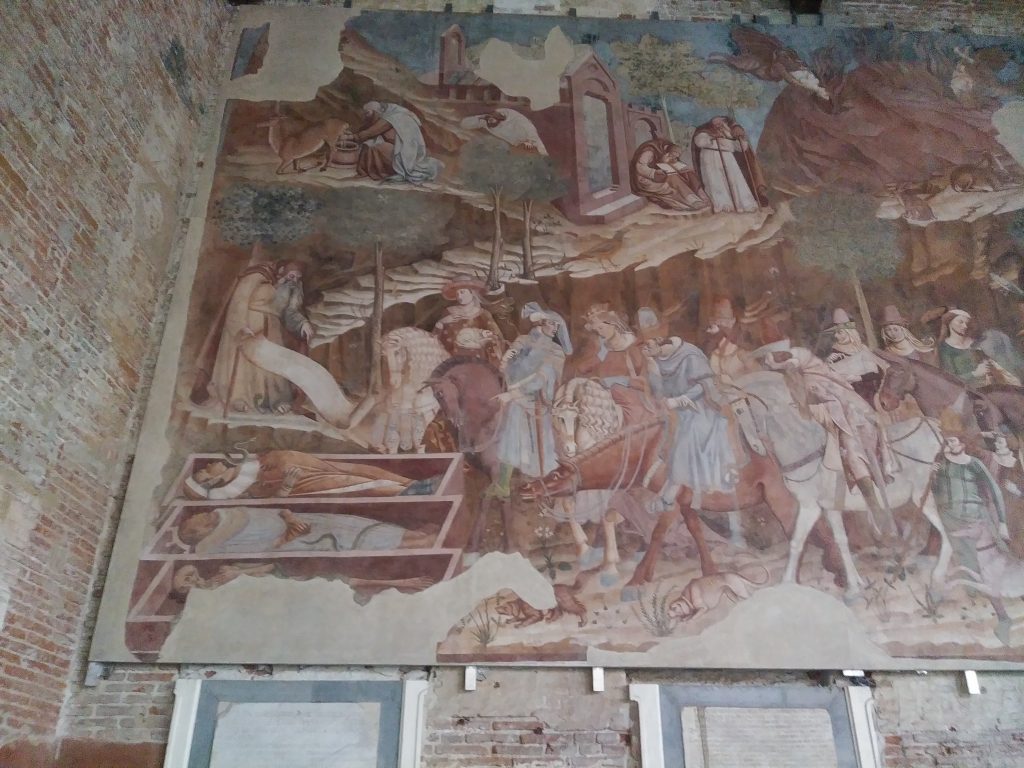
One woman puts her hand thoughtfully to her chin, another man holds his nose, and a horse leans in for a better whiff. A monk above them reads the Bible for an explanation of the meaning of death. The right side of the painting shows young people in a garden playing music (symbolizing earthly pleasure) unaware of what is happening around them. Demons swoop down to pull souls (shown as babies) from corpses, while winged angels fight them.

The large concentric circles in the corner are a representation of the 14th century view of the universe – everything held by Christ, with the earth in the center.

The dirt of the Camposanto is said to turn a body into bones in a single day. Returning Crusaders shipped it here from Golgotha on Jerusalem’s Mount Calvary, where Christ was crucified.
Restoration
The Camposanto suffered great damage during World War II. In the summer of 1944, the Allies had retaken much of southern Italy and pushed Nazi forces to the north bank of the Arno. German Field Marshal Kesselring fortified Pisa and was surrounded by the US Army’s 91st Infantry. On July 27, 1944, American warplanes launched a major air attack against Pisa. The wooden roof caught fire, its lead panels melted and the hot metal ran all over the frescoes. Many were completely destroyed and the few that remained were badly damaged.
American artist, Deane Keller, served during World War II as one of the “Monuments Men.” Following the war he helped to rebuild the Camposanto and restore the frescoes there. Following his death he was buried in the Camposanto with honors from the United States, Italy, and the Roman Catholic Church – recognizing his important role in the restoration.

Additional Sources
Art in Tuscany, accessed 12/20/2018. http://www.travelingintuscany.com/engels/pisa/camposantomonumentale.htm
Camposanto – Pisa, Italy, Sacred Destinations, accessed 12/20/2018. http://www.sacred-destinations.com/italy/pisa-camposanto