

Albion Interactive History / People / <Albion College
 John W. Laird, 1882
8th President, 1921-1924
Died January 17, 1966
Albion College President +
Accomplishments as President
- Secured support from the Kresge family for construction of the Kresge Gymnasium built on Albion’s campus.
Note: An ancestor of Dr. Laird would like to know if other members of the family are still alive. If you are a Laird family member, or know the identity of one, please write to AlbionVision.com Webmaster Isaac David Kremer, at placepromo@gmail.com. [Posted December 2003]
Biographical Information
Dr. Laird was born October 5, 1882, in Blantyr, Scotland, the son of Thomas and Jane (Patterson) Laird. After arriving in the United States as a small boy in 1888, they settled in Scranton, Pennsylvania. He graduated in 1905 from Wyoming Seminary, Kingston, Pennsylvania. He received his Ph.D degree in 1909 from Syracuse University, an institution which granted him a Doctor of Divinity degree in 1916. He was granted another honorary doctorate, that of LL.D., by Albion College in 1921, shortly after becoming Albion’s president. After receiving his bachelor’s degree from Syracuse, he and Margaret Lila Keller of Kingston Pennsyvania, were married, June 13, 1908. They had one son, Jack, who now lives in Miami, Florida, with two daughters.
While still a student, John W. Laird worked as supply pastor of Grace Methodist Church, the Bronx, New York, from 1910 to 1912; the Winsted, Connecticut, Methodist Church from 1914 to 1918, and the Mt. Vernon Place Methodist Church, Baltimore, Maryland, from 1918 to 1921. It was from the latter church that he came to Albion for the college presidency.
It was about the time Dr. Laird came to Albion that his book, The Role of the Educated Man, was published in 1921. He also is the author of a number of papers and addresses. It was not long after his arrival in Albion that students at the college and residents of the city heard some of those addresses. They caused listeners to realize that they had heard the words and voice of a vigorous, intense man whose personality was positive and strong. In its own way, his personality was as strong, probably, as that of his predecessor Dr. Dickie. Dr. Laird was tall, handsome, and his manner was assured.
Throughout their administrations, it is clear Dr. Dickie and Dr. Laird held what each regarded as the best interests of the college in mind. These two men strongly disagreed however. Factions backing both developed quickly among students and faculty members. Even many Albion townspeople were drawn into one faction or another. The disagreement between the youthful and the venerable, the old regime and the new regime, tradition and modernity, the personality of a strong and youthful man and the personality of a strong and venerable man.
Dr. Dickie loved the college as it was when he left office. To him Albion was a fine school and he helped make it fine. Dr. Dickie had done his work, but Dr. Laird was just starting his. It is natural for the new president to seek out conditions which he could improve, to look for work to do, to develop important plans to be carried out during his own administration. Dr. Laird’s seeking their adoption, and the manner in which he sought it may have implied that the new administration was critical of the old.
Students, faculty members, and trustees began to learn of the disagreement. Even faculty members and trustees quietly took sides. Students learned of this. A climax came on January 18, 1924 at an uprising. President Laird was greeted by a chorus of hissing, boos, catcalls, and stomping of feet at chapel service, walked out of the Chapel and out of Albion College. The resignation of Dr. John W. Laird from the presidency of the college was accepted Monday, January 21, 1924, at a meeting of the Board of Trustees in Detroit. Appointed to replace him on an interim basis until a new president could be appointed was Frederic Samuel Goodrich.
When he left Albion after a little less than three years as its president he became minister of the Brighton Presbyterian Church in Doylestown, Pennsyvania. Dr. Laird was in Doyleston briefly, however, before becoming professor of philosophy and social ethics in the school of theology of Temple University, Philadelphia, the same year. He taught with great success at Temple until his retirement in 1953.
By mid-summer Laird transferred his ministerial allegiance to the Presbyterian Church, assumed the pastorate at the Brighton Presbyterian church in Rochester, New York, and there he remained for the next twelve years. Ultimately his work as youth counselor and public lecturer led him in 1937 to a professorship in philosophy and social ethics in the School of Theology at Temple University in Philadelphia, where he taught with much acclaim until his semi-retirement in 1943. Thereafter he continued his ministry at the Port Kennedy Presbyterian Church in Philadelphia for another decade, still preaching and teaching until his death on 17 January 1966. Mrs. Laird died seven years later on 8 April 1973.
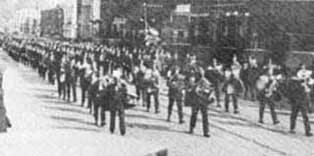
An inaugural procession 800 strong, led by the college band, marched from the campus to the First Methodist Church.
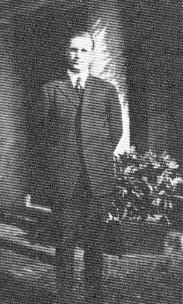
President-elect John Laird poses for a photo at the 1921 Commencement.
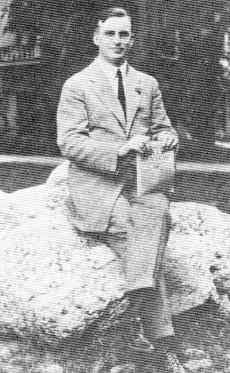
Source: Gildart, Robert. Albion College, 1835-1960, A History. Chicago: Donnelley Lakeside Press, 1961.
My great aunt, Mildred Oatley, was a member of the 1924 class of Albion College. My deceased wife, Terry, was the granddaughter of Rev. Stanley Niles who was helping lead the chapel service on January 18, 1924. I am a 1971 graduate of Albion. I remember hearing of the conflict centered on President Laird from both Aunt Mildred and grandpa but the details of the event were always very limited. Thank you for this more complete account. I have just found the report of this from the Albion Evening Recorder in a box of family papers.
Dr Laird had one adopted son and two granddaughters of which I am one. I was 12 when he died and only in the last several years came upon the details of his short lived presidency at Albion College. He was a brilliant man and wonderful grandfather. I wish in some ways I could know what truly transpired during his tenure but in other ways would rather remember him as I knew him.
Dr Laird was my grandfathers brother. My grandfather sadly passed away when my mother was three, in Scranton, Pa. I believe his name was David and he had four children. He died before the youngest was born.
Ginger- I just saw your comment and yes your grandfather was David Patterson Laird, my grandfathers younger brother by two years. My sister has done extensive research on the Laird family and has a picture of David with his wife and two young children. He was born June 30, 1880 in Scotland and died in Scranton Nov 22, 1913. That makes us distant cousins. If you see this please feel free to write me and I can share more about the family.
I should have said your grandfather was two years older than mine.