John Underhill of Ettington Manor
Isaac Kremer/ March 3, 2013/ family, Underhill/ 0 comments
Ettington Manor has roots going back before the Norman Conquest. The Domesday Book in 1085 noted the “Manor of Eatington” was occupied by Saswalo. This same figure Saswalo or Sewallis was the first ancestor of the House of Shirley that would gain possession of Ettington. Later, the same figure by the name of Saswalo founded and endowed a church at Ettington that was tied to the Priory at Kenilworth. The Priory had been established between 1139 and 1147, and was located in Kenilworth approximately 17 miles north of Ettington.[ii]Establishment of the church at Ettington in the 12th century started an exchange that was religious and later cultural, linking these two places together for centuries to follow.
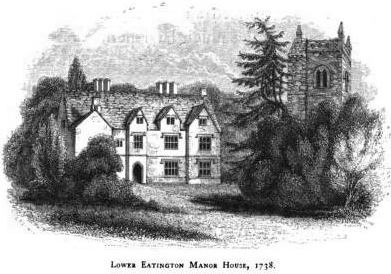
Lower Ettington Manor House, 1738 [iii]
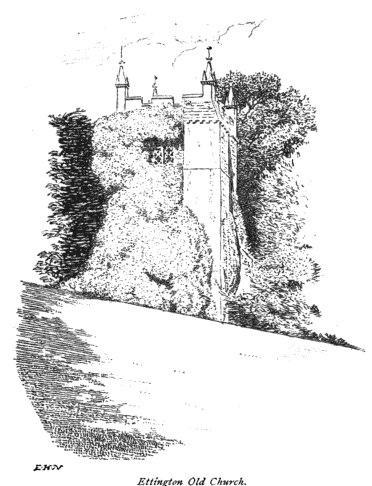
Ettington Old Church [iv]
Members of the House of Shirley would
rise to positions of great importance in England. Sir Hugh Shirley was the Grand Falconer
to King Henry IV in 1400. He lost his
life in the Battle of Shrewsbury in 1403, when
dressed as a decoy. He was mistaken as the King by the enemy and killed.
[v]Sir Hugh’s heroic efforts
later would be immortalized by Shakespeare in his
play Henry IV, in which King Henry said:
Hold up thy
head, vile Scot,
or thou
art like
Never
to hold it up again! the
spirits
Of valiant Shirley, Stafford, Blunt, are in my
arms:
It is the
Prince of Wales
that threatens thee;
Who never promiseth but he means
to pay.
Sir Hugh Shirley’s son Ralph was the next
to acquire Ettington. Ralph Shirley distinguished himself at the siege of Harlefleur in 1415. He was also a
principal commander at the Battle of Agincourt, where he had a retinue of
seven men at
arms and twenty-three archers. This Battle was remembered as a decisive
victory of England
over a superior
French force which outnumbered them nearly
six to one. The
use of the longbow especially was particularly decisive. Later Shakespeare would
use this battle as the
centerpiece of his
play Henry V.
John Underhill acquired
an 80
year lease for Ettington
from Sir Ralph Shirley in 1509. Underhill’s wife Agnes Porter was the daughter and heir of Thomas Porter who was a
former lessee of Ettington Manor.
[vi]Sir Ralph Shirley would eventually
die in 1517, and his son Francis Shirley would go on
to inherit Ettington following his father’s
death.
[vii]John Underhill himself died in 1518. Both he and
later his wife Agnes would be laid
to rest in the Chapel of
St. Nicholas on the
grounds of Ettington.
[viii]
Underhill and Porter would have three sons, all who would go on
to positions of importance. These include William Underhill (1475-1542), Thomas Underhill (1485-1520), and Edward Underhill (1486-1547). The will of
John Underhill clearly stated
that if his eldest son William Underhill died without heirs,
that his lands would pass on
to his
second eldest son Thomas and his heirs. William Underhill lived long enough for a fresh
one-
hundred year lease to be made
to him by the son of Sir Ralph Shirley, Francis Shirley, in 1541.
William Underhill unfortunately died the following
year in 1542
with “no issue.” Thomas Underhill and his wife
Anne Wynter of Hudington, who herself
came from a long
line of nobility, were the last
two in their respective families
to remain
Catholic. Thomas Underhill had long since been
dead by the time his brother William died in 1542. This meant
that the
property would then pass on
to Edward Underhill, the last surviving son of
John Underhill and Agnes Porter.
[ix]By the time of his
death in 1547, Edward Underhill gained
lease not only
to Ettington but also
to the Manor of Herbury and lands in Stratford-upon-Avon. This was merely prelude
to the accomplishments of his son William Underhill (1512-1570) who would go on
to study law and amass substantial landholdings of his own, while
rising to a position of prominence as a
member of the Inner
Temple in London.
[x]
[ii]The fortunes of a
Norman family: the de Verduns in England, Ireland and Wales, 1066-1316 By Mark
S. Hagger (Published by Four Courts Press, 2001. p.36.
[v]Charles Mosley, editor, Burke’s Peerage, Baronetage & Knightage, 107th edition, 3 volumes (Wilmington, Delaware, U.S.A.: Burke’s Peerage (Genealogical Books) Ltd, 2003), volume 1, page 1416. Hereinafter cited as Burke’s Peerage and Baronetage, 107th edition.
[vii]Sir Ralph Shirley was the son of
John Shirley and Eleanor Willoughby.2 He married, firstly, unknown wife (?).1 He married, secondly, Elizabeth Walsh, daughter of Thomas Walsh.1 He married, thirdly, Jane Sheffield, daughter of Sir Robert Sheffield and Jane Lounde, circa 1514.1,
3 He died in 1517.1
[viii]“Underhill Places in Staffordshire and Warwickshire,” News and Views, vol. 38, issue
3, Underhill Society of America, August 2005. p.10.
[ix]Underhill genealogy, Volume 5 by Josephine
C. Frost, Edwin
R. Deats, Harry Macy, Carl
J. Underhill, Underhill Society of America. Published privately by
M.
C. Taylor in the interests of the Underhill
society of America, 2002.
[x]Shakespeare’s Warwickshire contemporaries By Charlotte Carmichael Stopes (1907, Shakespeare Head Press). p.227.
