
Downtown – Somerville, New Jersey
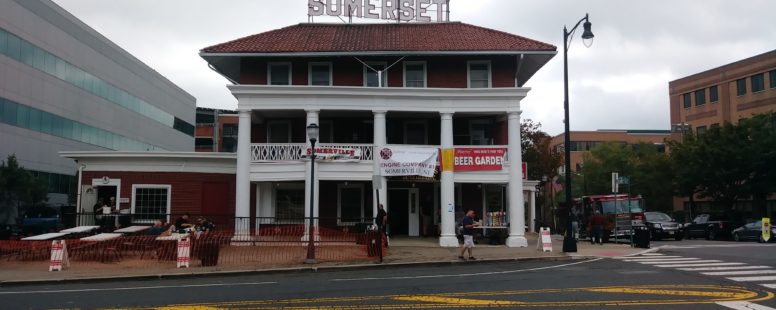
Development took off when the old Easton Turnpike (Route 28) was laid out. Among the early developments was a fashionable townhouse for Ferdinand Vanderveer. He was a prominent citizen and county politician who served as the Judge of Common Pleas from 1822-1835. The house was later occupied by the West End Athletic Association (1891-1895). In 1910, Benjamin Billian purchased the property and raised the house, constructing a lower floor to be used for business purposes. Dooley Bros. Chevrolet (1919-1959) and Somerville Aluminum (1960-2013) are a few other uses that followed. This early property captures the changing use over time and the shifting role of downtown Somerville, while remaining the county seat through it all.
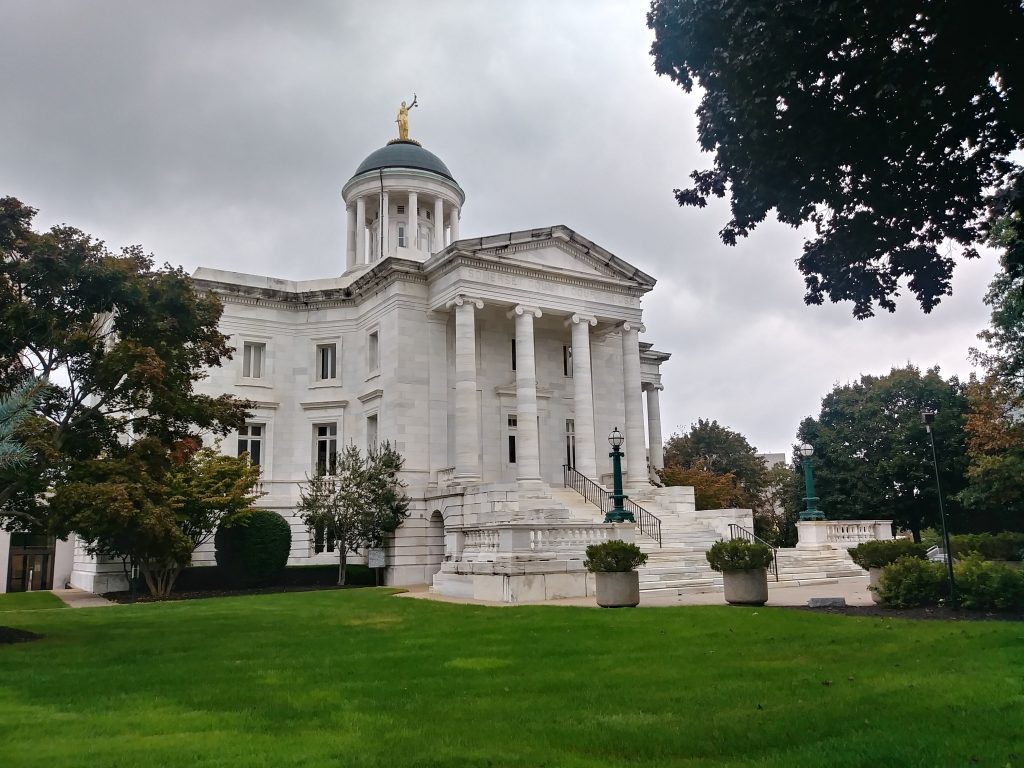
Our visit to Somerville fittingly started with the Somerset County Courthouse. Constructed between 1907 and 1909, this is an exceptional example of the Neoclassical style.


The architectural detailing of the building is what makes it special. The dado, leafwork, balusters, and a stylized lion head brass fountain were just a few of the highlights.

My son Thomas also joined in appreciating the architecture in his own way.

Near the courthouse was a well executed fountain and reflecting pool. The fountain head was in a handsome aedicule with water pouring from the mouth of a bucrania set within a niche. Composite columns on each of four corners supported an entablature with swag details carved along its length.

One detail in particular caught our eye. The scroll on top of the wlal and supporting the fountain provides a transition where there otherwise might have been a stark right angle. The interior of the spiral has a delicate rosette with a Greek cross feature at its center.

The Hotel Somerset today has a restaurant and bar. In its heyday it might have had more of a prominent role in the life of the community with people coming to town and needing to stay a few nights. The colonnade on the front is both aesthetic and functional, supporting outdoor space on the second floor level.
Cort Theater Building at 34 East Main Street was the location of Somerville’s last motion picture theater. The building opened in 1922 and closed in 1983. The fly loft to the rear of the building, where scenery was stored, is still visible.

We visited on the day of the Somerville Street Fair & Music Festival. Organized by a private company that does similar events throughout New Jersey, this free event benefited the Somerville BPA. While an important cause, events like this do little to promote the success of year round businesses. They most benefit the out of town vendors who are brought in for a day. Money spent in town at these vendors leaves town when the festival is over. Smart economic development strategies find ways to make local businesses first, and work to retain hard earned money in town. See Field Notes: Local First.


Division Street is a real point of pride in Somerville. Closed off to car traffic, this has created a sizable public space in the heart of the downtown. A barrier at the entrance promotes “Summer in Somerville.” Cruise Nights on Friday nights, Summer Stage every Friday night, and Starlit Cinema on Thursday night are just a few of the highlights.


The Gernert Building has handsome terra cotta detailing in the lettering and the scroll keystone over the main entrance. A slight crosette is visible in the lintel where it extends beyond the stones below.

Another excellent building in Somerville is the one that housed TD Bank. The bank is two stories with the lines of a classical temple. A modillion course supports an entablature and the pediment at one end. The ground floor resembles an arcaded block commercial building with uniform round arch windows. The main entrance has a slightly larger arched opening that rises above the height of all the others. On the second floor level there is a band of double-hung windows running the length of the whole building. Architecturally there are some similarities with the Tevis Block in Bakersfield, California..

In an alley was a mural installation recognizing “Somerville’s Own” Paul Robeson. A plaque identified him as a “Renaissance Man.” The Mural artist was James Kelewae. And the project was supported by Arts on Division whose purpose is “Building the Arts in Our Community.”


A curious pergola structure marked the entrance to the alley. Some plants were established on one side. Overall, however, the landscaping and the structure itself appeared to be in need of maintenance.

The Fireman’s Museum goes to show how much architectural character can be packed into a relatively small building. No wider than a common car, the firehouse doors at ground level, and a balconette and round arched window with keystone above fill most of the building space. The jerkinhead roof nestles up against the shape of the arch giving a sense of enclosure. Constructed in 1888 for the West End Hose COmpany, it was originally intended to meet the needs of residents on the west side of town. This brick building replaced a wooden shed which had the hand-drawn fire fighting apparatus of Union Fire Co. No. 1 (1852-1878). Some of the bricks used in the construction were salvaged when Daniel Robert demolished the “castle” on the site now occupied by Borough Hall. After the initial hand drawn fire apparatus, the building subsequently housed the Borough’s first horse drawn truck (1888) and Macky, the horse purchased to pull the single harness rig. In 1916 the first motorized apparatus was purchased. In 1970, West End Hose relocated to High Street. Their original firehouse was dedicated as a museum.

The cantilevered balconette is reiminscent of the shape and position of a roll down gate. In this instance, however, it appears to be an architectural feature that supports the balconette overhead with its decorative railing.


Another building that caught our eye before we left and surprised us, was the USA Architects Planners and Interior Designers building. The building clearly borrows from the modern language of architecture. Distinctive features include a stacked brick bond, the geometric arrangement of the building with a row of evenly spaced square windows, and use of a curtain wall for the entrance area to allow in extra light. The landscaping is of note too with topiaries, shaped to a degree, to accent the very minimalistic building.

Our visit to Somerville ended, much as it began, looking at architecture. We did not see a more humble and aged building than this carriage house. Clearly it had seen better days. Foundation issues have led to apparent settling. Many of the windows are boarded over, and some of the barn doors also are braced in the closed position. Given the significant age on the building, however, it presents an important connection to the days of Somerville’s settlement and early growth. Hopefully others see the historic value of this building and give it the care that is needed.