
Two Approaches to City Building
This week we take two examples locally, to demonstrate how city building should and should not be done.
The Bank One building on the north-west corner of the important intersection of Biddle and Eureka Ave. is a product of urban renewal and the idea that we need to save a city by destroying large portions of it and by creating something new.
Comparatively, the Wyandotte Theater is a historic downtown theater, that while demolition is not inevitable, the window to find a new use for this building is rapidly closing.
From these two examples, some lessons may be derived to determine how city building should and should not occur.
The Bank One building currently underutilized and with space available for lease, occupies two contiguous blocks (block 73 and 88) that once had over 30 buildings on each of them. These buildings were cleared, 2nd St closed between Sycamore and Eureka, and a new and modern building constructed at an angle to the street and other buildings, set back far from the sidewalk edge.
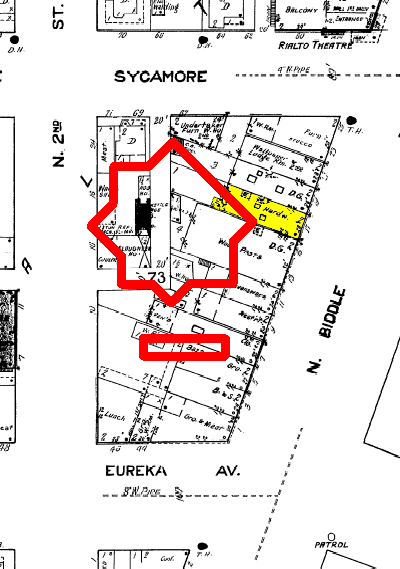
A map from 1922 shows an outline of the Bank One building and drive-through superimposed over the block and buildings on the block as they appeared in the 1920s.
Had some or all of the historic buildings that had formerly occupied this block been in place, they likely would complement and accompany a growing concentration of activities and businesses on surrounding blocks including the newly restored building on the north side of Sycamore that is home to Stroh’s and other businesses, and the new Energie Café and Austin’s Hyde Park to the east. Instead, the west side of Biddle Ave. between Sycamore and Eureka has an oddly placed and proportioned building that is separate from and does not contribute to either the historic character or the increasing activity downtown.
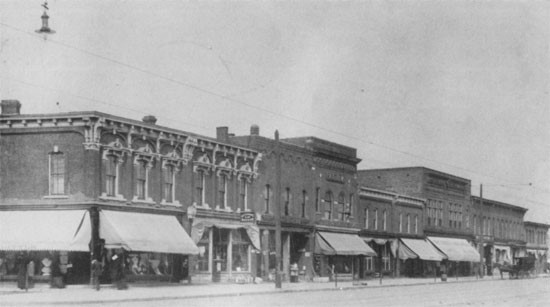
Buildings on Biddle between Eureka and Sycamore that were demolished.
The lesson to learn from this example is that while in the 1960s and 1970s the historic buildings on this block might not have had a clear use or function, that if retained today they would help to strengthen Wyandotte’s identity as a historic downtown, and complement emerging activities.
Soon the community will have to decide what is to be done with the Wyandotte Theater. This building too could be purchased, demolished, and replaced with something new. And it is possible that what replaces it is could be of high-quality and strengthen the downtown. Of course it is also possible, much like the Bank One building, that if the Wyandotte Theater is demolished that it could be replaced by a building of lower quality and future generations will judge us with scorn because we took away from them the opportunity to have a functioning historic theater and/or their opportunity to bring it back to life.
So perhaps the greatest lesson from all of this is that even while the future of the Wyandotte Theater is uncertain, that it is wise to avoid making a decision on what to do with the building until a decision absolutely needs to be made. Then with the appropriate information, a skilled project team could be assembled to consider preservation of this important building.