
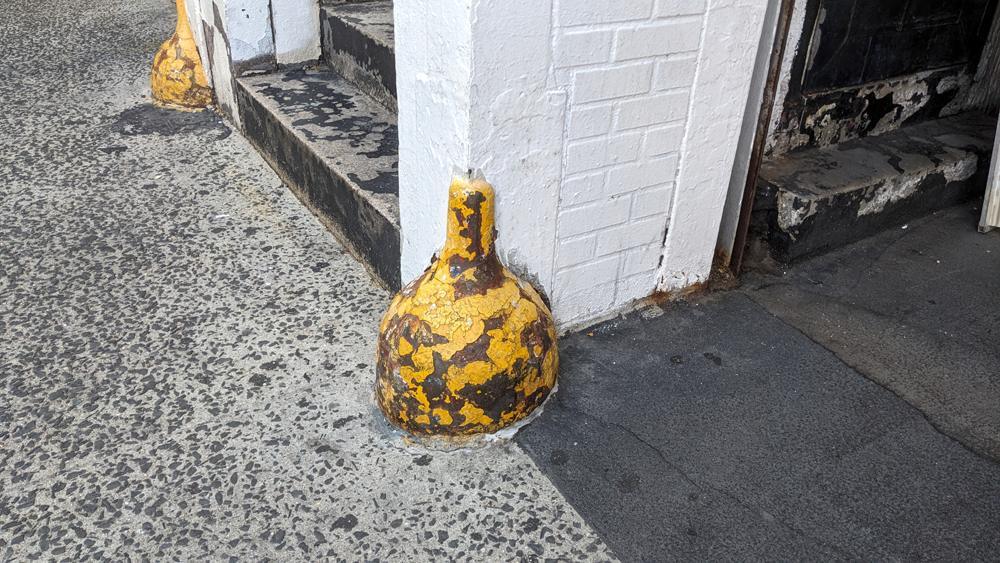
In French for “wheel chaser”, also widely referred to as a guard stone, jostle stone, or bouteroue. These were architectural features installed during the era of horse-drawn carriages and carts. Their purpose was to protect the corners of buildings and gateways from being hit or scraped by passing heavy wooden wheels and metal wheel hubs. The smooth, sloped, bell-like shape was highly intentional. If a carriage driver cut the corner too tightly, the wheel would mount the curved base, smoothly deflecting the carriage away from the structure rather than crashing directly into the brickwork or snapping the vehicle’s axle. While originally carved out of solid stone, the industrial revolution introduced molten cast iron versions like this one. They were bolted or cast directly into the structural corners of masonry buildings. Though completely obsolete in the era of modern automobiles, many remain preserved in historic urban neighborhoods (like Tribeca, the West Village, and SoHo in New York City) as fascinating architectural vestiges of 19th-century street traffic. (Kremer, 2026) Photo from Manhattan, New York, 2026.
« Back to Glossary Index